


Custom 3D LED Screen Solutions | L-Shaped, Curved & Transparent Naked-Eye Displays for Building Facades, Mall Atriums & Rental Events
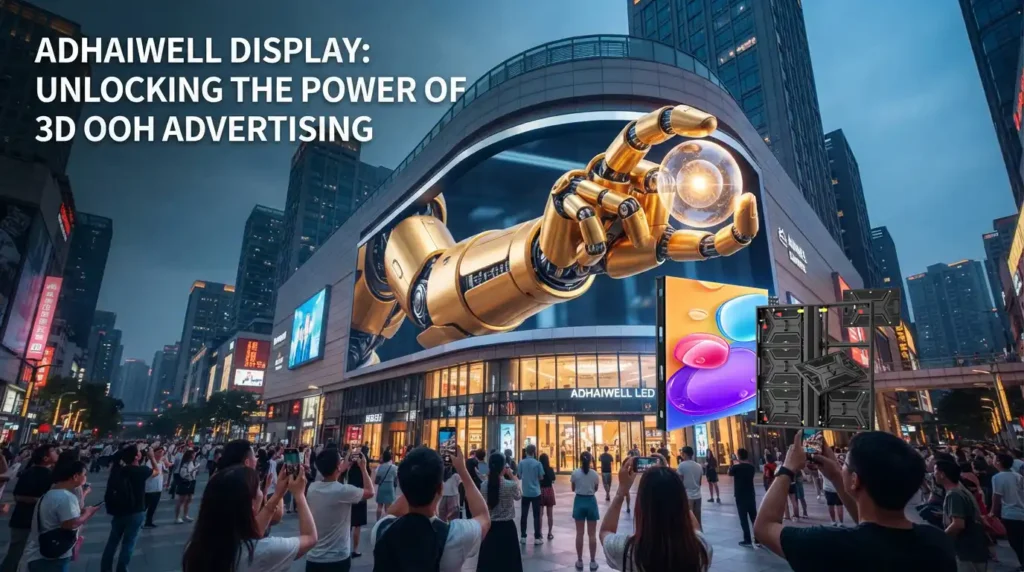
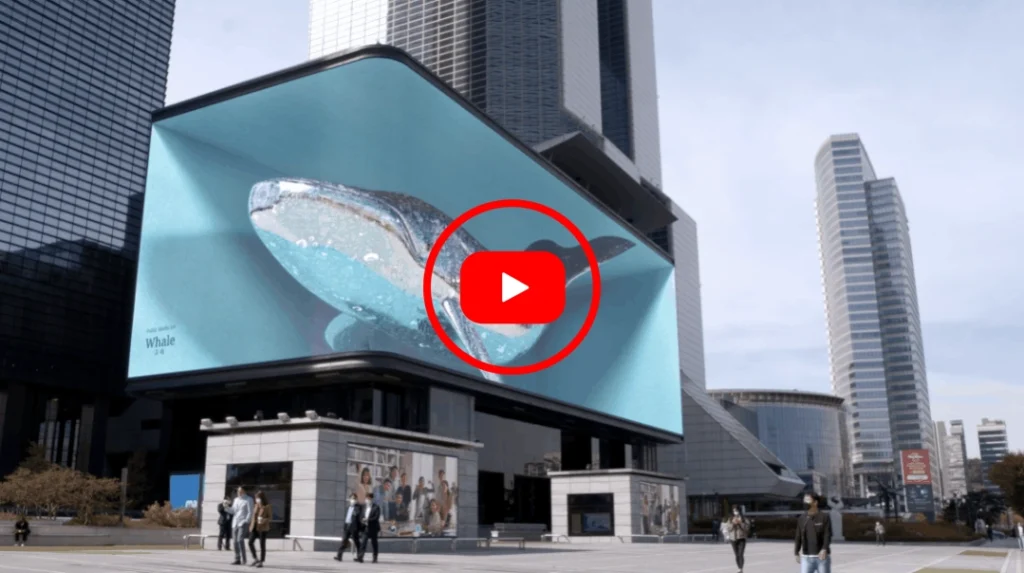
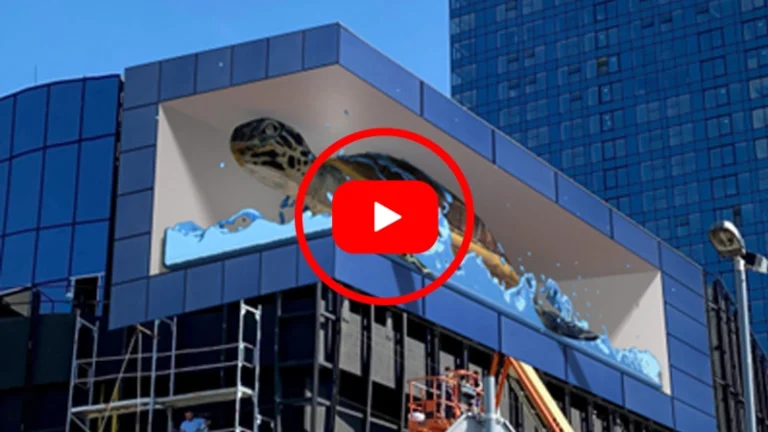
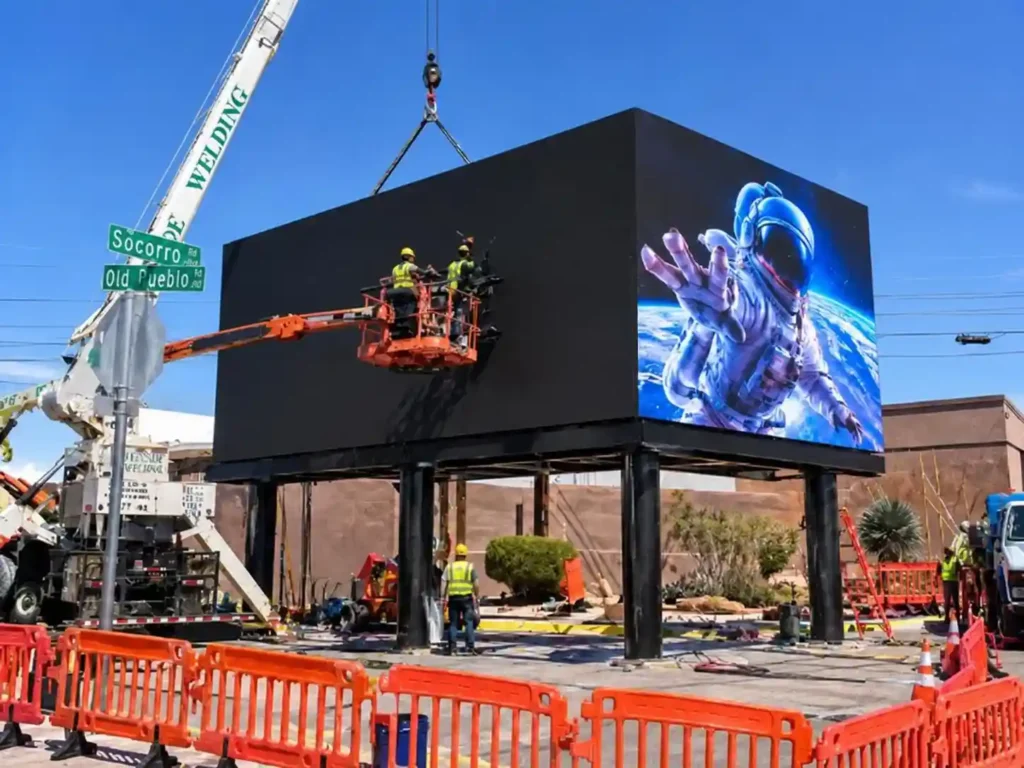
Adhaiwell 3D LED Screen solutions are configurable naked-eye 3D display systems engineered around your installation geometry, viewing position, pixel pitch, mounting structure and custom anamorphic 3D content. Rather than relying on a dedicated 3D cabinet model, we build each project using seven field-proven LED cabinet platforms, adapting them to L-shaped 90° corners, custom curved surfaces, transparent LED screens and flat building facades.

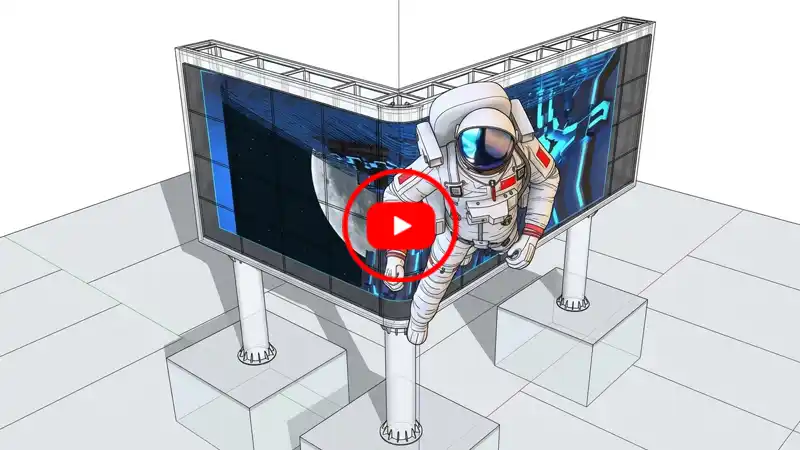
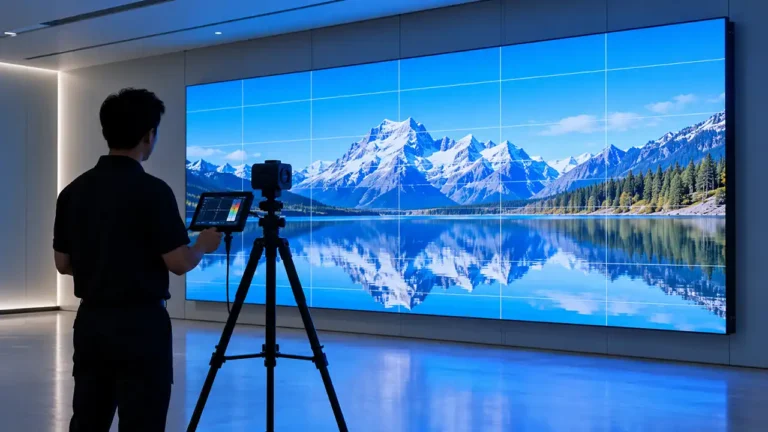
As an experienced China LED display manufacturer, Adhaiwell provides more than LED cabinets. Our engineering team offers free custom steel structure drawings based on your site video, while our in-house creative team produces anamorphic 3D videos calibrated to the exact left-face and right-face screen proportions. From cabinet selection and structural load assessment to viewing-distance mapping and video calibration, we help integrators build a complete naked-eye 3D LED display system.
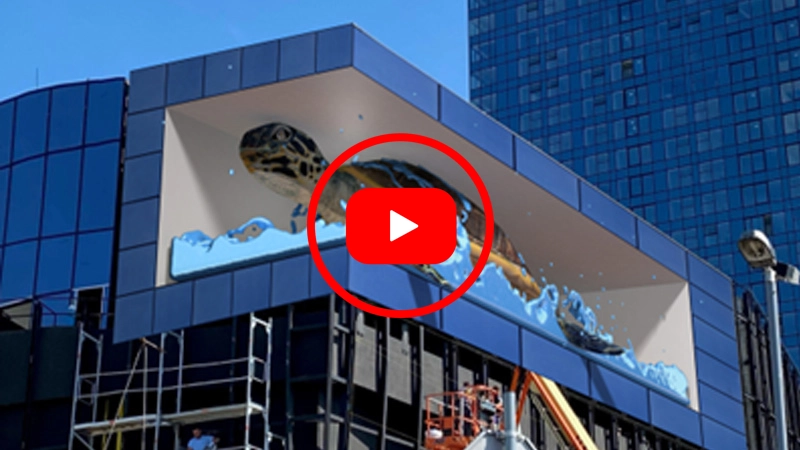
Designed for building facades, shopping mall corners, commercial landmarks, advertising installations and temporary rental projects, Adhaiwell combines display hardware, structural engineering and 3D content production under one supplier – helping reduce coordination between vendors and achieve a consistent glasses-free 3D visual effect from the intended street-level viewing position.
3D LED Screen – Custom Naked-Eye 3D Display Solutions
Send us your building photos or site video, approximate screen dimensions and viewing distance. Our team will help evaluate the installation, recommend a suitable LED cabinet configuration and provide a project-specific solution.
ADHAIWELL 7 CORE LED CABINET PLATFORMS FOR CUSTOM 3D DISPLAYS
A naked-eye 3D LED screen is not a one-size-fits-all product, but an engineered integration based on site conditions, structural load, transparency needs, and budget.
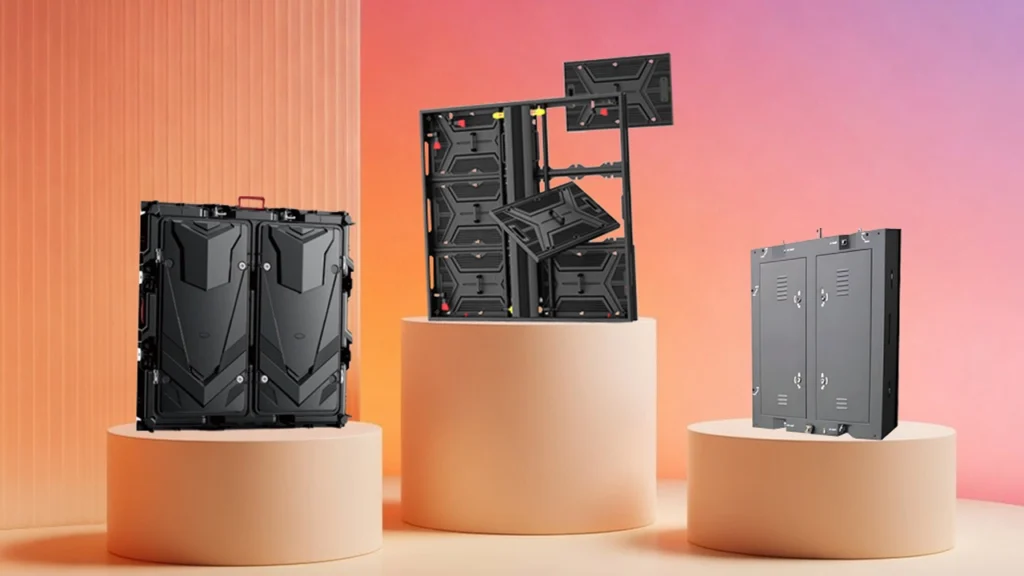
Adhaiwell offers seven established LED cabinet platforms for building custom naked-eye 3D display systems. Each platform is designed for different installation environments, structural requirements, and display applications.
Whether you are planning a large outdoor building facade, an L-shaped 90° corner display, a transparent glass installation, or a temporary exhibition screen, selecting the right cabinet platform is the first step toward a reliable 3D LED project.
Below is a structural comparison to assist procurement managers, system integrators, and project engineers in selecting the correct hardware platform.

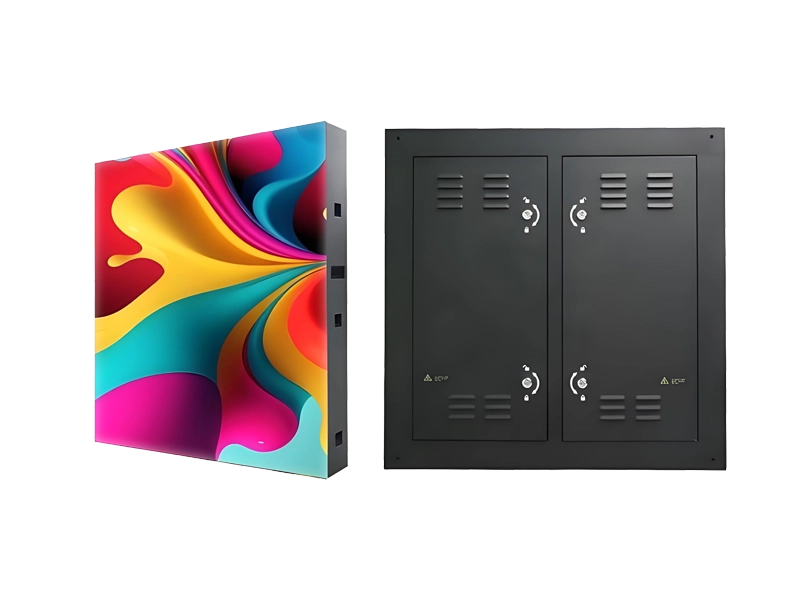
Outdoor Aluminum Profile Alloy 3D LED Cabinet
Technical Features: Precision extruded aluminum alloy housing offering lightweight performance (40% lighter than steel) and superior passive thermal conductivity.
Core Advantages: Reduced structural load on building facades, rust-proof operation in coastal/high-humidity environments, and precise CNC module alignment.
Selection & Application Guide: Ideal for building facade corners and rooftop 3D billboards where structural weight capacity is strictly limited, or projects located in high-salinity coastal areas.
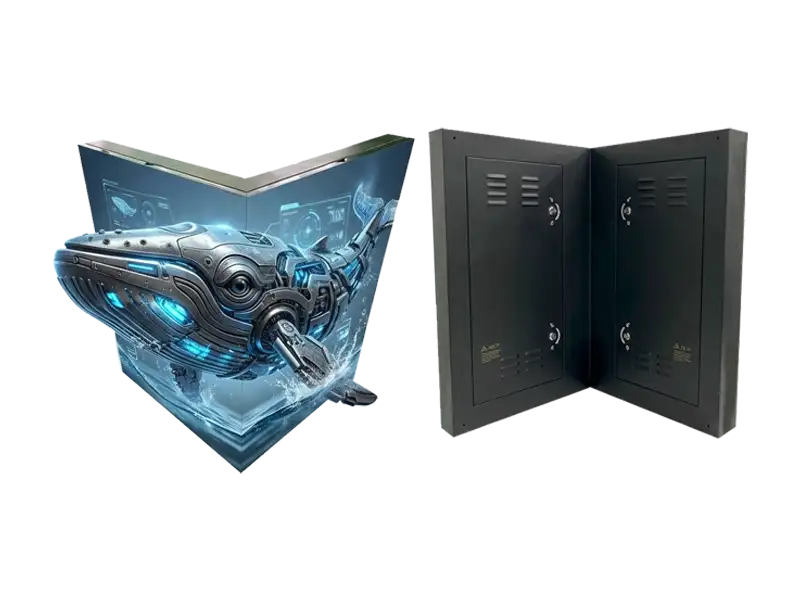
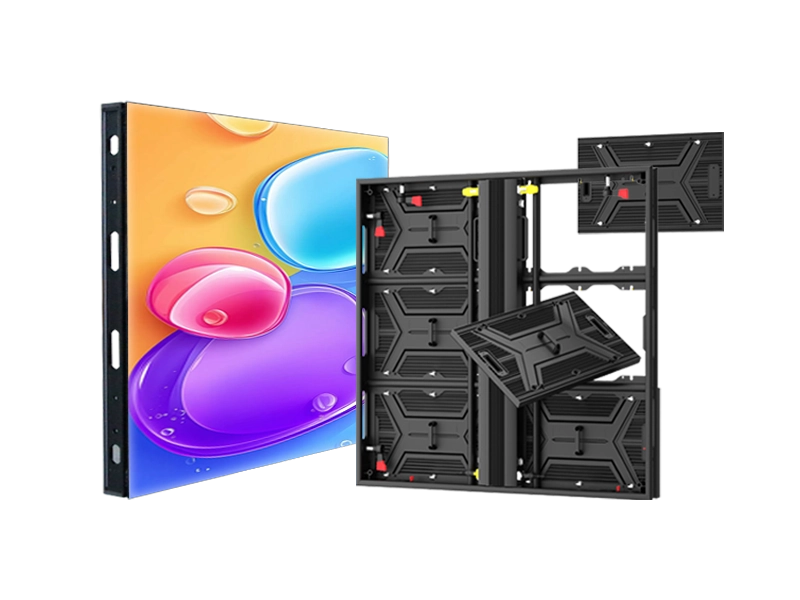
Outdoor Standard Steel 3D LED Cabinet
Technical Features: High-strength, cold-rolled steel construction with an anti-corrosion coating, IP65 rear-enclosure protection, and a custom Curved or round LED cabinet.
Core Advantages: Maximum structural rigidity for large-scale outdoor billboards, high thermal resistance, and lowest cost per square meter for heavy-duty installations.
Selection & Application Guide: Recommended for permanent wall-mounted or high-pole outdoor DOOH billboards with physical corner lengths over 10 meters, where structural weight support is available and rear service access is required.
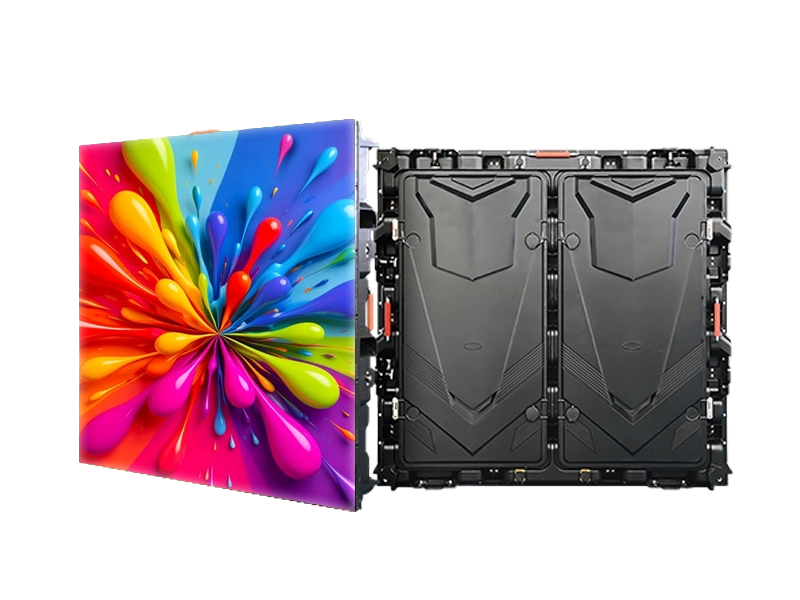
Outdoor Die-Cast Aluminum 3D LED Cabinet
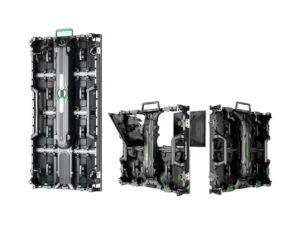
Technical Features: High-precision die-cast aluminum frame (CNC tolerance ±0.1 mm) with fast-locking design and front/rear dual maintenance.
Core Advantages: Achieves sub-millimeter seam precision at 90° corners and curved transitions, protecting seamless anamorphic 3D depth perception.
Selection & Engineering Note: Ideal for high-density outdoor 3D displays (P2.5–P4) at close viewing distances. Important: Corner seams and arc transitions require custom steel transition cabinets for precise geometric alignment.
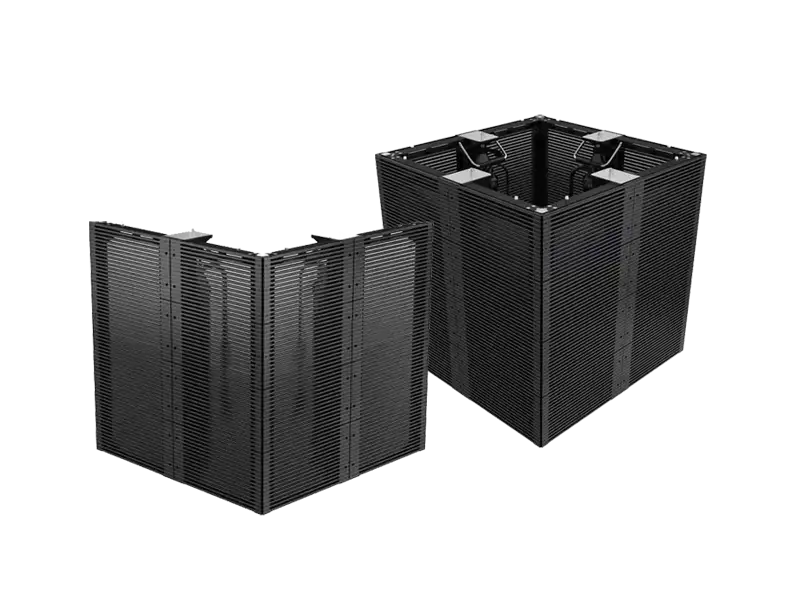
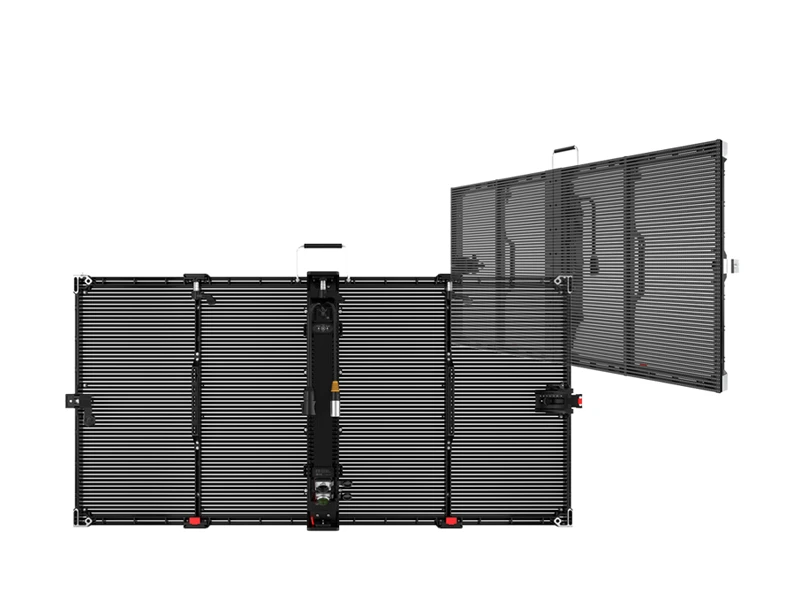
Outdoor Transparent 3D LED Screen / Mesh Display
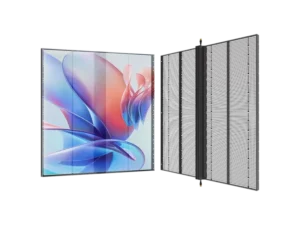
Technical Features: High-permeability aluminum strip/mesh cabinet architecture, delivering 40% – 70% light transparency and low wind resistance.
Core Advantages: High brightness (>5500 nits ) under direct sunlight, drastically reduced wind load on high-rise structures, and minimal disruption to building daylighting.
Selection & Application Guide: Essential for high-rise glass curtain walls, windy coastal building facades, and large-scale outdoor architectural wraps requiring 3D visuals without blocking interior natural light.
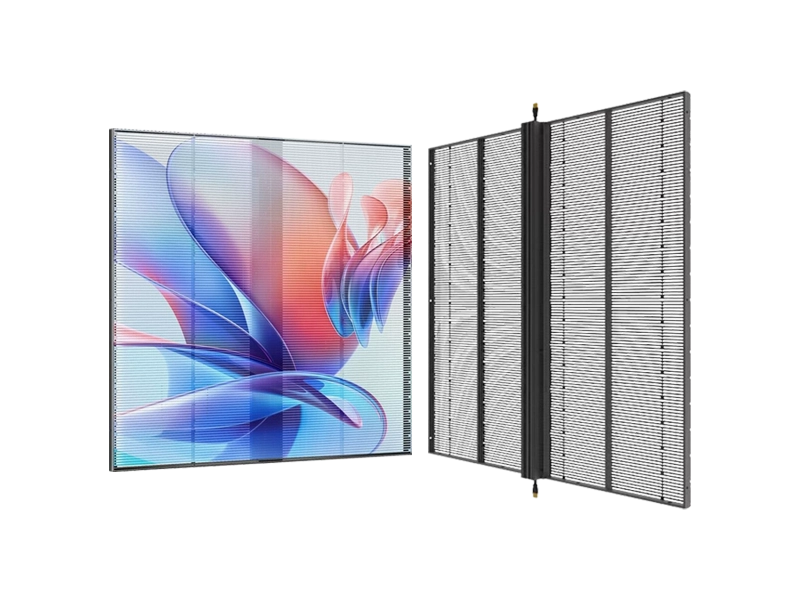
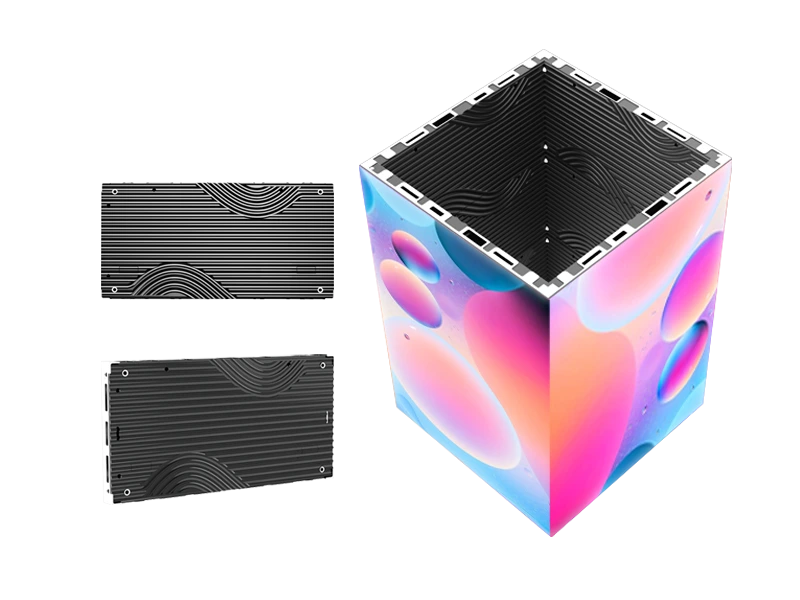
Indoor Glass Transparent 3D LED Screen
Technical Features: Ultra-thin glass-mounted transparent LED panel (70% transparency) with high-density side-emitting or front-emitting LED strips.
Core Advantages: Lightweight hanging structure, silent convection cooling, elegant visual integration with architectural glass, and 360-degree floating 3D visual mapping.
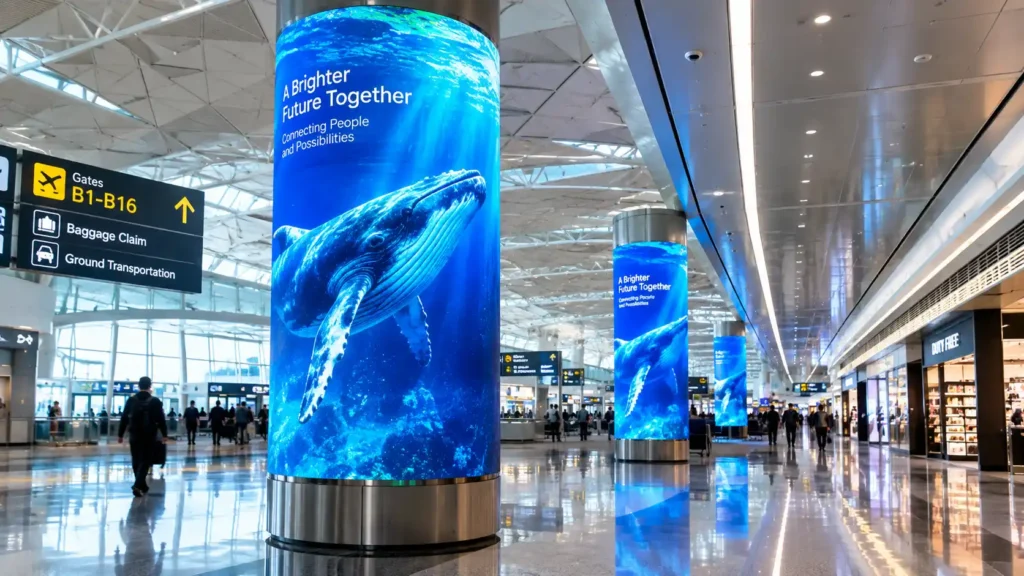
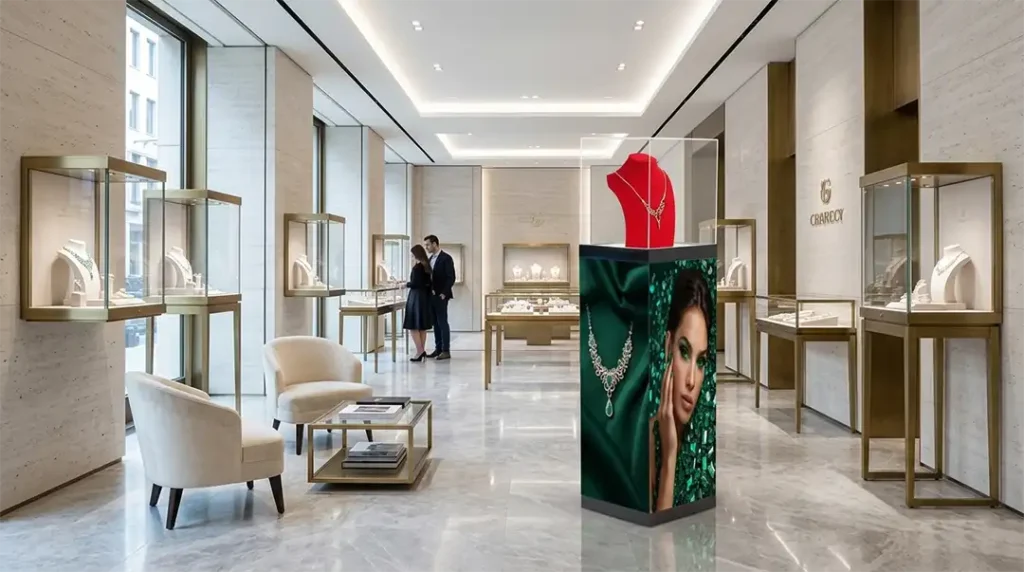
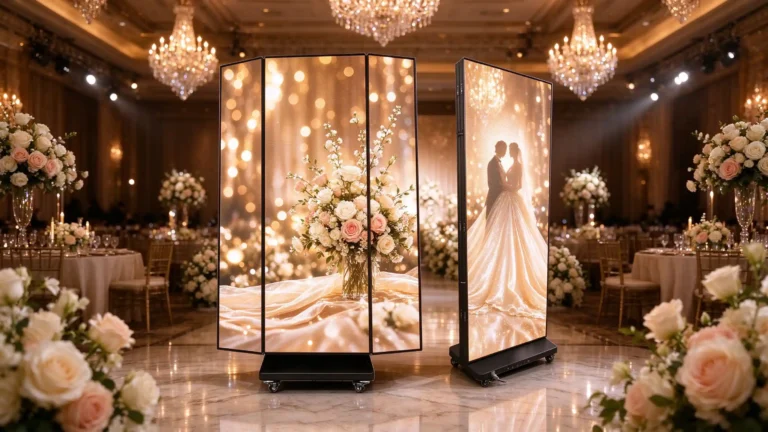
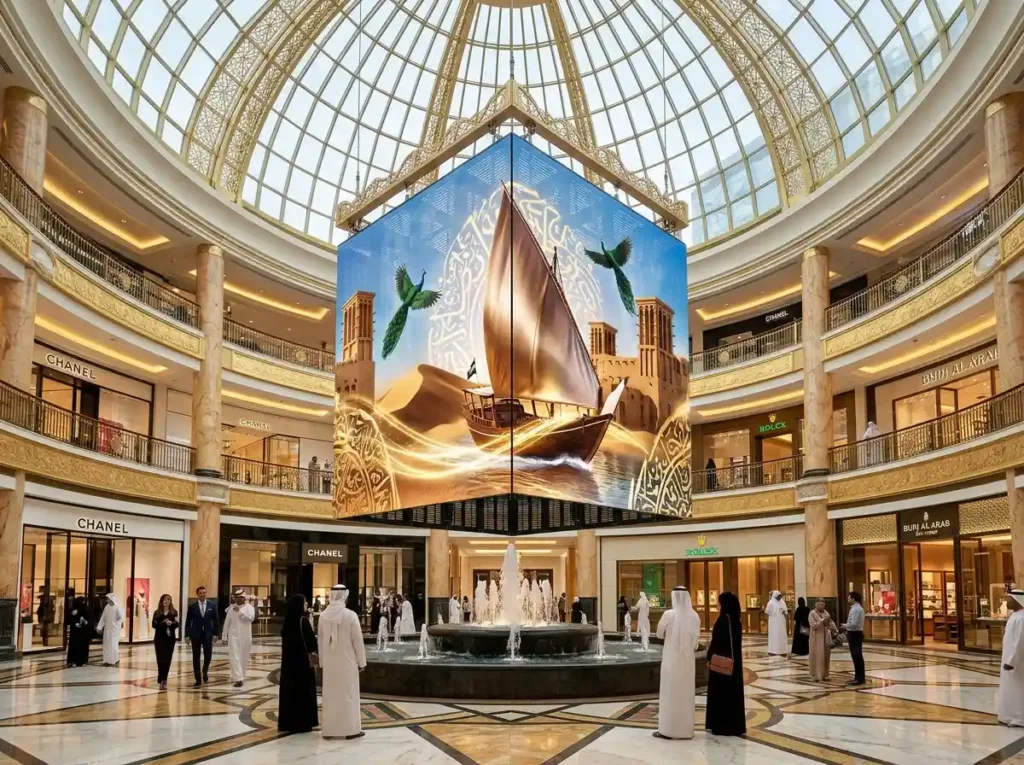
Selection & Application Guide: Designed for indoor commercial spaces, luxury shopping mall atriums (hanging 4-sided cube pillars), flagship retail storefronts, and interior glass balustrades or Glass exterior walls of an elevator.
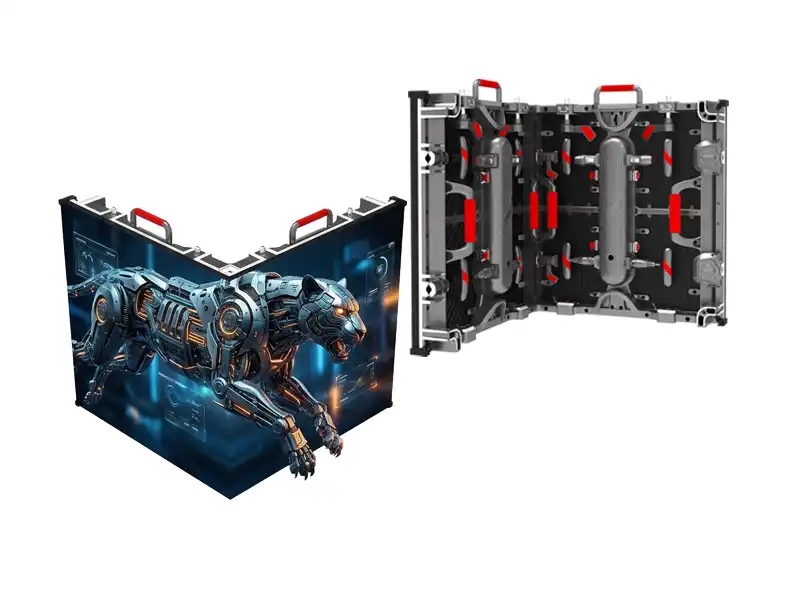
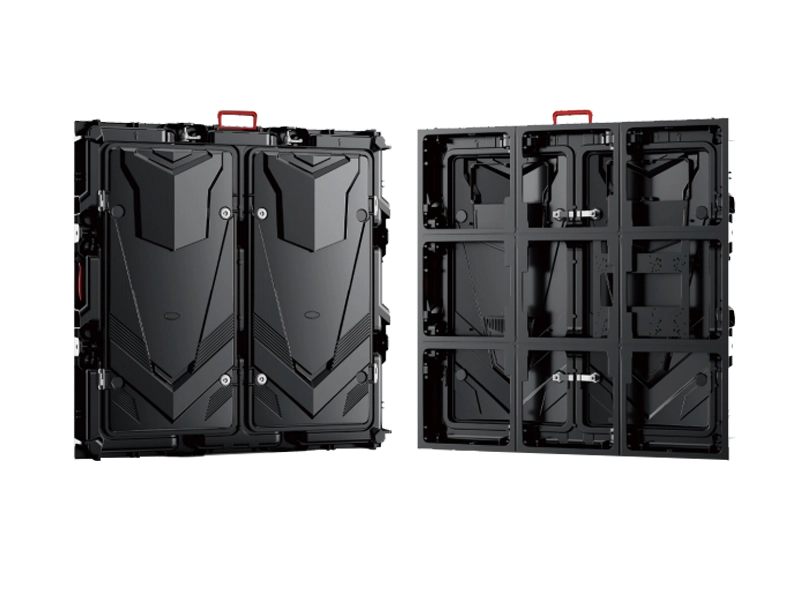
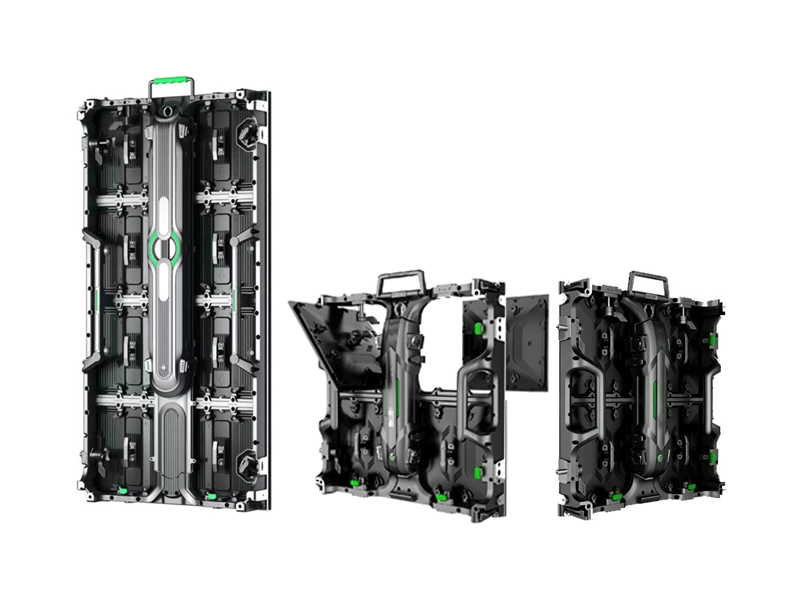
Outdoor Stage & Concert Rental 3D LED Screen
Technical Features: Heavy-duty die-cast aluminum rental frames with quick-lock handles, drop-proof corner protection, and integrated adjustable arc locks (-5° to +5° ).
Core Advantages: Rapid assembly and disassembly by small crew teams, high structural durability for repeated transport, and flexible curved/corner setup capabilities.
Selection & Application Guide: Tailored for event rental companies, touring concerts, and outdoor temporary trade show booths requiring fast-deployable 90° corner or curved 3D display setups.
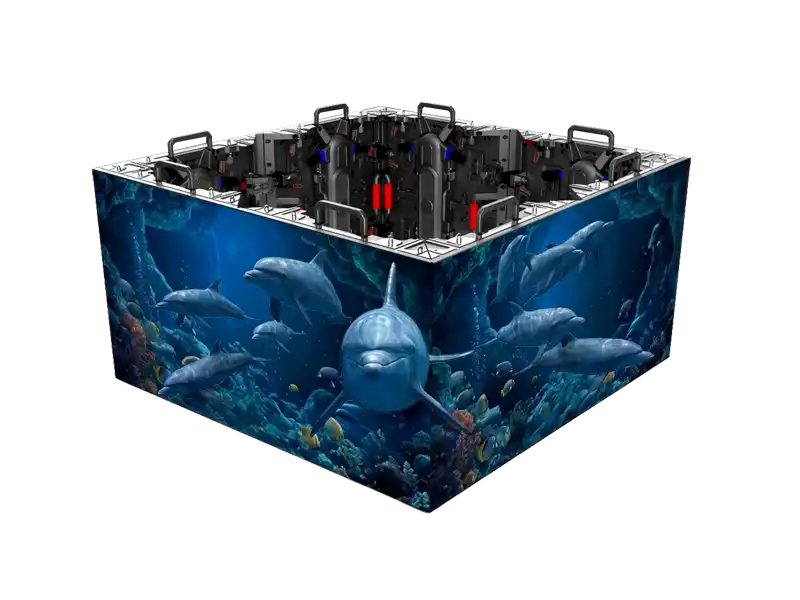
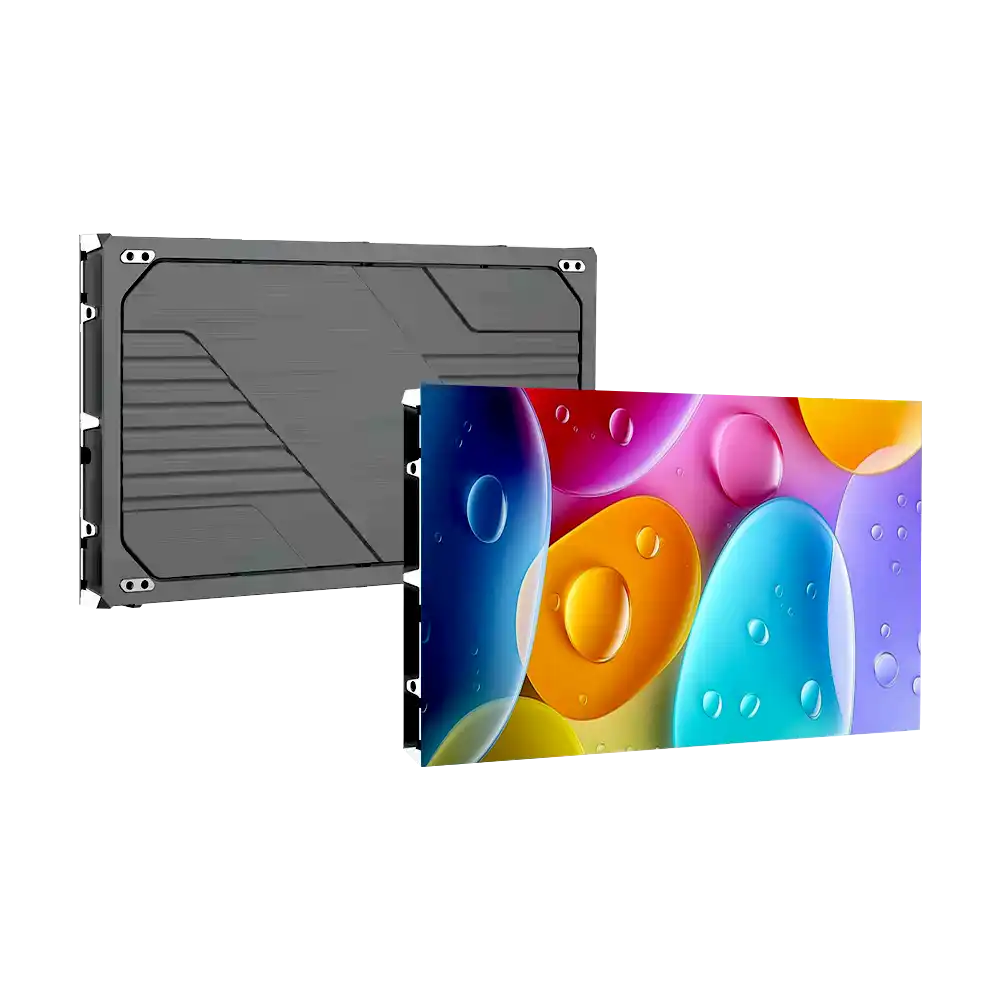
Indoor Event Rental 3D LED Display
Technical Features: Fine-pitch die-cast aluminum rental cabinets featuring ultra-high refresh rates (>3840 Hz to 7680 Hz ) and low-reflection matte black LED encapsulation.
Core Advantages: Zero camera scan lines during live broadcasts or smartphone photography, lightweight hanging rigging, and precise seamless vertex locking.
Selection & Application Guide: Perfect for indoor corporate product launches, trade show exhibition booths, television studios, and temporary indoor immersive 3D experience zones.
Technical Specifications
Cabinet Families Available for a 3D Build
| Cabinet family | Cabinet size (mm) | Weight / cabinet | Pixel pitch options | Brightness | IP | Power max / avg (W/m²) | Typical role in a 3D build |
|---|---|---|---|---|---|---|---|
| Steel cabinet | 960 × 960 | 40 kg | P4, P5, P6.67, P8, P10 | 5,500–7,000 nits | IP65 | 800 / 300 | Large flat faces on pylons and building walls |
| Aluminum profile | 1000 × 1000 (also 1000 × 500 to 1500 × 1000) | 23 kg | P3.91, P4.81, P6.25, P7.81, P10.42 | 5,500–10,000 nits | IP65 | 650 / 200 | Long corner walls, wrapped facades, weight-limited roofs |
| Die-cast aluminum | 960 × 960 | 27 kg | P4, P5, P6.67, P8, P10 | 5,500–7,000 nits | IP65 | 800 / 300 | Corners needing 0.1 mm flatness at the joint |
| Outdoor transparent | 500 × 500 / 1000 × 500 | 4.5 / 7.5 kg | P3.91-7.82, P5.2-10.4, P10.4 | 4,500 nits | IP65 | 800 / 260 | Corner behind glazing, four-sided atrium columns |
| Indoor glass transparent | 500 × 1000 × 50 / 1000 × 1000 × 50 | 15 kg | P3.9 × 7.8 | 4,500 nits | IP30 | 800 / 300 | Interior glass corners, mall and hotel atriums |
| Outdoor rental (R3) | 500 × 500 × 84 / 500 × 1000 × 84 | 8 / 14.5 kg | P2.604, P2.976, P3.91, P4.81 | 4,500–5,000 nits | IP65 | 800 / 200–300 | Touring corners, festival and stadium stages |
| Indoor rental (500K) | 500 × 500 × 84 / 500 × 1000 × 84 | 8 / 15 kg | P1.95, P2.604, P2.976, P3.91, P4.81 | 600–1,000 nits | IP31 | 800 / 200–300 | Exhibition L-walls, indoor launches, showrooms |
Shared by all seven: 3,840 Hz refresh rate, 160°/160° viewing angle (140° on outdoor transparent), 10,000:1 contrast, −20 °C to +60/+65 °C operating range (IP30 indoor variant −20 °C to +50 °C), AC 110–240 V input, Novastar control.
Fields Confirmed per Project, Not per Catalogue
| Field | Decided by |
|---|---|
| Screen geometry | Corner length, height, corner angle, arc radius, single- or double-sided |
| Pixel pitch | Nearest viewing distance and content type; a corner viewed at 8 m and at 40 m are two different specifications |
| Cabinet family | Structural load, daylight requirement, service access side, fixed vs rental |
| Brightness | Face orientation and sun exposure; north- and south-facing faces can differ |
| Control | Novastar synchronous (live playback) or asynchronous (4G/Wi-Fi cloud scheduling) |
| Structure | Steel frame design, attachment points, wind load, maintenance platform |
| Content | Anamorphic render spec, media player, scheduling, revision rounds |
Values above apply to the listed standard cabinet configurations. Brightness, power and weight change with pixel pitch, cabinet size and control system, and a 3D build always mixes at least two cabinet orientations — confirm the final matrix with Adhaiwell against your drawings before specifying.
Custom 3D LED Screen Applications & Project Reference
Commercial Deployment Scenarios for Custom 3D LED Display Systems
Selecting an outdoor or indoor 3D LED screen requires matching hardware specs—cabinet material, pixel pitch, brightness, and structural tolerance—to real-world environmental constraints. As a direct China factory manufacturer and custom supplier, Adhaiwell engineer-backed display solutions ensure long-term ROI, minimal maintenance overhead, and seamless corner integration for high-traffic commercial projects.
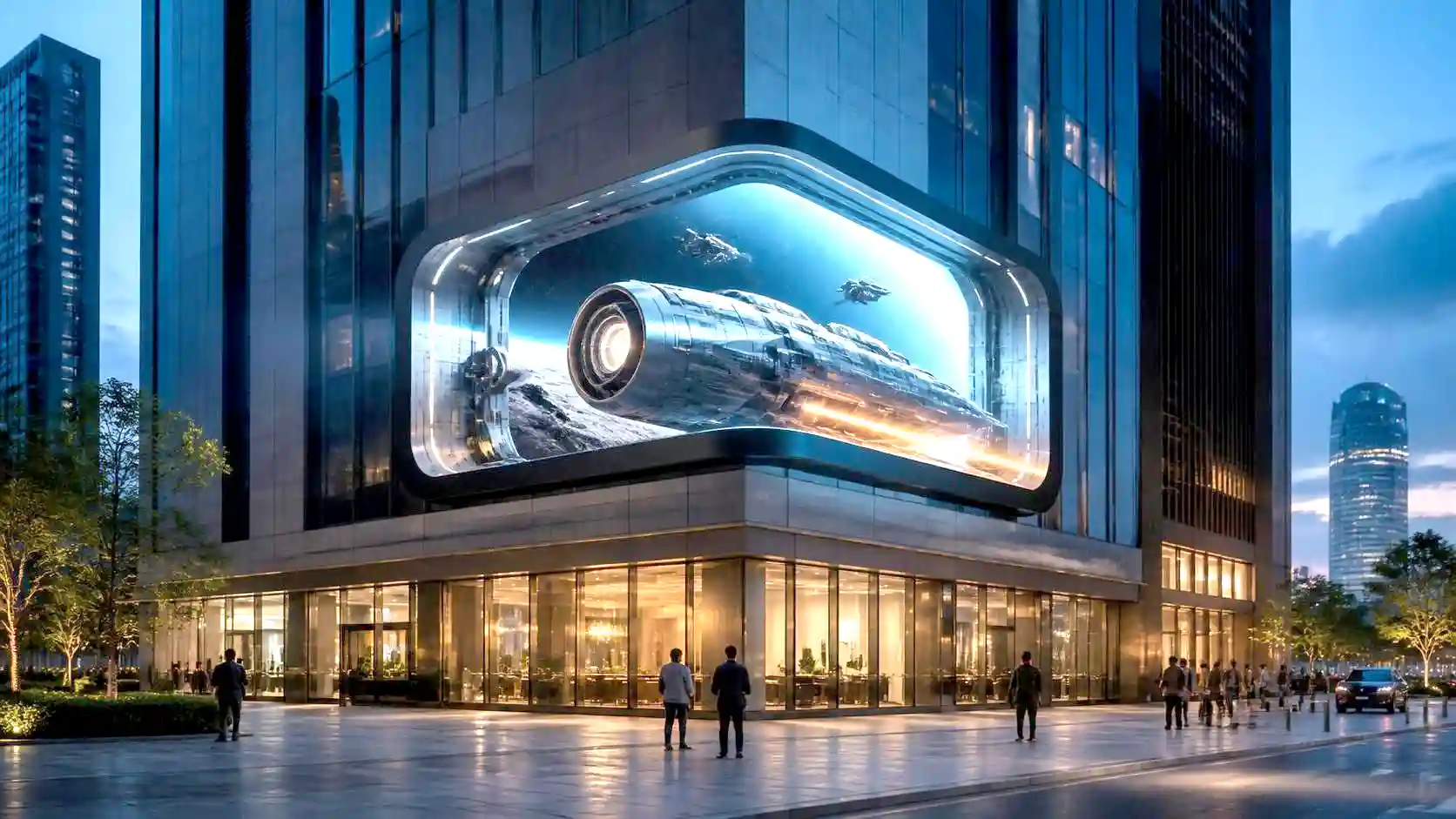
Building Corners and Tower Facades
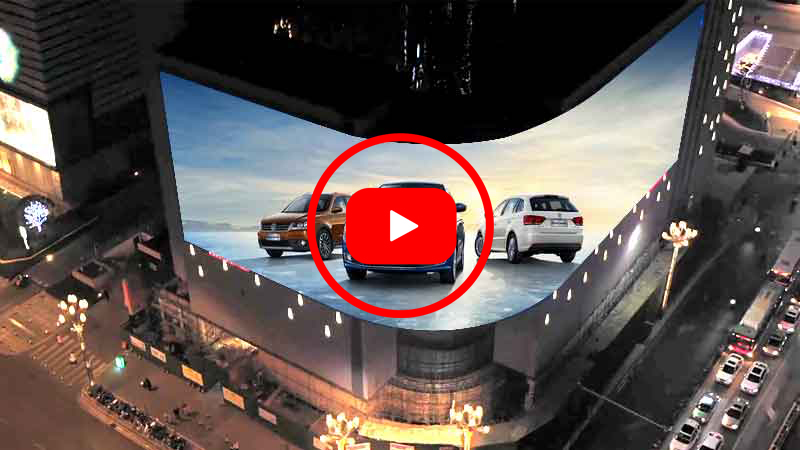
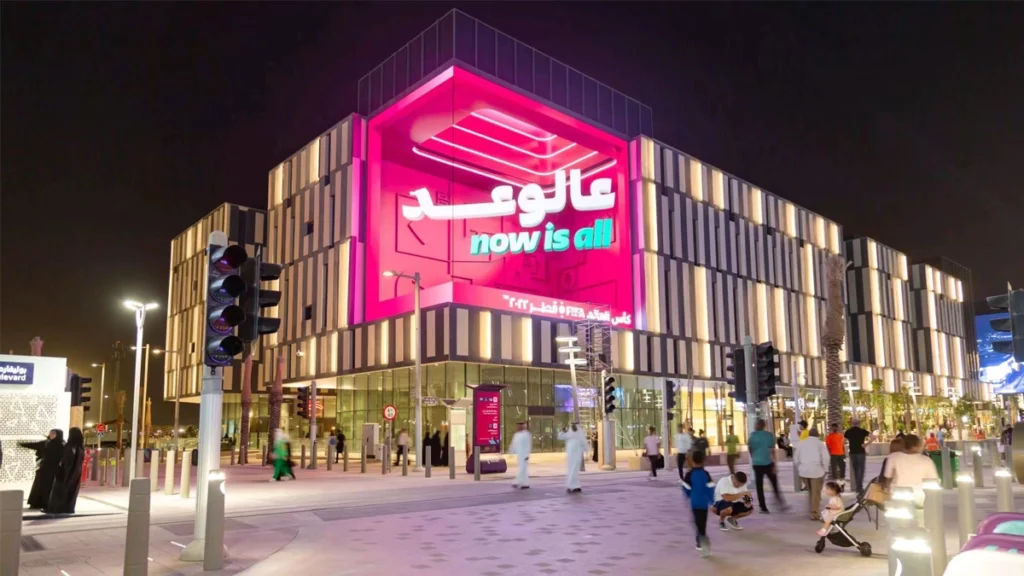
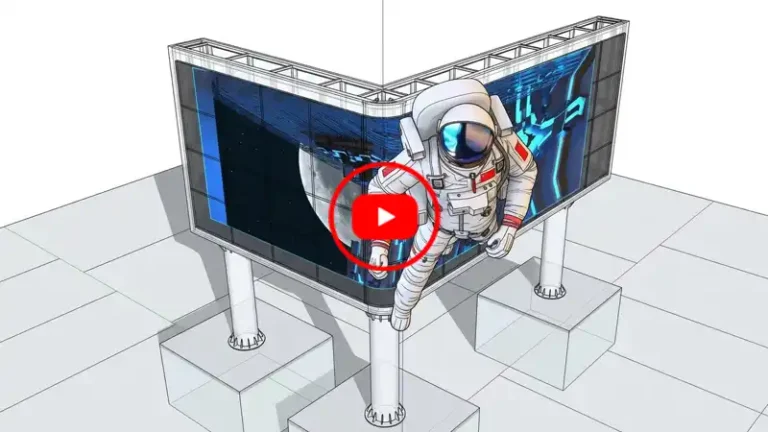
The classic L-shaped build: two faces meeting at a structural corner, viewed from a plaza or a road junction. Die-cast or aluminum profile cabinets suit towers where flatness at the joint is visible from below; steel suits lower walls where the budget is tighter. Verify the attachment points and the wind exposure on the existing structure before ordering — a corner screen adds both weight and sail area, and on older facades that review usually decides the cabinet family.
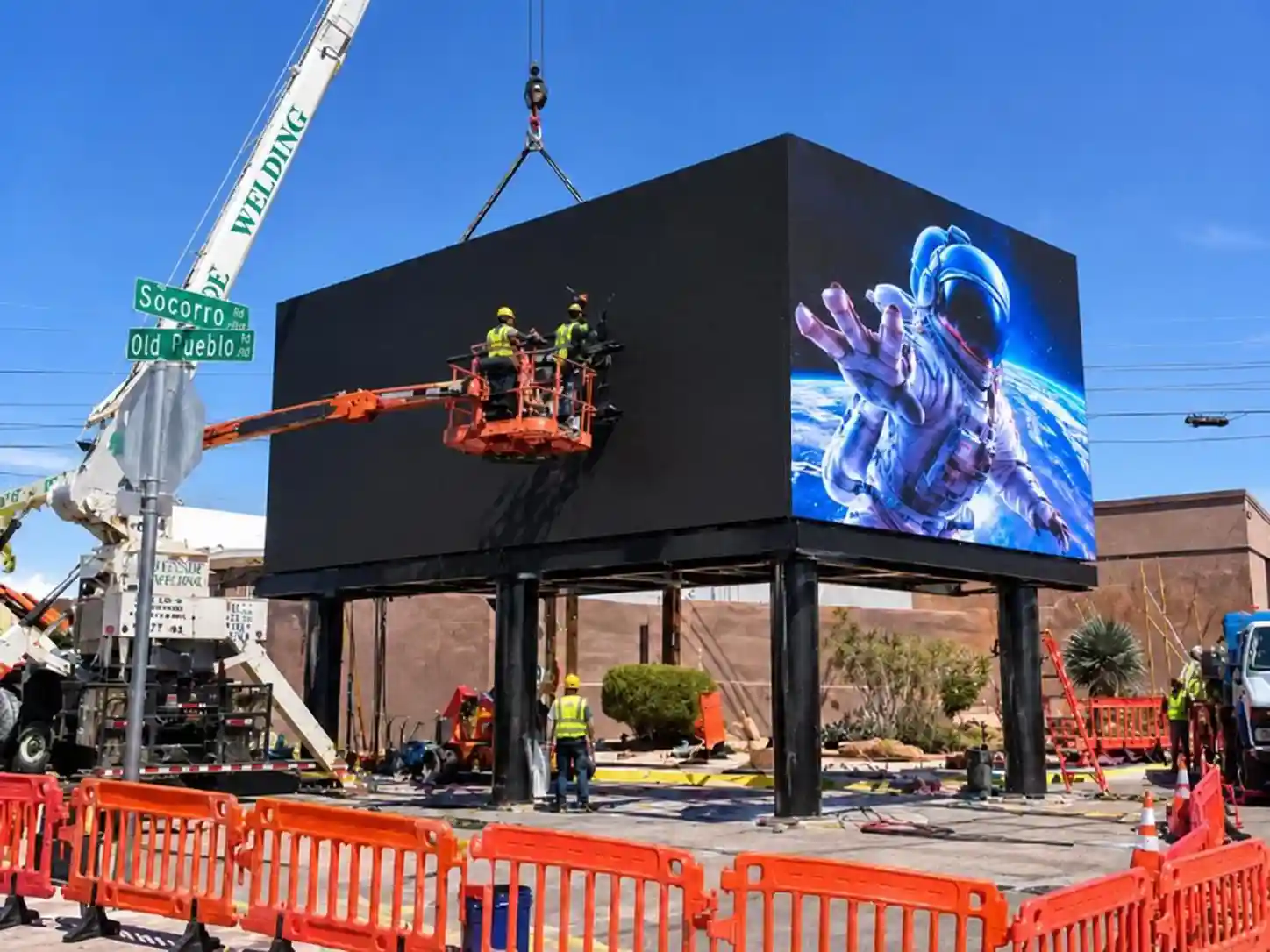
Outdoor L-Shaped Billboard and Roadside Landmarks
A pylon puts two faces at 90° on a self-supporting column, so the frame carries both the screen and the wind load at height. Steel or aluminum profile at P6.67–P10 suits the 25–60 m viewing distance typical of a roadside site; finer pitch spends money on pixels no one can resolve. If the site sits in a coastal zone, check the anti-corrosion specification rather than assuming the standard coating covers salt fog.
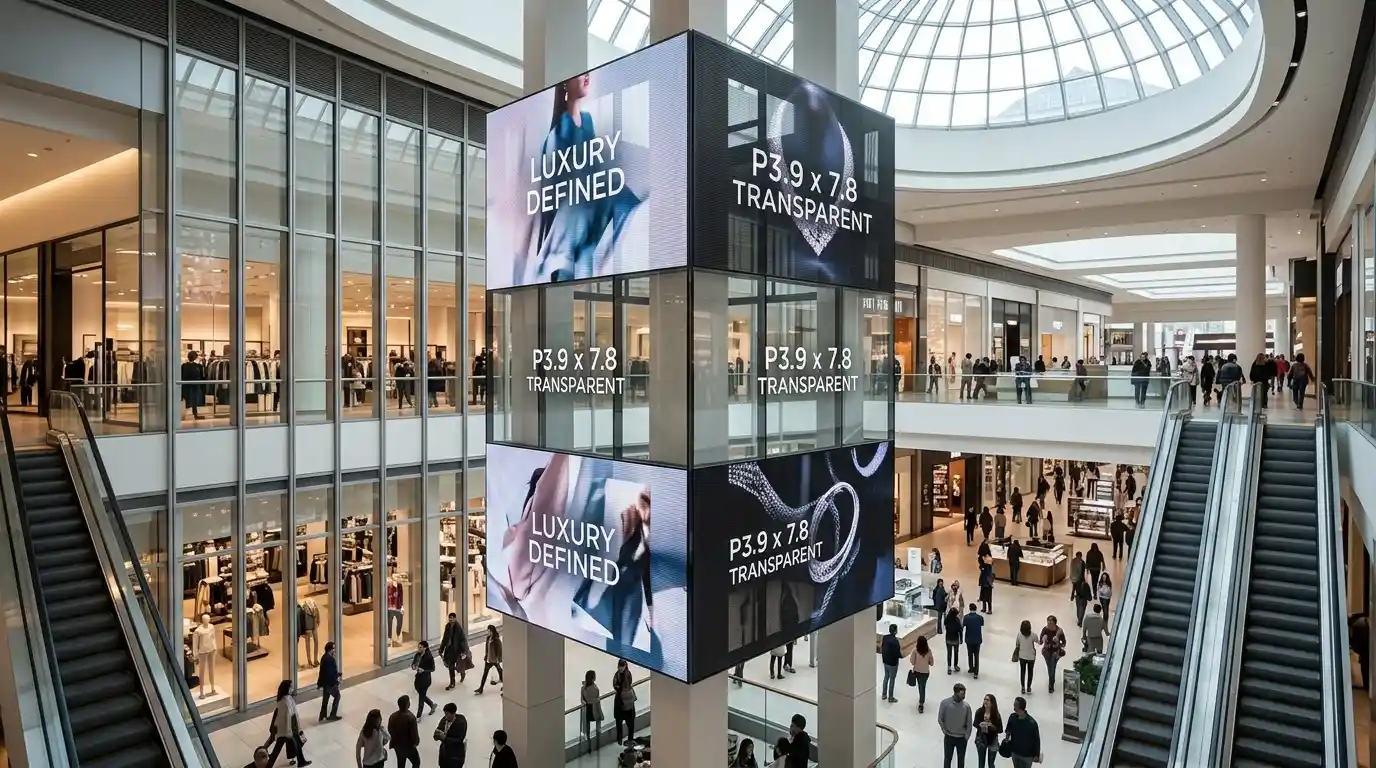
Shopping Mall Atriums and Four-Sided Columns
Transparency is the constraint here, not brightness: shoppers need to see through to the storefront or the floor above. A four-sided transparent column at P3.9 × 7.8 returns 85% transparency at 4,500 nits, which is enough for an atrium and not enough for a sunlit exterior. Confirm the mullion spacing first — standard cabinets land on 500 mm or 1000 mm modules, and a 700 mm mullion grid means wasted area or custom frames.

Exhibition L-Walls and Trade Show Corners
Indoor rental cabinets at P1.95–P4.81 with 0°/5°/10° locking angles build a corner in an hour and strike it the same night. The constraint is the venue: floor loading, rigging height and the 2 m² minimum order for rental cabinets decide whether a corner is viable at all. A 3D corner also needs the audience to stand in a defined zone — on a trade floor with four aisles, the illusion breaks from three of them.
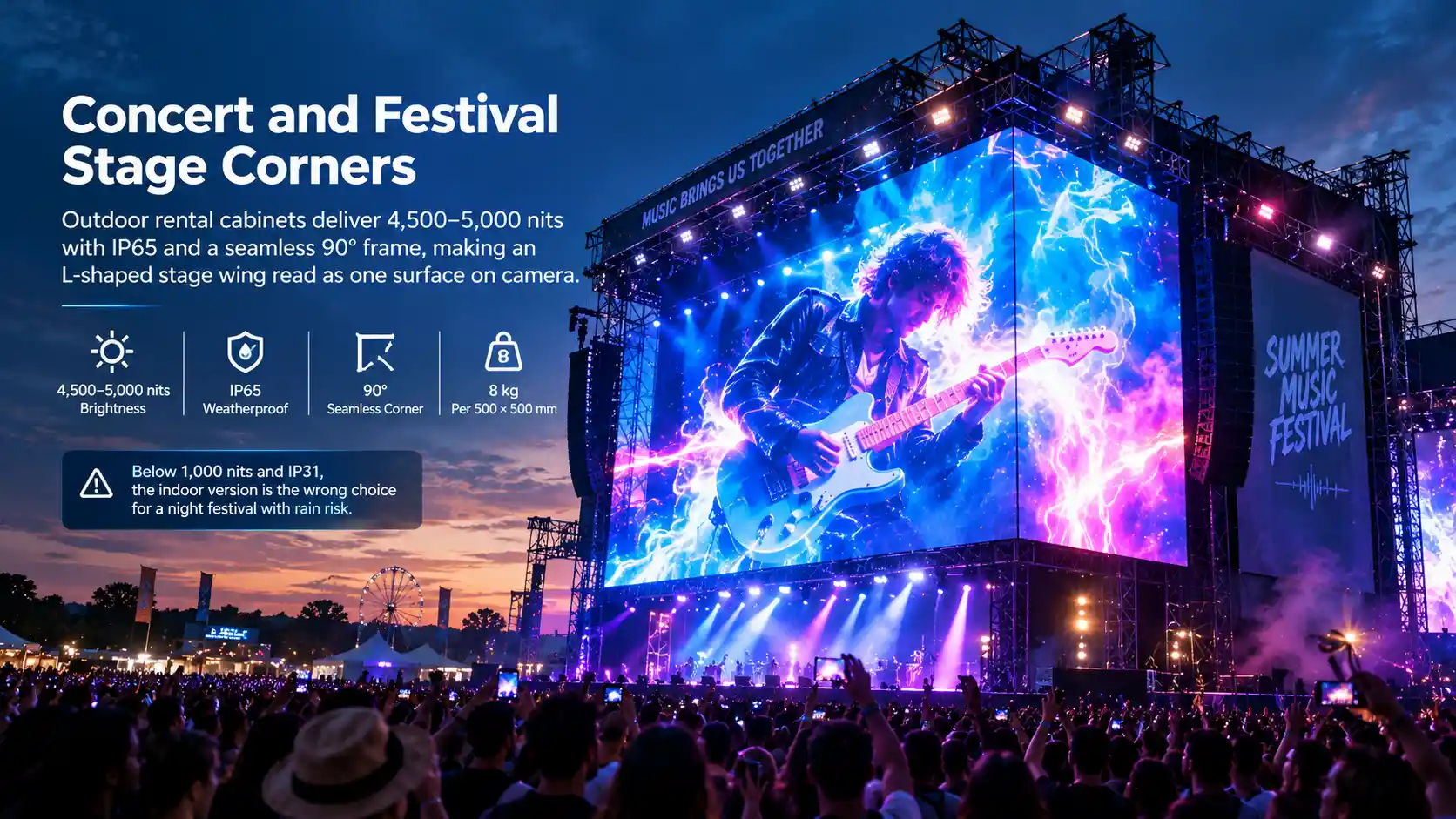
Concert and Festival Stage Corners
Outdoor rental cabinets return 4,500–5,000 nits with IP65 and a seamless 90° frame, which is what makes an L-shaped stage wing read as one surface on camera. Weight matters more than pitch here: 8 kg per 500 × 500 mm cabinet keeps rigging loads inside the truss rating. Below 1,000 nits and IP31, the indoor version is the wrong choice for a night festival with rain risk.
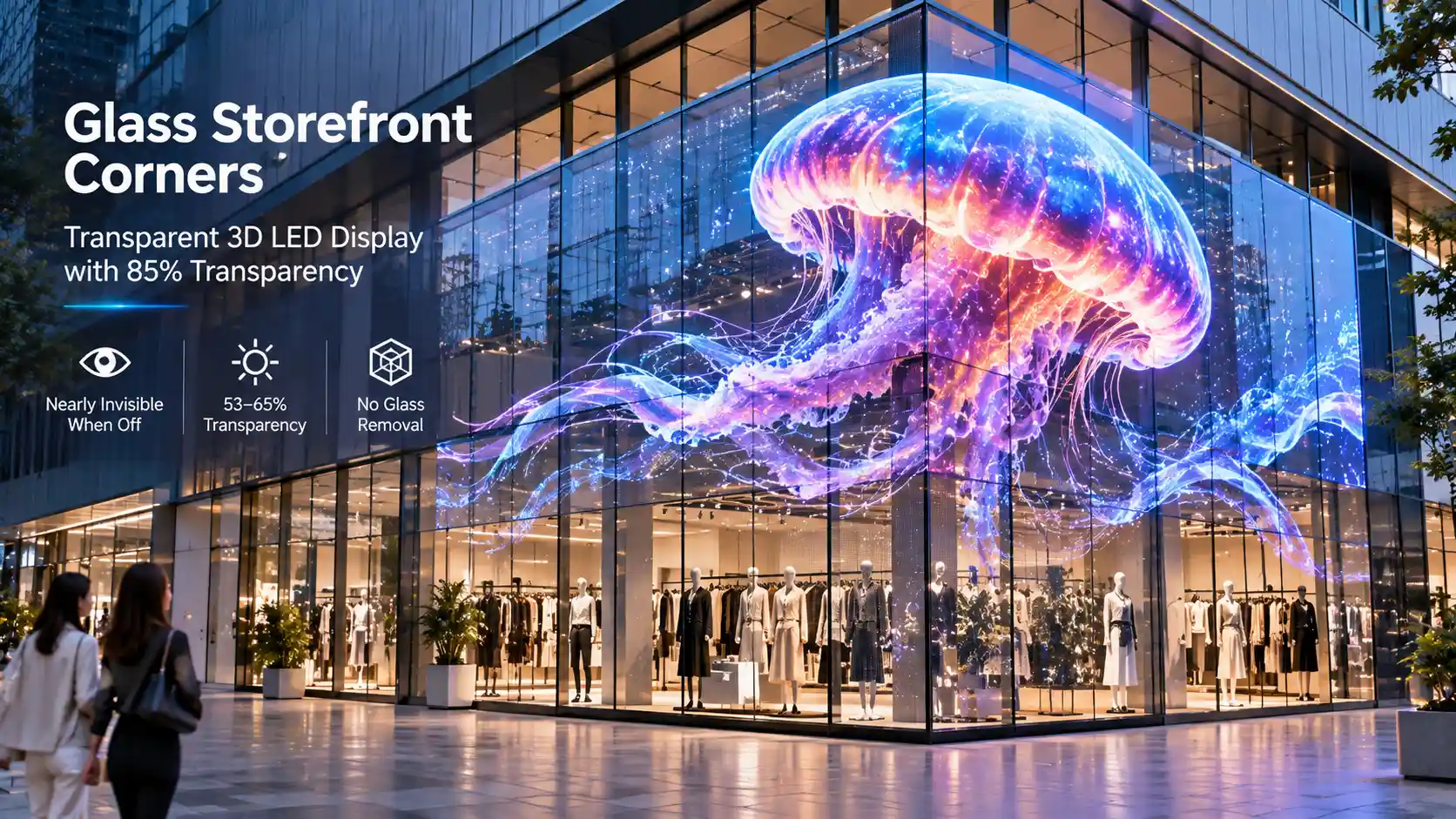
Glass Storefront Corners
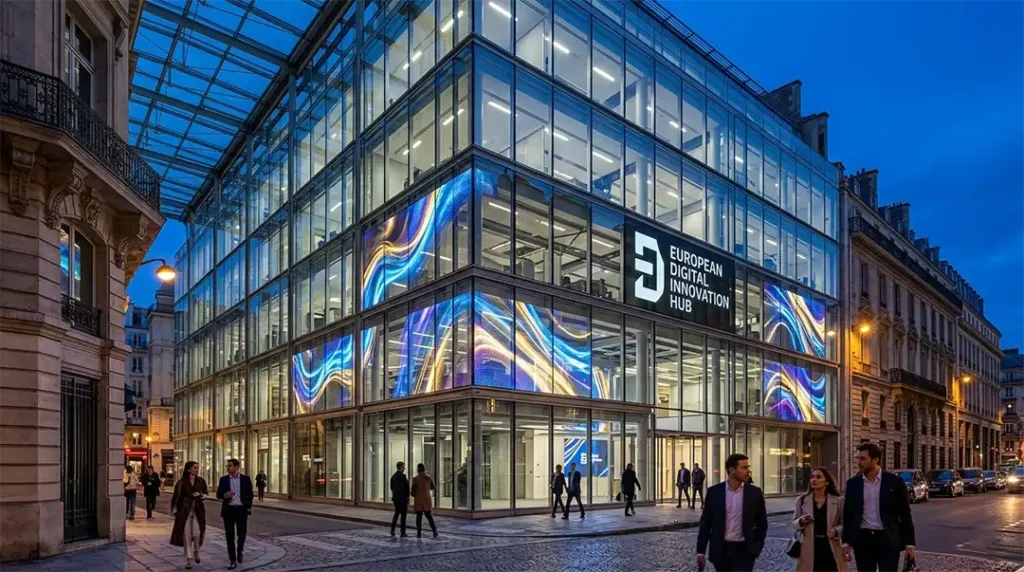
A retail corner behind existing glazing can carry a transparent build without removing the glass, hanging from the mullions on steel ropes or brackets. The limit is daylight: at 85% transparency the screen is nearly invisible when off, but at 53–65% on the outdoor transparent cabinet the interior darkens noticeably. For a boutique window, test the transparency figure against the store’s lighting plan before committing.
Custom Engineering, Quality Validation, and Factory Manufacturing Standards
As a direct Shenzhen factory manufacturer and custom supplier, Adhaiwell executes end-to-end production—from PCB assembly to pre-shipment corner trial fittings. Every 3D LED project follows strict structural, optical, and environmental validation to eliminate on-site fitting risks and protect commercial asset ROI.
Commercial Supply Process, 3D Content Production, and Cost Optimization
Deploying a high-impact 3D LED display requires a synchronized approach across structural hardware, export logistics, and high-resolution anamorphic 3D content. Adhaiwell provides end-to-end integration—delivering 1:1 pixel-mapped 3D videos alongside tailored cabinet engineering, transparent pricing models, and structural interface documentation to guarantee turnkey ROI for commercial operators.
The project workflow moves systematically from site photo review and geometry proposals to cabinet layout confirmation, production, and export logistics (ISPM-15 plywood crates for fixed builds; flight cases for rental fleets). Adhaiwell provides structural interface drawings, electrical wiring schematics, and load data. Local structural engineers maintain final sign-off for building attachments, supported directly by Adhaiwell’s engineering documentation.
3D display projects are quoted per project rather than by flat square-meter rates. Total pricing depends on five key variables: corner cabinet geometry (requiring transition frames and additional structural steel), cabinet material (steel, aluminum profile, or die-cast), pixel pitch/brightness selection, structural installation access, and anamorphic 3D content production. Matching brightness to actual sun exposure prevents over-specifying nits and wasting capital expenditure.
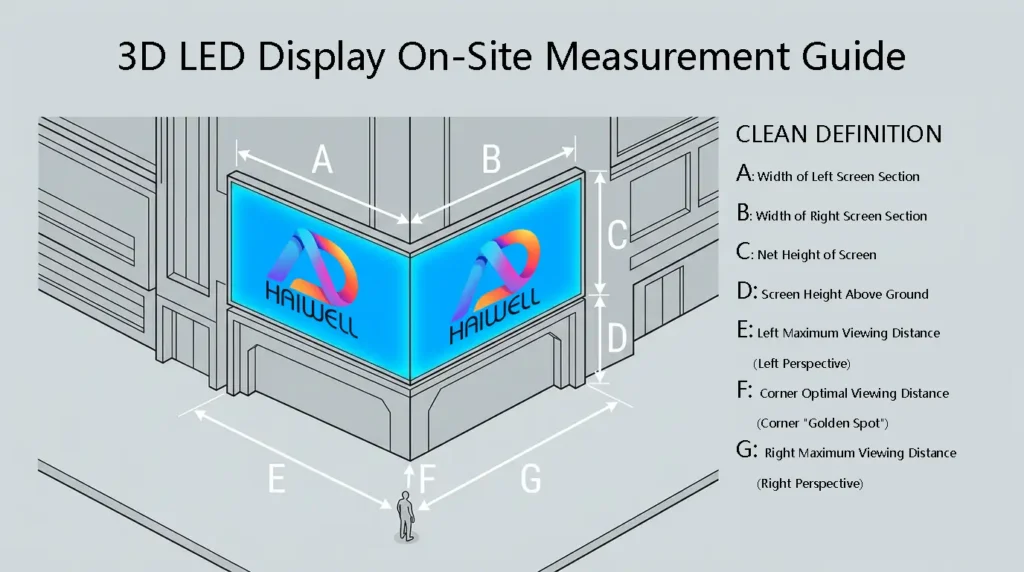
Successful project planning requires defining the viewing zone (audience distance and approach angles) first, followed by screen geometry, cabinet load capacity, daylight access, and service clearance. Pixel pitch and brightness are determined last as a consequence of site geometry. For a two-day quotation turn, buyers should provide building elevation drawings, target screen dimensions per face, corner angles, viewing zone constraints, and site environment data.
An anamorphic 3D screen requires perfectly engineered visual assets to create deep spatial illusion. Adhaiwell offers complete 3D video content services: creating bespoke, high-impact anamorphic 3D assets from scratch or customizing pre-designed library animations to fit your brand identity. All video files are rendered to match your screen’s exact resolution and corner aspect ratio with 1:1 pixel-to-pixel accuracy, preventing perspective distortion, edge tearing, or scale stretching on-site.
Frequently Asked Questions
End-to-End 3D LED Project Engineering
Deploying a commercial 3D LED screen involves more than just purchasing display hardware. As a direct China manufacturer, Adhaiwell delivers a complete turnkey solution—covering preliminary project consulting, structural steel engineering, precision LED display fabrication, remote or on-site installation guidance, and 1:1 pixel-mapped 3D video content production. Browse our engineering FAQs below to understand how we streamline your project timeline, mitigate structural risks, and protect your commercial ROI.
Is a 3D LED screen a cabinet product?
No. It is a display geometry assembled from standard cabinets, joined at a corner or curve, with content rendered for that geometry. The cabinets are seven existing Adhaiwell families; the design work is in the joint, the structure and the anamorphic mapping.
Which cabinet should I use for a building corner?
Start from the load and the daylight requirement. Transparent cabinets (7.5 kg per 1000 × 500 mm) suit glass facades and atriums with weight limits; die-cast aluminum (27 kg per 960 × 960 mm) suits visible corners needing 0.1 mm flatness; steel (40 kg) suits lower walls on a tighter budget. Rear clearance and service access then narrow the choice.
What corner angles and curves can be built?
90° is standard on transparent builds through 45° bevel-cut cabinets, and on rental builds through dedicated 90° frames. Curves use ±15° arc locks on transparent cabinets or −5° to +5° half-arc locks in 2.5° steps on rental cabinets. Angles other than 90°, and curves tighter than the lock range, need a transition or segmented frame — send the drawing and it will be confirmed against the cabinet.
How do I choose pixel pitch for a 3D corner?
From the nearest viewing distance, not the average. P3.91–P4.81 suits 4–6 m, P6.25–P6.67 suits 6–8 m, P8–P10 suits 10 m and beyond. On an L-shaped corner the far face is usually seen at an angle, so a coarser pitch there is often invisible to the audience while a finer pitch at the joint is the one that sells the illusion.
Can a 3D screen be installed on an existing glass curtain wall?
Yes, if the transparency and the weight work. Transparent cabinets mount behind the glass on steel ropes or brackets fixed to the mullions, with no glass removal. The limit is 53–65% transparency outdoors (85% on the indoor glass version) and the mullion grid: standard cabinets land on 500 mm or 1000 mm modules, so a non-standard grid means wasted area or custom frames.
Who produces the 3D video?
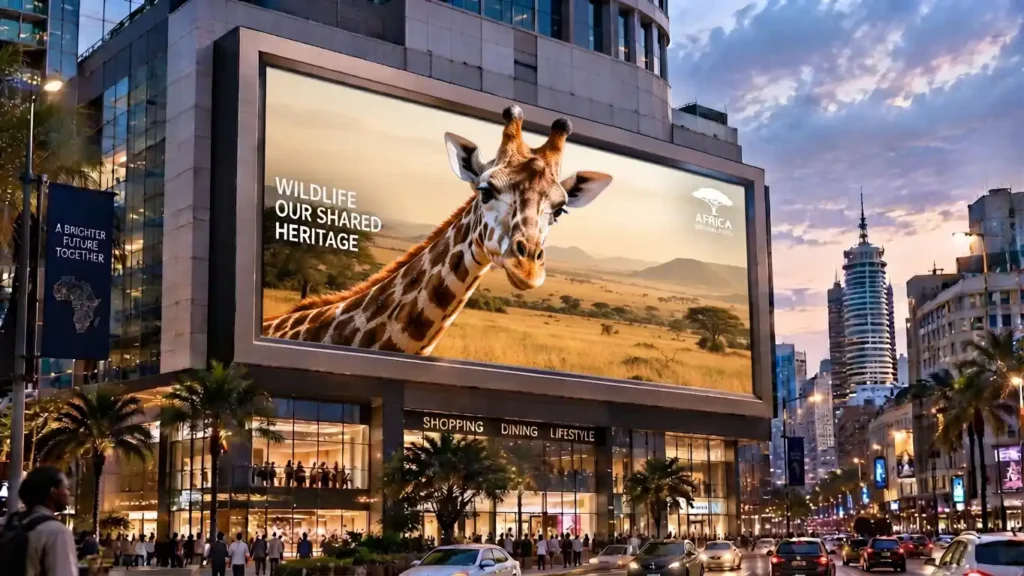
Adhaiwell supports 3D content design as part of a turnkey project — the USA, Fiji, and Mozambique naked-eye billboard was delivered with structure design and content design in the same scope. For buyers with an existing creative agency, the screen geometry, cabinet grid and eye position are issued as a content specification that the agency can render against.
Can the same design be rented instead of built?
Yes, within the rental ranges. Indoor rental cabinets run P1.95–P4.81 at IP31 and outdoor rental P2.604–P4.81 at IP65 with a seamless 90° frame, with a 2 m² minimum order — about eight 500 × 500 mm panels. A rental build will not match a fixed façade on brightness or fine pitch, so it is a prototyping and event tool rather than a permanent substitute.
What information do you need for a quotation, and what will it include?
Send building drawings or photos, the corner angle, the intended size per face, the viewing zone, indoor or outdoor conditions, fixed or rental use, content status, destination and required certificates. The quotation returns a cabinet layout in cabinet multiples, a per-face specification, the structure interface drawing, packing and freight, and the certificate scope. MOQ, warranty and lead time are stated per project because all three depend on the cabinet family and the structure.
What Makes a 3D LED Screen Different from a Standard LED Video Wall?
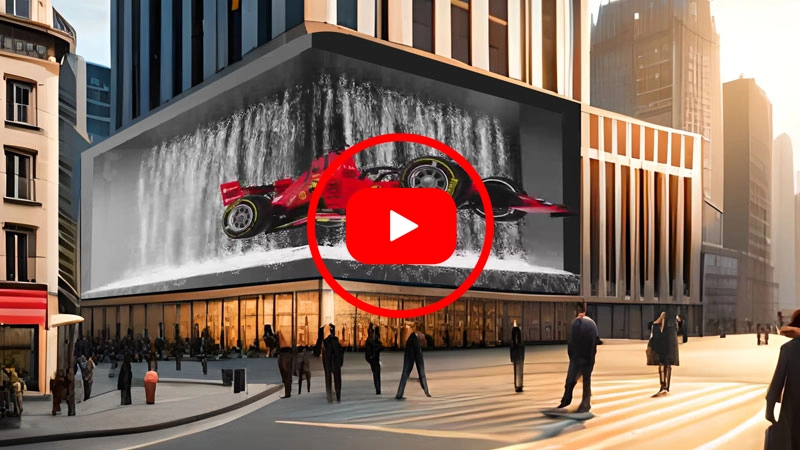
The difference is not the LED chip or the cabinet alone, but whether the screen geometry and the video content are engineered as one system. A standard video wall displays a rectangular image; a 3D screen uses an L-shaped or curved physical fold plus anamorphic content to create a viewpoint-dependent illusion. If either the corner angle or the video mapping is approximate, the 3D effect degrades into a warped 2D image。
Can I Use Generic 3D Content on a Custom L-Shaped Screen?
No. Generic “3D billboard” footage is not calibrated to your screen’s exact resolution, left/right face split ratio, or viewing distance. The content must be rendered for the specific pixel grid and corner geometry; otherwise the perspective breaks at the fold and the object appears detached or distorted. Adhaiwell’s in-house 3D team produces content mapped 1:1 to the project screen.