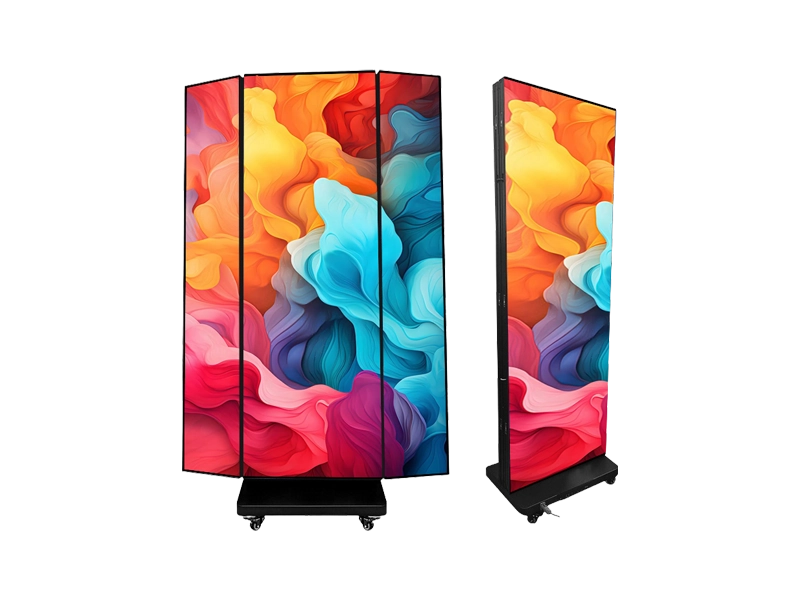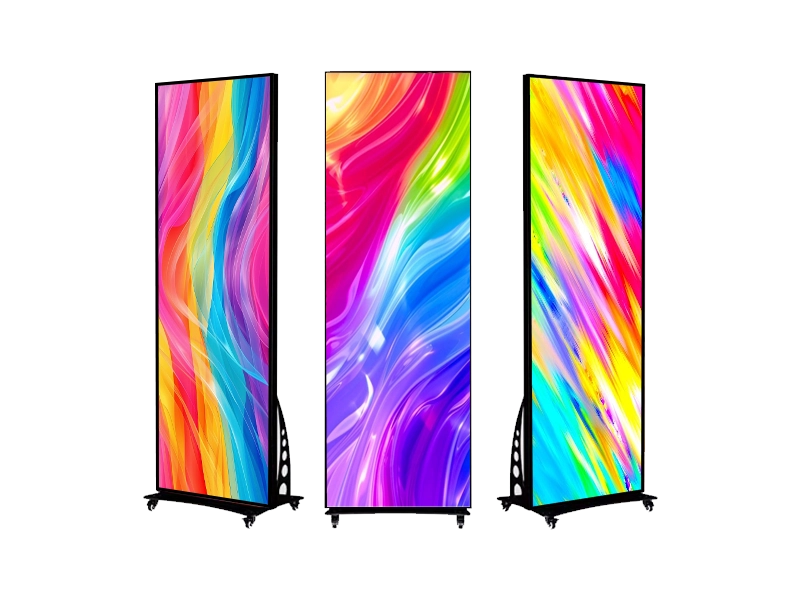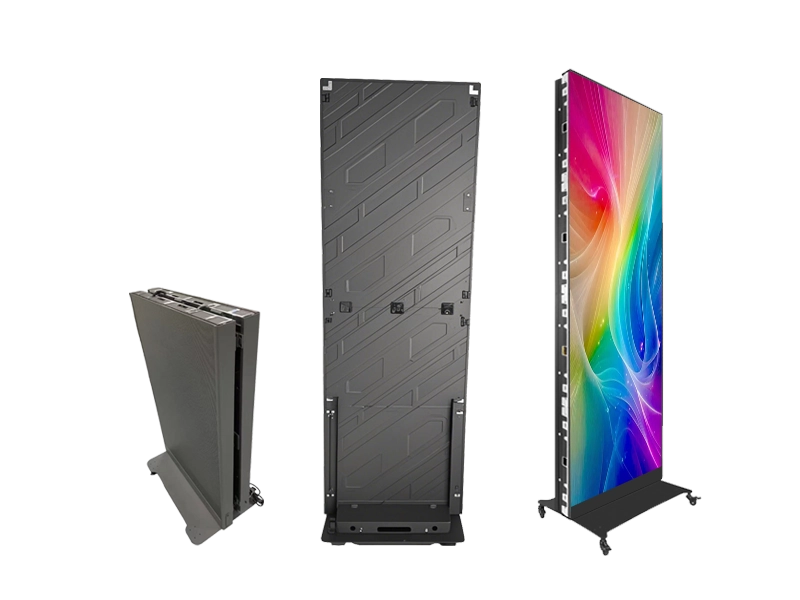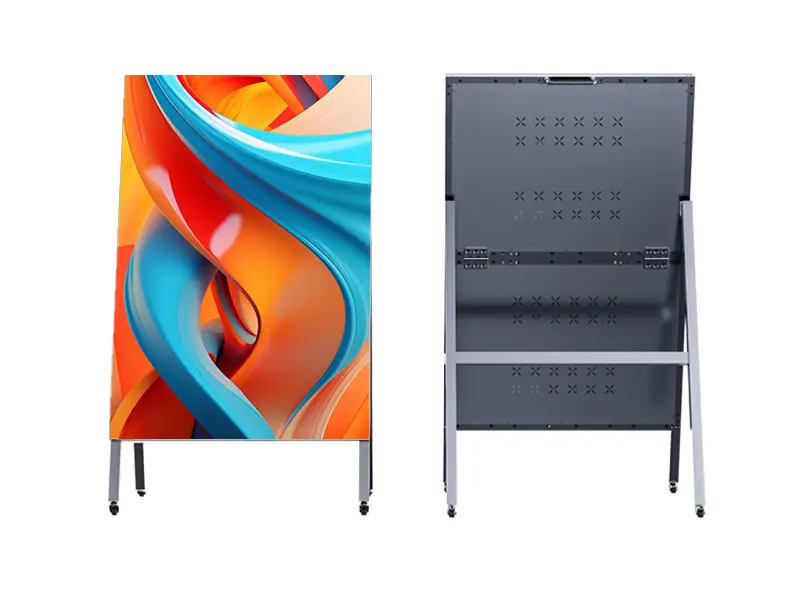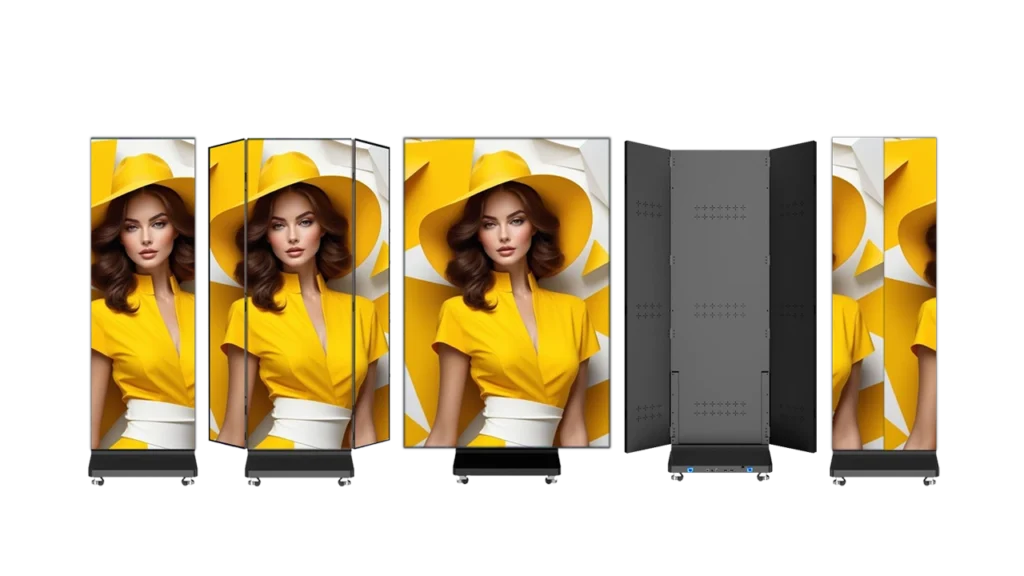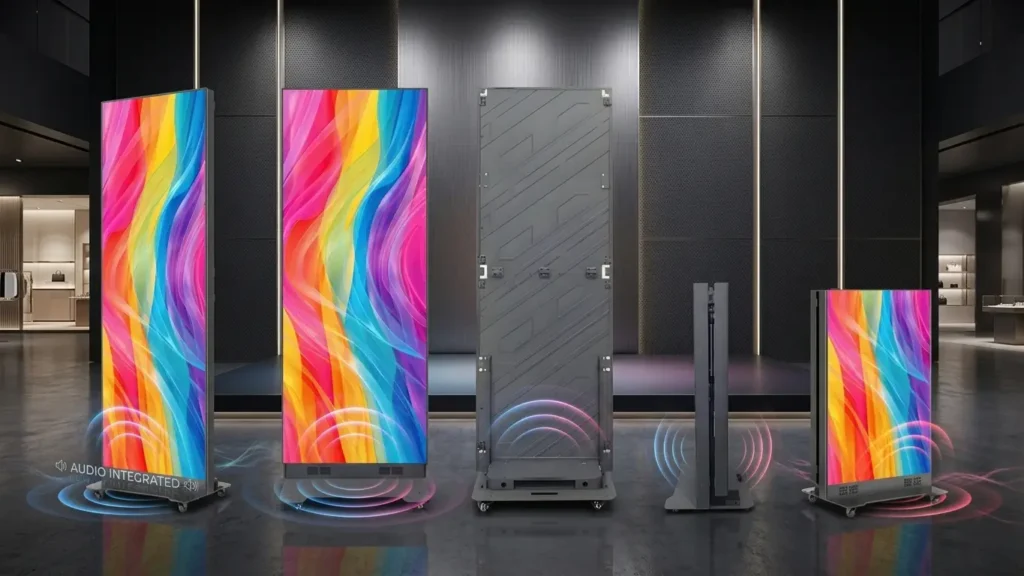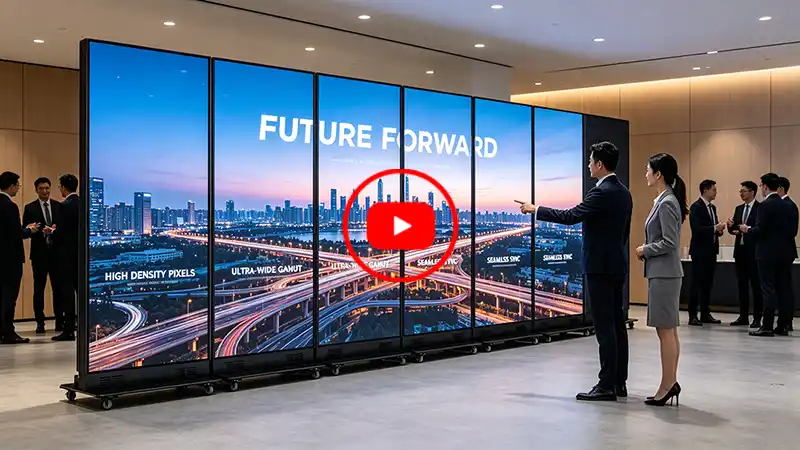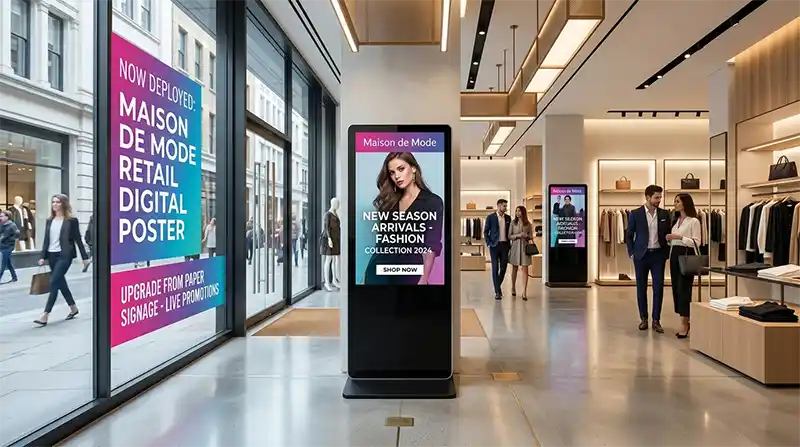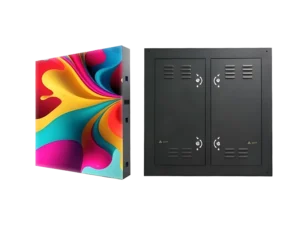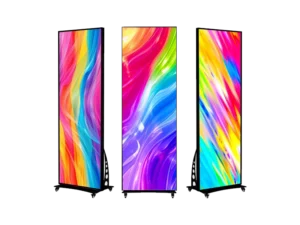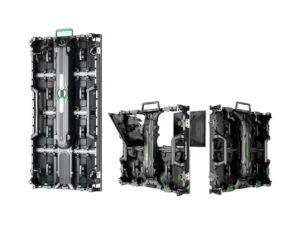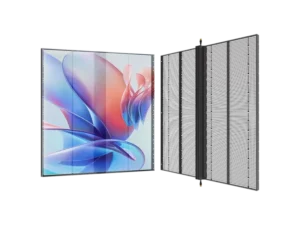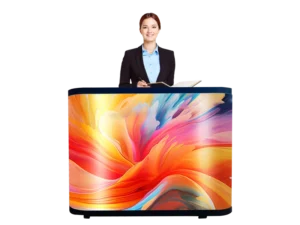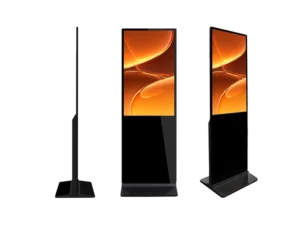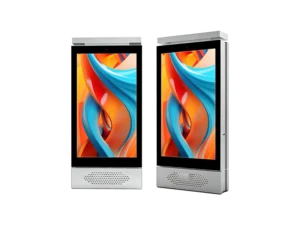
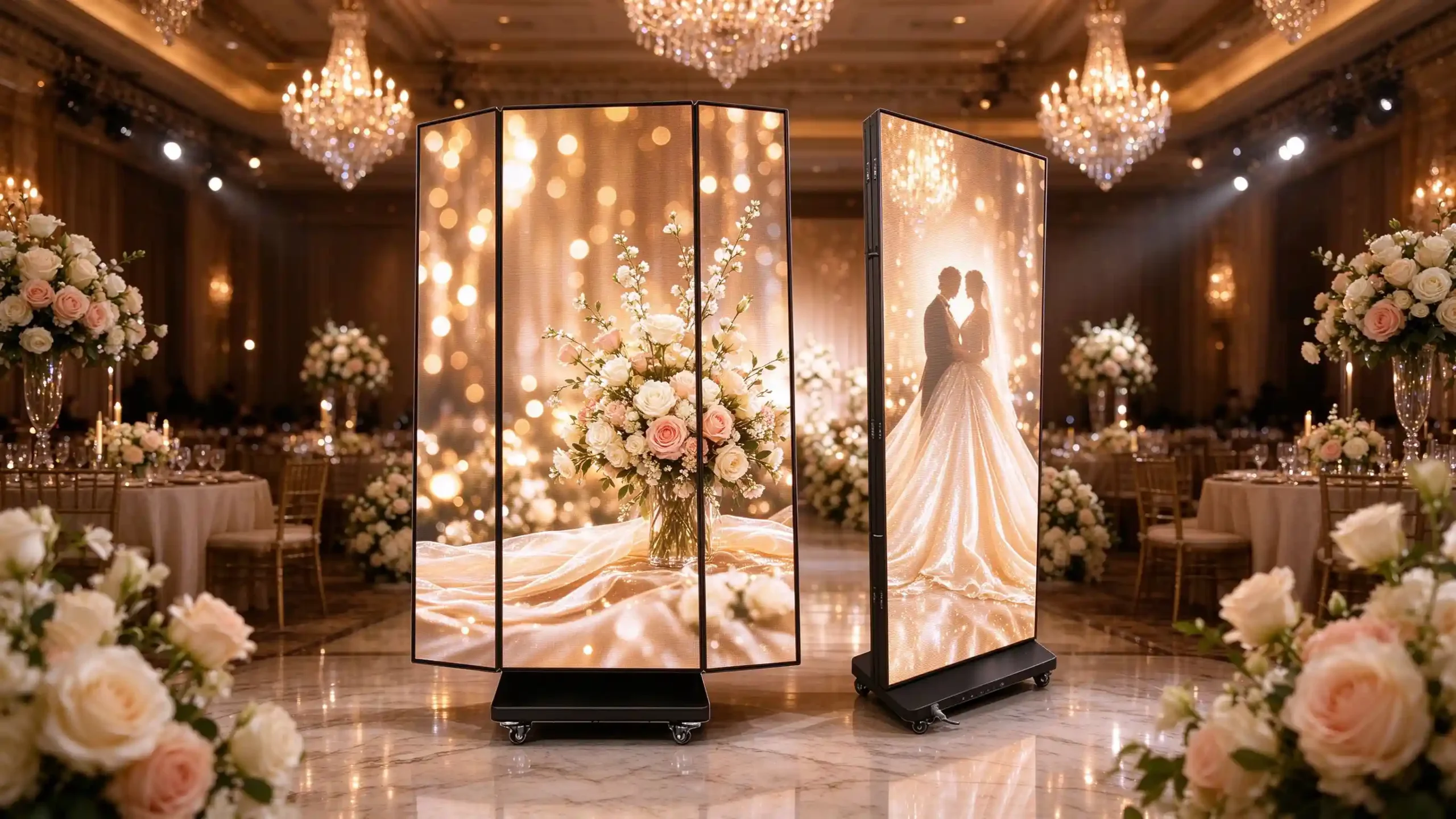
A tri-fold LED poster screen is a floor-standing display with three hinged panels that opens as either one 1,280 × 1,920 mm face or two 640 × 1,920 mm faces looking in opposite directions. At a wedding it replaces the printed welcome board; in a rental fleet it is one bookable item covering weddings, conferences and exhibition work without a build crew. Four variables decide whether it suits a given event: how close guests stand, how bright the room is, what power the venue will release, and whether the event is indoors at all.
Key takeaways
- One display, two ways to present content. Unfolded, the face is 1,280 × 1,920 mm (2.46 m²); folded back, it becomes two 640 × 1,920 mm faces. At P2.5 both settings carry the same 393,216 pixels, so folding redistributes the canvas rather than adding to it.
- The published range is indoors. IP31 and 650–800 nits rule out rain and direct sun; an open-sided marquee needs a different configuration confirmed in writing.
- Finer pitch costs brightness in this range. P1.25 and P1.53 are published at 650 nits, P1.86 at 700 and P2.5 at 800, so a bright foyer can favour the coarser pitch.
- Plan the circuit, not just the plug. At 800 W/m² across 2.46 m² the unit draws about 1.97 kW at peak — roughly 16.4 A on 120 V, above a standard 15 A branch circuit.
- Rental margin comes from content reuse. Template packs per event type, in both aspect ratios, are what turn one unit into three bookable products.
What Is a Tri-Fold LED Poster Screen?
It is a steel-framed LED cabinet in three sections, where the two outer sections swing through 180° on hinges, so the screen is also its own stand. Nothing is rigged, flown or fixed to a wall.
The published indoor range runs from P1.25 to P2.5 in a single 1,280 × 1,920 mm format, at 78 kg, IP31, 16-bit grey and a refresh rate of at least 3,840 Hz. Most of what follows is arithmetic on those figures.
What makes it different from a flat LED poster?
A conventional LED poster is a flat panel on a weighted base; the tri-fold makes the display itself the structure.
- No rigging and no wall fixings, because the unit stands on heavy-duty castors — useful in a ballroom whose contract forbids fixings.
- Front service on a steel cabinet, so modules stay reachable when the screen is pushed against a draped wall.
- One documentable specification, rather than a family of variants whose numbers drift between quotes.
It is not a stage wall: one unit presents 2.46 m², about a fifth of a 4 × 3 m backdrop. It is also not the site’s lighter 36 kg foldable poster, which has an aluminium cabinet and a different handling routine — ask which model a quotation refers to before comparing weight or crew size.
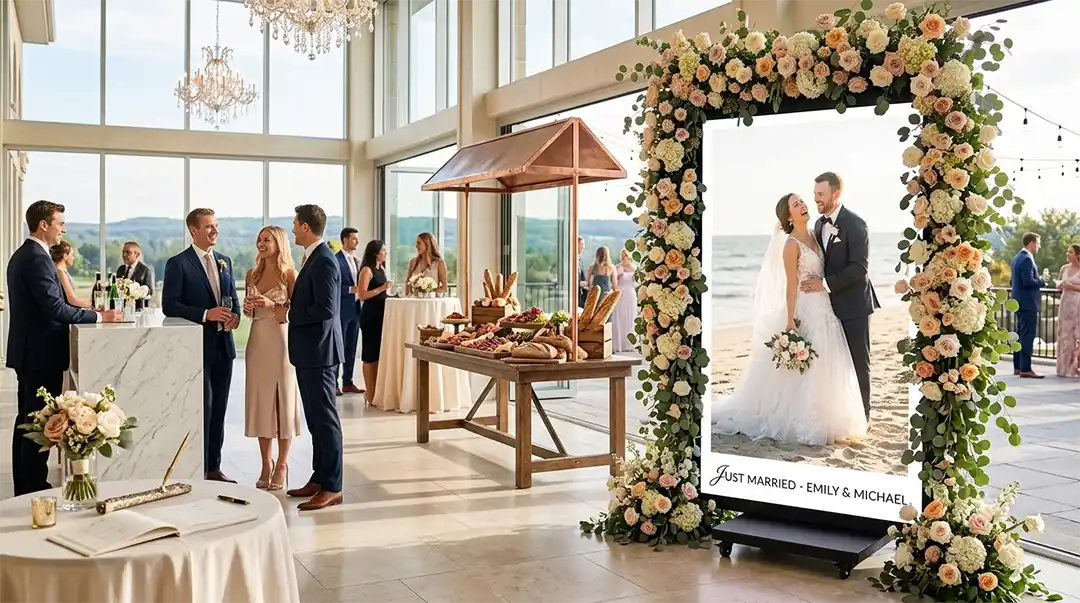
Where a Tri-Fold LED Poster Actually Makes Sense
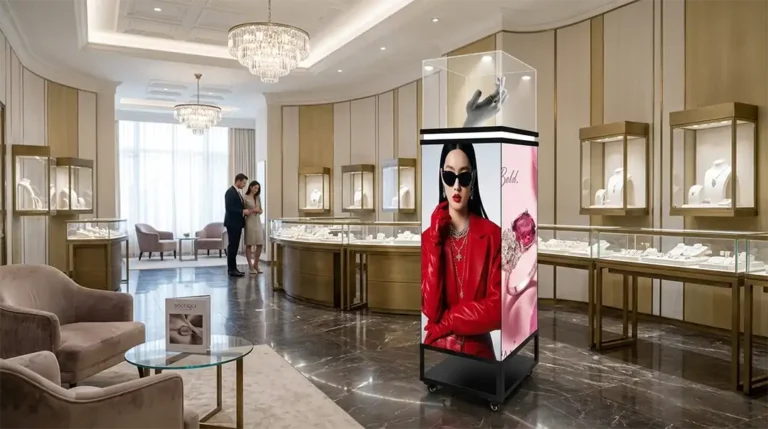
This foldable LED poster is built for locations where a fixed installation isn’t possible but a printed roll-up banner won’t carry the visual weight. One unit opens into either a 1280×1920mm single screen or two 640×1920mm double-sided faces, so you’re not choosing between a wide-format brand moment and a walkway display — you get both in the same chassis. It runs on Nationstar GOB LEDs and a NovaStar controller, plugs straight into AC power, and needs no brackets, no rigging, and no technician on site.
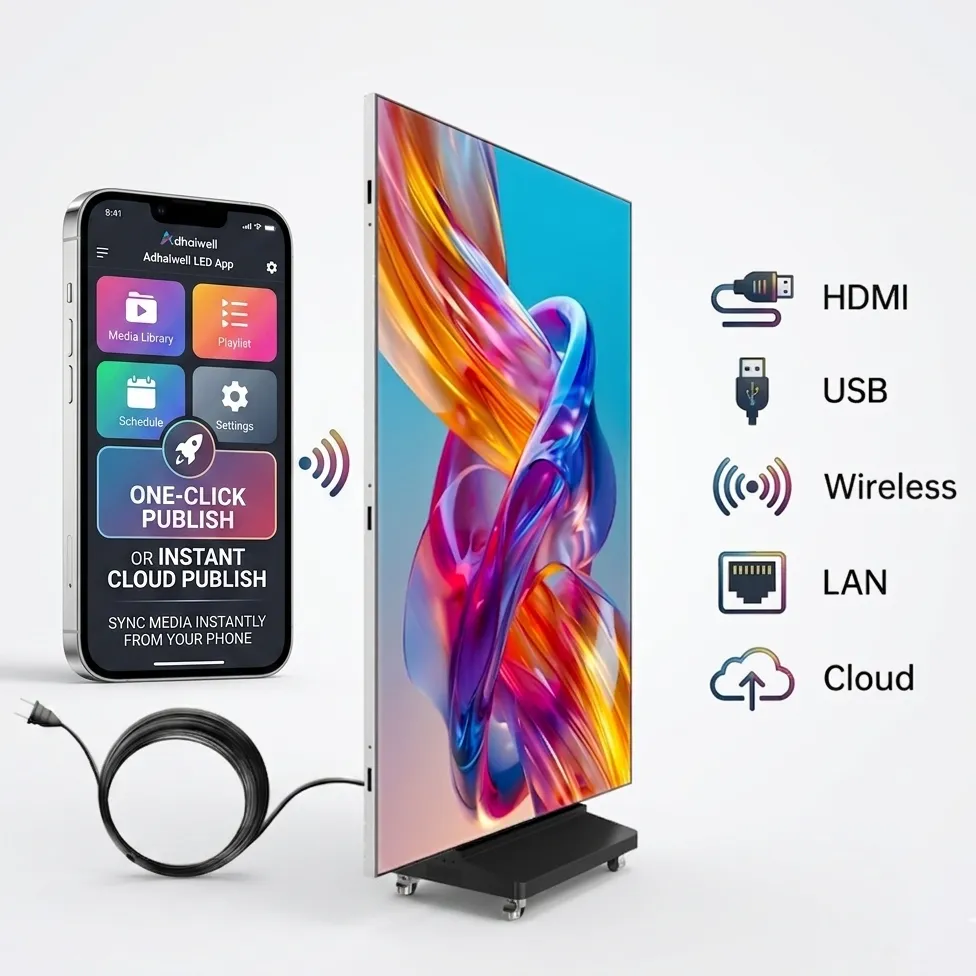
How Content Gets onto the Screen
The display ships with a NovaStar control board. You can push video and images over Wi-Fi or LAN from the ViPlex app on iOS or Android, feed a live signal through HDMI, or play from a USB drive. If you’re rolling units out across multiple stores, event venues, or a rental fleet, the cloud CMS lets you schedule playlists and swap content remotely without traveling to each site.
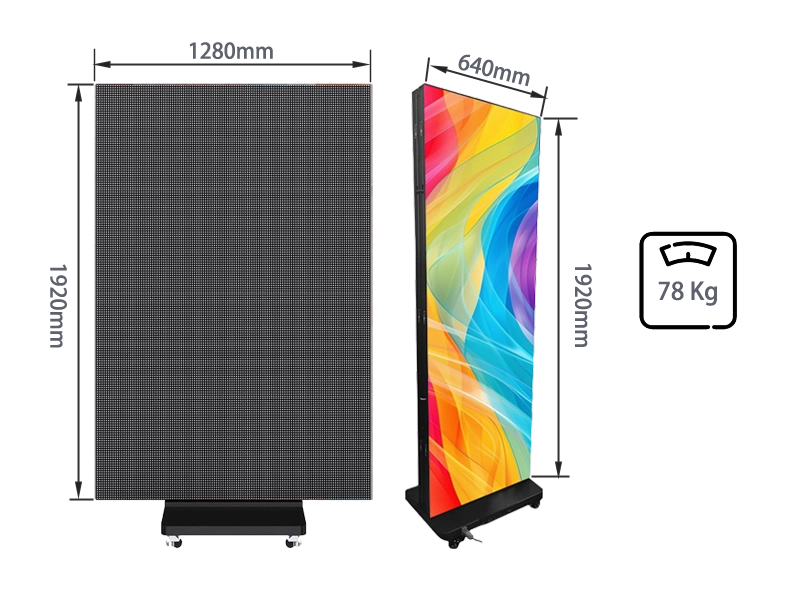
Physical Size, Weight, and Power Draw
Fully opened as a single screen, the panel is 1280mm × 1920mm; in double-sided mode each face is 640mm × 1920mm. The steel cabinet weighs 78 kg and sits on four locking casters, so two people can reposition it between rooms or load it into the flight case. It draws 200–300 W on average (800 W peak), runs on 90–264 V AC, and holds 700–800 nits brightness depending on pixel pitch — enough for a lit mall or ballroom without washing out under spotlights.
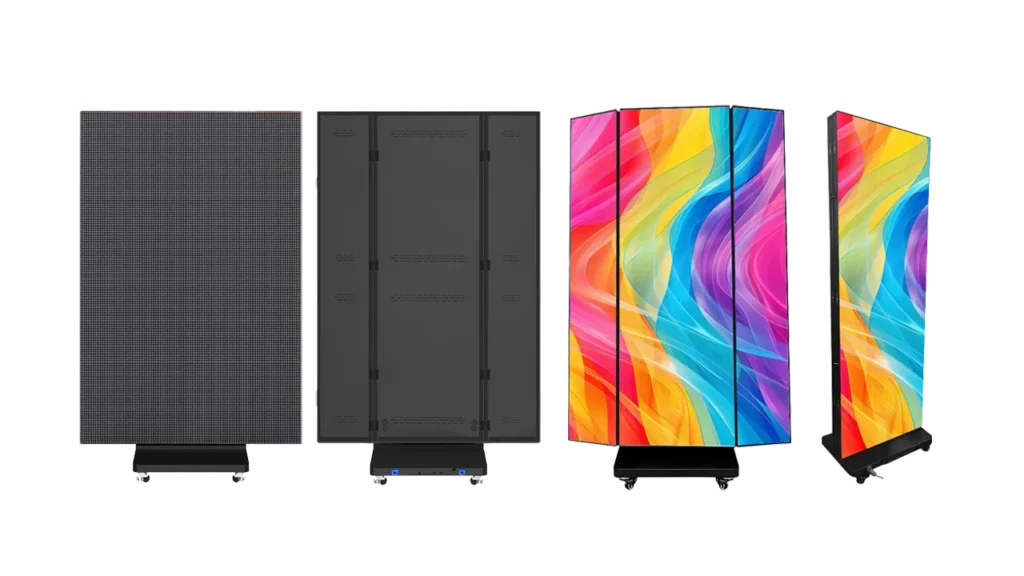
Two Display Modes on One Hinge
The center panel stays fixed while the two side wings rotate on a precision hinge up to 180°. Lay them flat for a seamless large-format totem; angle them outward for double-sided visibility in a corridor, trade-show aisle, or hotel entrance. Maintenance is front-service, and the foldable structure cuts shipping volume by roughly 60% compared with shipping a rigid LED cabinet — a real line-item difference on air freight to the US, Europe, or the Middle East.
How do the three panels create two display modes?
The wings rotate 180°, and that single movement produces both modes.
| Mode | Face size | Aspect ratio | Resolution at P2.5 |
|---|---|---|---|
| Unfolded, single face | 1,280 × 1,920 mm | 2:3 | 512 × 768 px |
| Folded back, double sided | 2 × 640 × 1,920 mm | 1:3 per face | 2 × 256 × 768 px |
Both rows carry 393,216 pixels at P2.5. Folding does not add resolution; it splits the same canvas into two narrow faces. A layout authored for the 2:3 screen loses two-thirds of its width in double-sided mode, which is why production teams keep two master files per event.
How Can a Tri-Fold LED Poster Screen Be Used at Weddings?
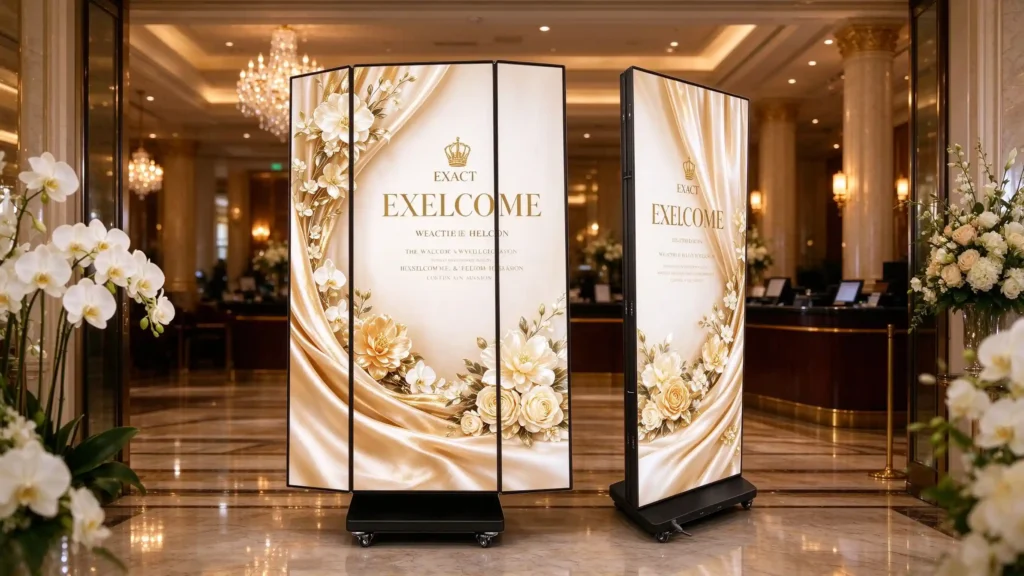
At a wedding the screen does three jobs — arrival, orientation and atmosphere. The narrow double-sided faces suit arrival messaging and wayfinding; the single unfolded face suits a photographic or filmic moment.
Print belongs in the same comparison. A printed board costs a fraction of a screen, needs no power and cannot fail at four o’clock on a Saturday. LED signage for wedding entrances earns its place when content changes late, when the room is dark enough for the screen to act as a light source, when the couple wants motion or a bilingual rotation, or when one asset must serve three events in a week.
Can a tri-fold screen work as a wedding welcome sign?
Yes, and it is the most reliable use of the format: names, date and one line of direction sit naturally on the 1:3 strip. Three conditions decide whether it looks considered or improvised.
- Pitch against approach distance. The industry rule of thumb is that pitch in millimetres should be no coarser than the nearest viewing distance in metres. Guests reach a welcome sign at about 1.5 m, so P1.86 is comfortable and P2.5 is a compromise.
- Brightness against ambient light. Published figures are 650 nits at P1.25 and P1.53, 700 at P1.86 and 800 at P2.5. The finer pitches are not the brighter ones, so a glazed foyer at midday argues for the coarser pitch or another product.
- Frame rate against phone cameras. At 3,840 Hz the panel is unlikely to be the source of banding in guest photos, though the camera still has a say.
How do you show names, dates and reception details?
Treat the screen as a scheduled player rather than a poster. Four cards of eight to twelve seconds carry welcome, order of the day, a transport note and next-morning details — more than a printed board holds, less than a scrolling feed.
Two rules keep it legible. Set the primary line at about 15% of canvas height, which is 288 mm on the 1,920 mm face, and hold each card long enough to be read twice, because guests arrive in a trickle. Photo backdrops work on the unfolded face; they work poorly on a 640 mm strip.
Can it display a seating chart or a schedule?
A schedule, yes. A full seating chart, only with care: the double-sided face is 640 mm wide, so a 120-guest plan in two columns leaves roughly 300 mm per column, about the width of a hand.
Three options work. Use the unfolded face and accept that one side of the room cannot see it; paginate three or four screens on one face, changing every 15 seconds; or keep the chart on card and put the table number on the screen. The third is the calmest, and it is what most planners settle on.
Where should the screen stand at a venue?
Where guests stop, not where they pass: the foot of the entrance steps, beside the escort-card table at a slight angle to the door, or the end of the bar where people queue. Sight lines and power decide more of this than aesthetics do, and the best sight line is frequently across a fire exit route.
How Can Event Rental Companies Use One LED Poster Screen for Different Events?
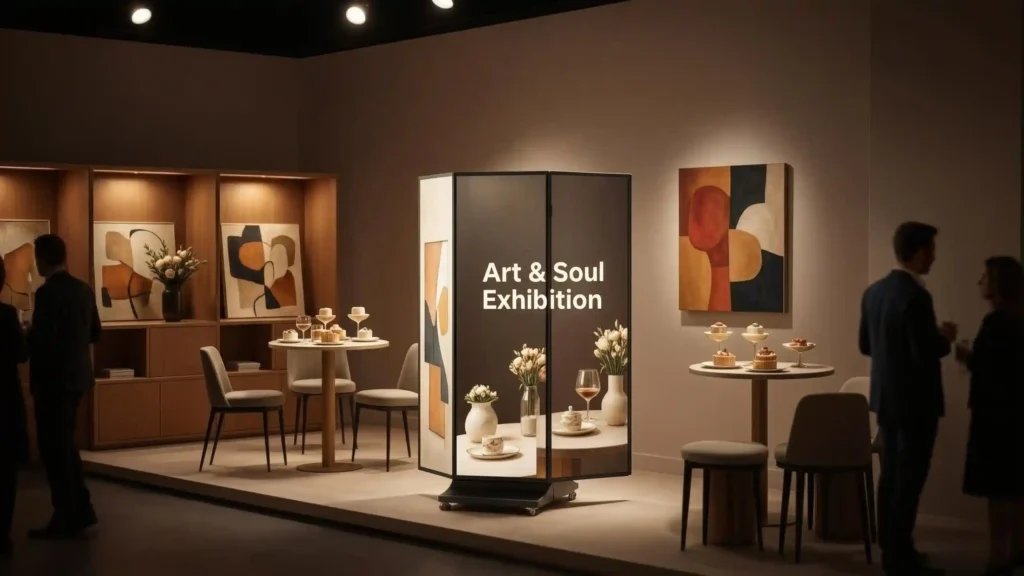
One unit sells three ways: a double-sided wayfinding screen at registration, a single-face hero screen at an entrance, and a content-only package where the rental firm supplies the loop and the venue keeps its own hardware. The same chassis covers all three, which is the commercial case for the format rather than the hinge itself.
Which event types can share the same unit?
Weddings and corporate dinners share almost the same brief: an arrival message, a run of show, a sponsor acknowledgement. Conferences add a registration queue and a session board; exhibitions want a silent booth loop; activations want motion and a photo moment. All of them sit inside 2.46 m² and 650–800 nits, so the equipment list does not change — content, placement and aspect ratio do.
How do you reuse one unit across clients?
Reuse is a content problem before it is a hardware problem: the unit does not know which event it is at, the playlist does.
- Template packs by event type, not by client — wedding, conference, exhibition sponsor, awards — each produced in both the 2:3 and 1:3 ratios.
- A shared type scale, so a headline that works on one client’s card works on the next without re-setting.
- A fixed goods-in check — power-on, dead-pixel scan, hinge lock, castor brake, case seal — five minutes that catches what would otherwise surface in front of a client.
The operational limit is the calendar. A Saturday wedding striking at 23:00 and a Monday 08:00 conference load-in leaves about 33 hours for strike, transport, cleaning and reload: enough for one unit handled by two people, not for a queue sharing a van.
Where Else Can You Use a Tri-Fold LED Poster Display?
Beyond weddings, the format suits any indoor venue where a small, movable, two-faced screen beats a fixed installation — in practice, anywhere the audience walks up to the message rather than viewing it across a room.
| Venue | Typical use | Verify before quoting |
|---|---|---|
| Trade shows and exhibitions | Product film at a booth corner; sponsor loop | Stand footprint, aisle clearance, drayage |
| Hotels and ballrooms | Arrival message, banquet direction, agenda | Door and lift widths, a dedicated outlet |
| Retail and shopping malls | Promotion loop, window support | Ambient light, scheduling rights, floor loading |
| Corporate events | Agenda, session board, sponsor acknowledgement | On-site control access, signal routing |
| Brand activations | Motion visuals, two-way capture, photo moment | Double-sided placement, transport, security |
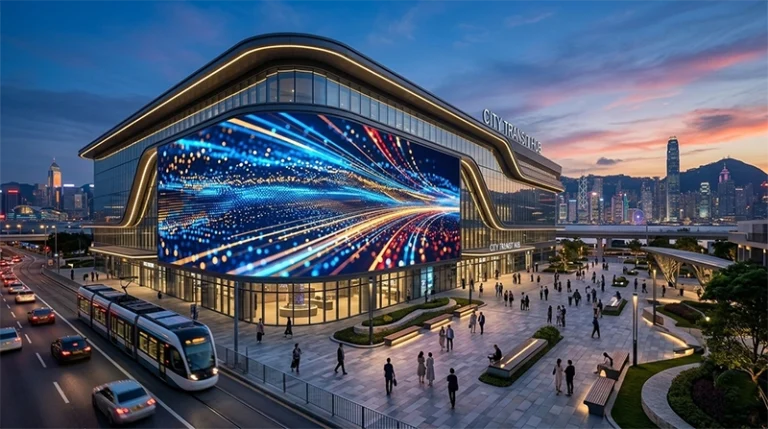
Each row needs confirmation against the specific model’s mounting, brightness, control and operating limits — not against a photograph of a similar-looking screen. Transit hubs use the same logic: no build, no rigging, and a screen that moves when the concession layout changes.
Tri-Fold LED Poster Screen vs. Large LED Video Wall: Which Is Better for Events?
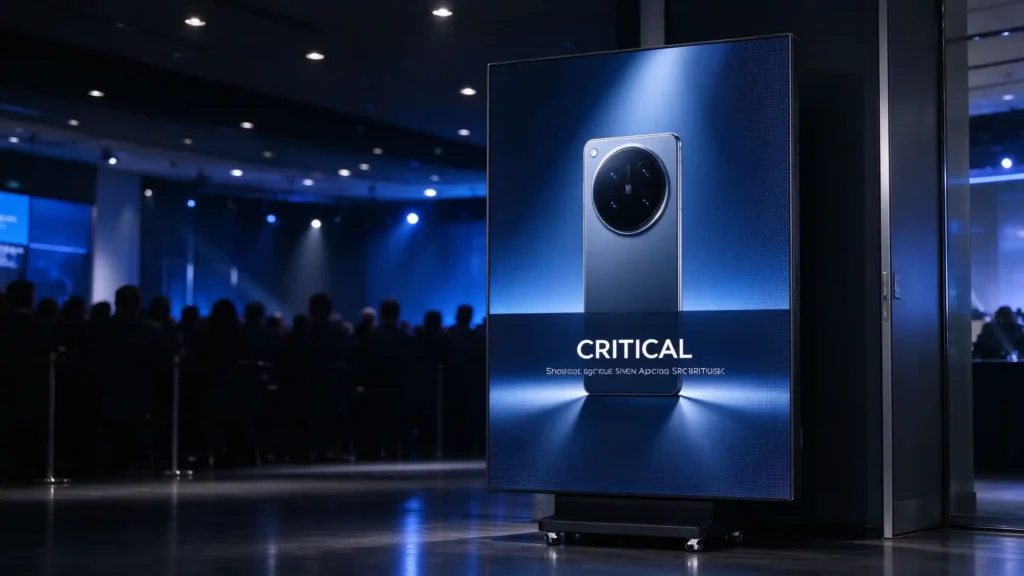
Neither is better in general. The tri-fold is a signage product and a rental LED wall is a staging product, and most rental companies end up owning both for different jobs.
| Buying factor | Tri-fold LED poster | Rental LED wall (500K series) |
|---|---|---|
| Image area | 2.46 m² per unit, fixed | Built to order from 500 × 500 or 500 × 1,000 mm cabinets |
| Cabinet weight | 78 kg complete, on castors | 8 kg / 15 kg per cabinet |
| Pixel pitch | P1.25 – P2.5 | P1.56 – P4.81 |
| Brightness | 650 – 800 nits, IP31 | 600 – 800 nits indoor; 4,500 – 5,000 nits at IP65 |
| Structure | Self-supporting A-frame, no build | Truss or ground support, 0° / 5° / 10° curving |
| Crew and time | One to two people, playing within about 15 minutes | Crew, rigging, power and signal distribution |
| Best fit | Entrances, wayfinding, sponsor loops | Stage backdrops, large-format playback, curves |
Choose the poster when the message is short, the audience walks up to it, and the room cannot take a build. A 78 kg unit wheeled in by two people and playing within a quarter of an hour wins on labour, on venue permissions and on how many bookings one van can service in a week.
Choose the wall when the screen is the backdrop rather than the sign: a stage reveal, an IMAG surface, a curved set piece, or anything read from 10 m away. At that distance a 640 mm-wide face is a detail, not a message.
Area, distance and portability settle it in that order. Image area sets the category, viewing distance sets the pitch, and portability decides whether the equipment reaches the room at all — a 78 kg poster through a service lift is straightforward; 12 m² of wall through the same lift is not.
What Technical Specifications Should You Check Before Buying?
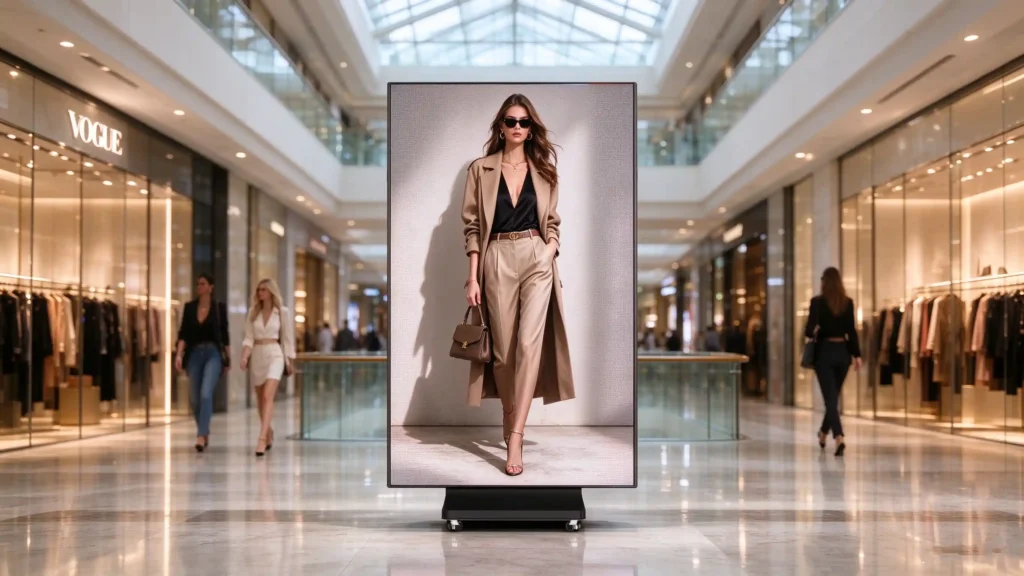
Check seven things in order: face size and aspect ratio, pitch against viewing distance, brightness against ambient light, control and content workflow, power draw, transport weight and packing, then protection rating against the venue. The tri-fold LED poster screen specification table is a useful benchmark because it lists figures per pitch rather than quoting one headline number for the series.
Which pixel pitch suits wedding and event use?
Match pitch to viewing distance, then buy one step finer if the content is text-heavy.
| Pitch | Single face | Double face | Pixels per face | Brightness | Typical use |
|---|---|---|---|---|---|
| P1.25 | 1,024 × 1,536 | 2 × 512 × 1,536 | 1,572,864 | 650 nits | Close-range detail, small print, tables |
| P1.53 | 832 × 1,248 | 2 × 416 × 1,248 | 1,038,336 | 650 nits | Welcome signs read at 1–1.5 m |
| P1.86 | 688 × 1,032 | 2 × 344 × 1,032 | 710,016 | 700 nits | General wedding and conference use |
| P2.5 | 512 × 768 | 2 × 256 × 768 | 393,216 | 800 nits | Lobbies and booths, 2.5 m and beyond |
P1.86 is the usual compromise for a wedding at 1.5 m: it holds a headline and a line of detail without the cost of P1.25. P2.5 suits a bright lobby or an exhibition corner where nobody stands closer than 2.5 m, and it is the brightest option in the range — worth remembering when venue lighting is the problem rather than resolution.
How do brightness and viewing distance interact?
Brightness has to beat the room, not the sun. At 650–800 nits the range is comfortable in ballrooms and exhibition halls, marginal in a glazed foyer at midday, and unsuitable outdoors. The 160°/160° viewing angle is what makes the double-sided mode work in a corridor, where guests approach at an angle and from two directions.
What about refresh rate and camera capture?
At 3,840 Hz one refresh cycle lasts about 260 microseconds. A 1/50 s exposure integrates roughly 77 cycles, so the panel is unlikely to cause banding in ordinary video; a 1/1,000 s still integrates fewer than four, which is where interference can appear.
The rating is one input, not a guarantee. What lands in the photograph also depends on the camera’s rolling-shutter readout, the exposure the photographer chose, and the driver’s PWM dimming at low brightness. If the screen will be filmed professionally, test it with that camera at that brightness rather than trusting the datasheet.
What control and connectivity options do you need?
The range is published with HDMI, USB, LAN and wireless input, a Novastar control system and a cloud CMS with iOS and Android apps. For a rental fleet the practical pairing is cloud scheduling for multi-site updates plus a USB fallback, because a hotel ballroom’s guest network will not carry a content upload at 17:00 on a Saturday.
What power supply does it require?
The published input is AC 90–264 V, 47–63 Hz, at 800 W/m² maximum and 200–300 W/m² average. Across 2.46 m² that is about 1.97 kW at peak and 0.5–0.7 kW in normal use; folding the wings changes neither figure, because the pixel count is the same in both modes.
Current matters more than wattage. On 230 V the peak is about 8.5 A, comfortable on a dedicated 13 A or 16 A circuit. On 120 V it is about 16.4 A — above a standard 15 A branch circuit — and if site voltage sags toward the 90 V floor of the input range, current approaches 22 A. Ask for a dedicated circuit, and ask what else shares it.
Should you choose an indoor or outdoor LED poster screen?
The published tri-fold range is IP31 throughout, and the rating should be read literally. Under IEC 60529 the first digit 3 means protection against solid objects over 2.5 mm — tools and thick wires, not fine dust — and the second digit 1 means protection against vertically falling water drops: condensation and a light drip, not rain driven at an angle, not a hose, not a wet lawn at midnight.
An open-sided marquee, a garden ceremony or a poolside position therefore needs a different product with a documented IP rating, brightness in the thousands of nits and written confirmation of operating conditions.
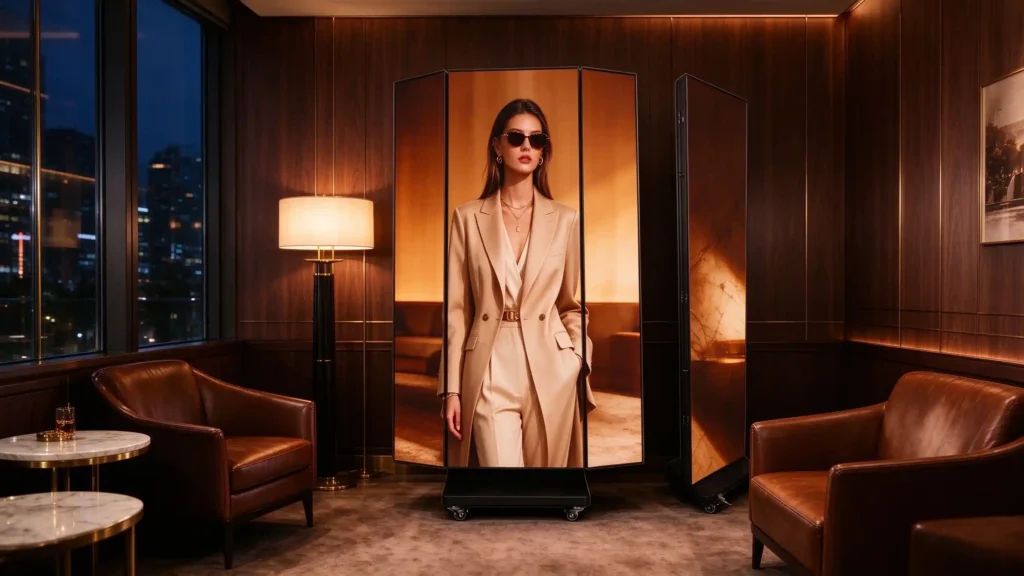
How Should You Design Content for Single-Sided and Double-Sided Display Modes?
Design for the mode, not for the screen. The two modes share a pixel count but not a shape, so a single master file rescaled between them will either crop the headline or leave two-thirds of each face empty.
| Mode | Canvas | Aspect | Type area at P2.5 | Type area at P1.86 |
|---|---|---|---|---|
| Single face | 1,280 × 1,920 mm | 2:3 | 512 × 768 px | 688 × 1,032 px |
| Double face | 640 × 1,920 mm per side | 1:3 | 256 × 768 px | 344 × 1,032 px |
What canvas does each mode give you?
The single face is a portrait poster: one message, one image, room for a logo lock-up at the foot. The double face is a strip, three times as tall as it is wide, which suits a name and a line of direction, a vertical run of four schedule items, or a sponsor stack. It does not suit a table plan, a landscape group photograph, or any layout assuming a reading path wider than about 20 characters.
The figures also explain a common production error. Because the face is physically 1,280 × 1,920 mm in both modes, a type size set in pixels changes physical size when the pitch changes: 15% of the canvas is 288 mm either way, but that is 115 px at P2.5, 155 px at P1.86 and 230 px at P1.25. Specify type in millimetres if a fleet mixes pitches.
How should a double-sided layout differ?
Write for two readers who arrive from opposite directions and never see both faces.
- Duplicate the essential line on both faces. A guest who reads one side should still learn the room name.
- Split, don’t mirror. Give each face its own job — welcome on one, direction on the other — because mirrored artwork reads as a mistake in a corridor.
- Keep the horizon identical. Both faces should sit at the same height and margin from the floor, or the unit looks assembled rather than designed.
What Should You Check Before Using an LED Poster Screen at a Wedding?
Work through six checks in the week before the event, in this order, because each can invalidate the next.
- Resolution and aspect ratio. Confirm the mode and the exact canvas in pixels, then build artwork to it. A 16:9 file dropped onto a 2:3 face letterboxes into a strip nobody can read.
- Viewing distance and venue lighting. Measure the approach and set pitch and brightness against it. Ask about the lighting state during arrivals, not during dinner, when the room is dark and almost any screen looks good.
- Power and cable routing. Confirm a dedicated circuit within cable reach, the connector type, and a route that crosses no fire exit. At 1.97 kW peak, a shared ring is the most common cause of a tripped breaker mid-event.
- Access, transport and setup space. 78 kg on castors rolls easily on a flat floor and does not go up a staircase. Check lift dimensions, door widths, ramp availability and where the flight case will live during the event.
- Content rehearsal. Run the loop end to end on the unit, at the venue’s brightness, on the venue’s power, with no network connection — including the handover between cards and the return to the first. Twenty minutes here is cheaper than a technician call-out at the reception.
- Indoor or outdoor suitability. Confirm the room is enclosed, the screen is out of direct sun, and nothing overhead drips. IP31 is an indoor rating; a marquee with the sides open is an outdoor installation for practical purposes.
Two operational questions belong on the list: who is responsible for the screen between the end of the reception and the venue’s lock-up, and whose insurance covers it there. Both are answered before the event or argued about after it.
Should You Buy or Rent a Tri-Fold LED Poster Screen?
Buy when the unit will be booked regularly and one chassis can serve two or three event types without fresh content every time. Rent when events are occasional, when dates cluster into one season, or when you have not yet learnt what clients will ask for.
| Factor | Buying | Renting or hiring |
|---|---|---|
| Frequency | Needs a booking rhythm to justify the capital | Pay per event, no idle months |
| Upfront cost | Published unit price of US$2,000–3,000, plus case, freight, duty and clearance | Deposit and hire fee only |
| Transport | Van with a ramp, two people, city access rules | Usually included or charged by the hirer |
| Storage | Dry, secure, upright space for the cased unit | None |
| Maintenance | Spare modules, your labour, downtime risk | The hirer’s problem |
| Content | Your templates in both ratios, your production hours | Often bundled, rarely tailored |
| Risk | Idle asset; technology ages while it waits | Availability on the date you need |
Which costs belong in the comparison?
Compare contribution per booking, not day rate. Six lines belong in the calculation: the unit and its flight case; inbound freight, duty and clearance; transport per event, including fuel and city access charges; labour for setup, strike and travel; content production per client, the line nobody quotes and everybody absorbs; and storage plus spares at your own rate per square metre.
How do you calculate payback without guessing?
Payback in months ≈ landed cost ÷ (net contribution per booking × bookings per year ÷ 12), where net contribution is the hire fee minus transport, labour and content cost — not the invoice value. The table applies that formula to a placeholder landed cost of US$3,500 and three contribution levels, to show how sensitive the answer is.
| Bookings per year | US$80 per booking | US$120 per booking | US$160 per booking |
|---|---|---|---|
| 12 | 44 months | 29 months | 22 months |
| 24 | 22 months | 15 months | 11 months |
| 36 | 15 months | 10 months | 7 months |
Read that as a sensitivity test, not a forecast, and replace every input with your own: local hire rates, crew cost, content hours and a realistic booking count. Because the denominator is a product, halving bookings doubles the payback; because contribution excludes labour, a firm that forgets crew hours understates payback by its largest line.
How to Choose a Reliable Tri-Fold LED Poster Screen Manufacturer in China
Judge the supplier on documentation and spares rather than on the showreel. A factory that produces a model-specific datasheet, a named control system, a spare-parts list and a warranty covering modules separately is telling you how it will behave after the sale. The static signage replacement case for tri-fold posters is a useful cross-check on how the format is positioned commercially, though it addresses advertising use rather than weddings.
What documentation and quality evidence should you request?
Ask for the datasheet of the exact model, not the series: face dimensions and resolution in both modes, pitch, brightness, refresh, grey depth, maximum and average power, cabinet weight, protection grade, operating temperature and control hardware by name. Then check that the figures reconcile — resolution multiplied by pitch should equal the face dimension.
Ask also what is tested per unit and per batch, whether there is a burn-in period, and how a module is replaced. Front service on a steel cabinet is the practical arrangement for a fleet. Read the warranty as three questions: how long, what it excludes, how fast a replacement ships.
What certifications and quotation terms matter?
CE (EMC and LVD) and RoHS are the baseline for EU and UK buyers; FCC with UL or ETL applies in the US, and other markets differ — confirm your own requirement rather than accepting a general claim, and settle who is importer of record before the goods ship.
A usable quotation states model, pitch, face configuration, control option, packing, quantity, unit price, trade term, lead time, warranty and HS classification. On the published range the terms are MOQ from 1–2 units, lead time 7–20 days by quantity, and FOB, CIF or EXW — confirm each in writing, because these are the fields that turn into disputes.
Planning to add LED poster displays to your event rental business? Contact Adhaiwell to confirm available pixel pitches, display configurations, technical specifications and customization options for your target events. Share your viewing distance, venue conditions and intended application so our team can identify a suitable configuration — the inquiry form is the fastest route, and a photographed venue layout helps more than a description does.
Frequently Asked Questions About Tri-Fold LED Poster Screens
These answers draw on Adhaiwell’s production and export work with foldable and double-sided LED poster displays, and on the published specification for the tri-fold range. Where a figure depends on configuration, the configuration is named; where a question needs a site-specific answer, the answer says so.
Can a tri-fold LED poster screen be used for wedding ceremonies?
Yes, most often at the entrance and the escort-card table rather than at the altar. Run it double-sided for two-way guest flow or unfolded for a photographic welcome, in P1.86 if guests stand about 1.5 m away, and confirm a dedicated outlet within cable reach. Check first that the room is enclosed, because the range is rated IP31.
Is a double-sided LED poster screen suitable for event rentals?
Yes, provided the logistics match the weight. At 78 kg on castors the tri-fold is a two-person item needing a van with a ramp, and 24 hours between a late wedding strike and an early conference load-in is realistic for one unit but not for a queue of them. The commercial case rests on reusing one chassis across weddings, conferences and exhibitions.
What pixel pitch should I choose for indoor wedding signage?
P1.86 where guests approach to about 1.5 m, which covers most welcome signs and direction boards. Choose P1.25 only if the content carries small print or a detailed plan, and P2.5 for lobbies and exhibition corners viewed from 2.5 m or more, where its 800 nits are also an advantage.
Can the screen show different content in different configurations?
Yes. The two modes are independent layouts on the same canvas, and the product page states that each panel can run independently, so the two faces need not carry the same loop. Confirm how that is configured and scheduled on the model you buy, because the workflow differs between standalone playback and a cloud CMS.
What power supply does a tri-fold LED poster screen require?
AC 90–264 V at 47–63 Hz, drawing about 1.97 kW at the published maximum of 800 W/m² and roughly 0.5–0.7 kW in average use. On 120 V that peak is about 16.4 A, so a standard 15 A branch circuit is not enough; ask the venue for a dedicated circuit and confirm what else shares it.
Can it be used outdoors?
Not in the published tri-fold configuration. The range is IP31 at 650–800 nits, an indoor specification whose water protection covers vertical drips only. Outdoor work needs an IP-rated product with brightness in the thousands of nits and written confirmation of site conditions.
Should an event rental company buy or rent LED poster screens?
Buy when bookings are regular and one unit covers several event types; rent when events are occasional or seasonal. Model it before deciding: landed cost divided by net contribution per booking gives the number of bookings needed to break even, and if that exceeds your realistic calendar, hiring is cheaper than owning.
What should I confirm before ordering from a Chinese LED display manufacturer?
Confirm the model behind the quotation, the datasheet for that exact model, the control hardware by name, the per-unit test routine, the spare-parts list, the certificate naming your model, and the packing and trade term. A supplier who answers all seven before quoting a price is easier to audit afterwards, and ask which pixel pitches are actually in stock rather than which are listed.
The format is not complicated once the numbers are on the table: 2.46 m², 78 kg, IP31, 650–800 nits, and one canvas that changes shape twice a week. Before ordering, put your venue list beside the published tri-fold LED poster display specifications and check three columns — nearest viewing distance against pitch, brightest room against nits, circuit capacity against 1.97 kW. If you are still deciding between poster formats rather than between suppliers, the LED poster display comparison buyer’s guide sets the four formats side by side on the same criteria.