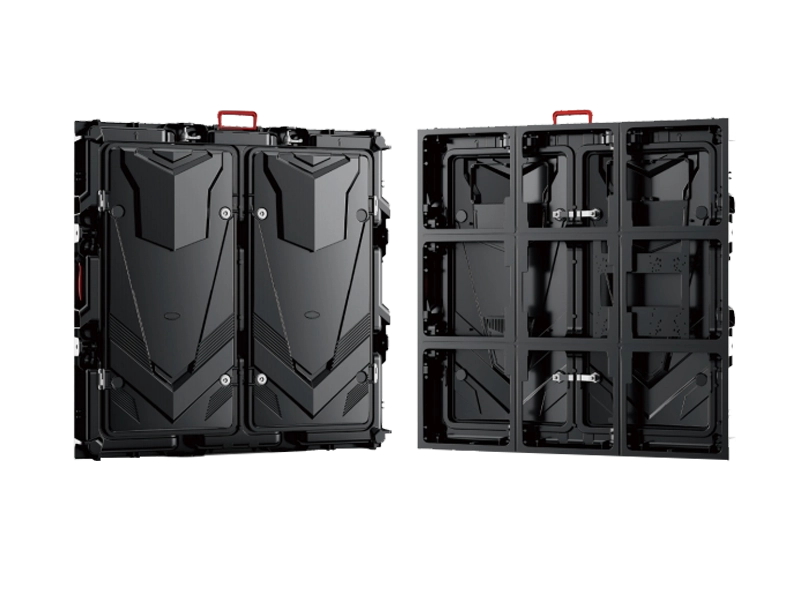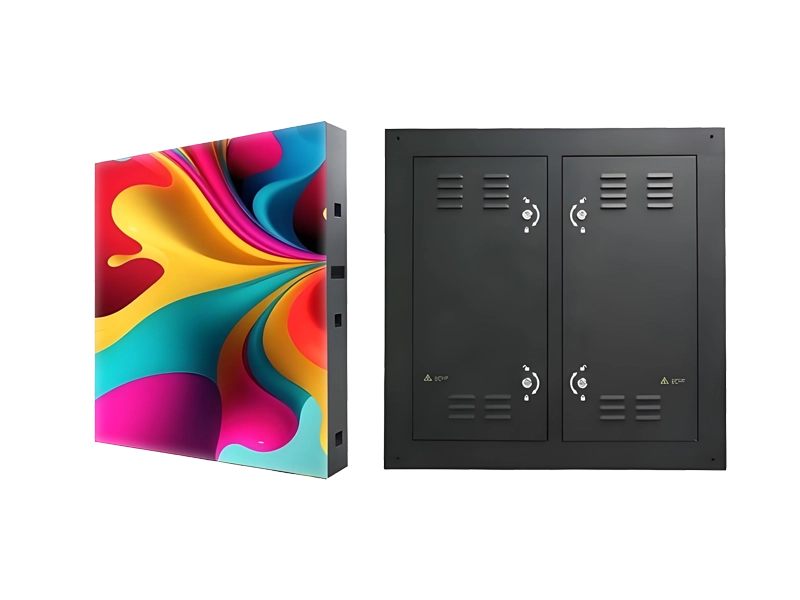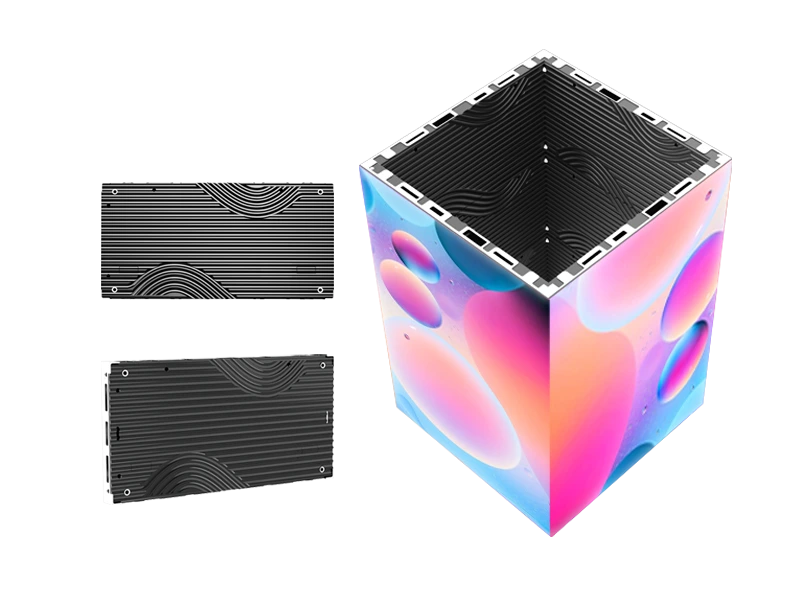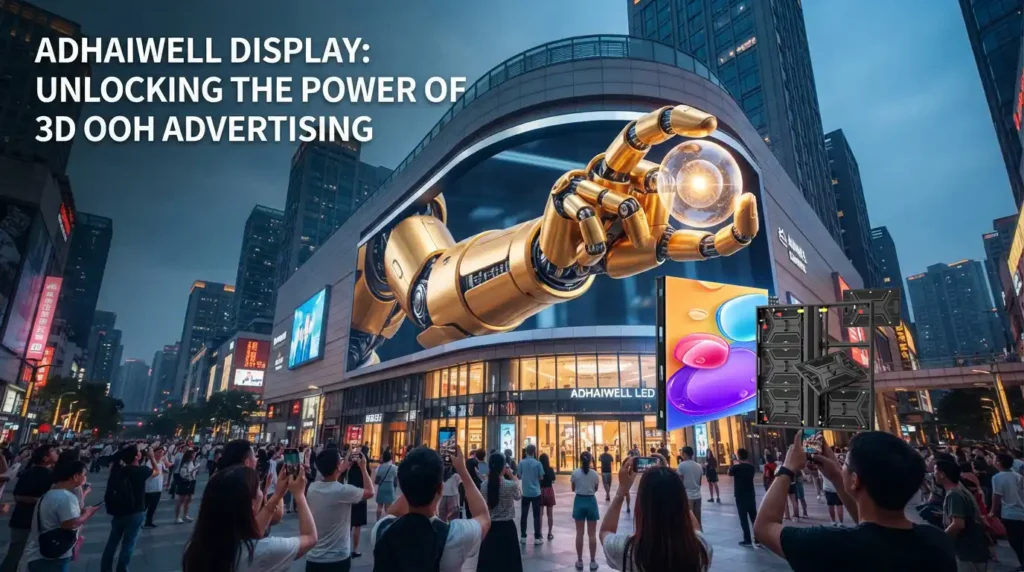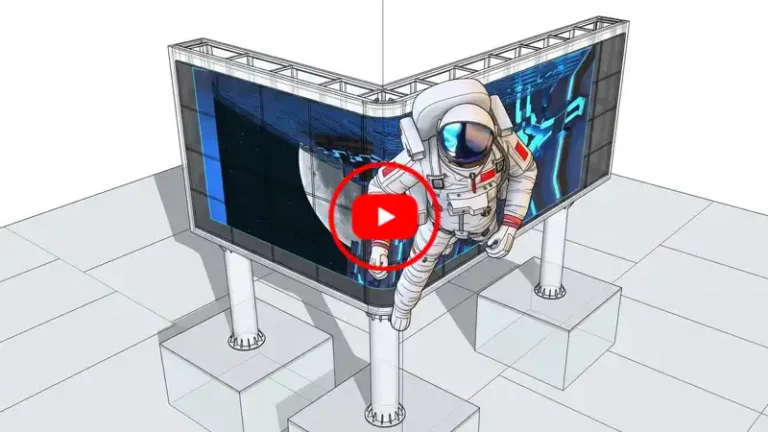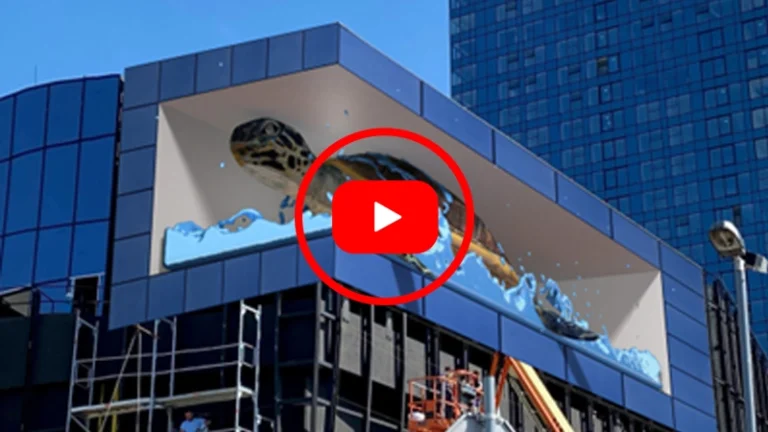
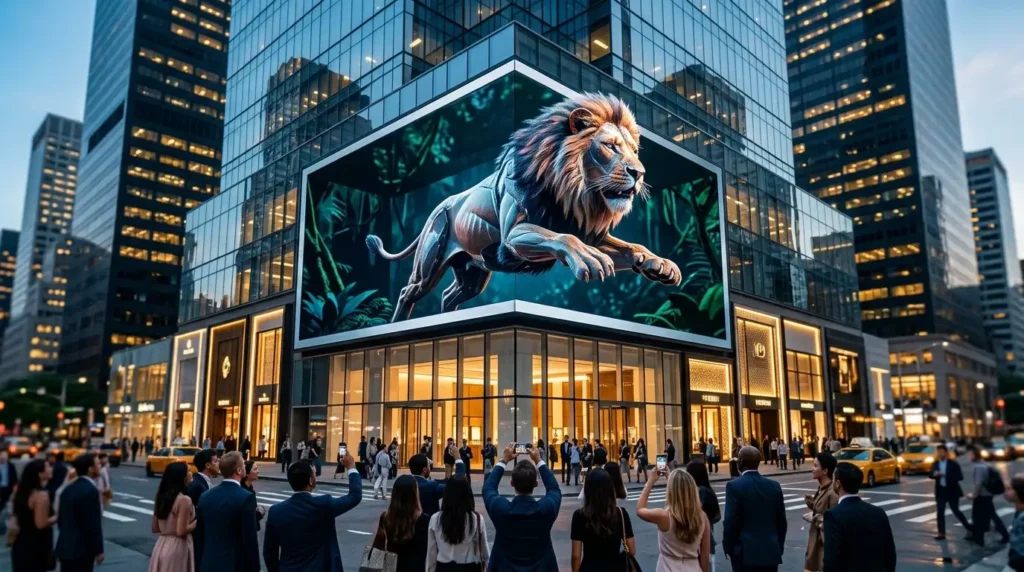
L-shaped LED Cabinet Displays create the strongest naked-eye 3D effect of the three mainstream cabinet designs — Curved LED Screens come second, and flat screens a distant third. The reason is physical, not technical: anamorphic 3D content needs a hard architectural edge to build depth against, and only a true 90-degree corner gives the brain the two intersecting planes it reads as a single three-dimensional volume. As the naked-eye 3D LED display category moves from novelty to standard DOOH inventory, the cabinet decision has become the first specification buyers need to get right. This article compares the three geometries on effect strength, engineering cost, and best-fit building types, then closes with a verification checklist for procurement teams.
Key Takeaways
- L-shaped cabinets with a true 90-degree corner produce the strongest naked-eye 3D effect, because anamorphic content maps depth onto a physical corner edge.
- Curved cabinets deliver a softer, continuous wraparound illusion, but the bend radius must be fixed at the design stage and content re-rendered for that exact geometry.
- Flat screens can only run “3D-style” video; without a corner, depth depends entirely on content perspective, so the effect reads weakest.
- Cabinet flatness and corner splicing tolerance decide whether the illusion holds — a visible seam at the corner breaks the 3D read.
- Budget for structure and content alongside hardware: asymmetric wind loads on an L-shape need an engineered frame, and 3D content production must run in parallel with manufacturing.
What Do L-Shaped, Curved, and Flat LED Cabinets Actually Mean?
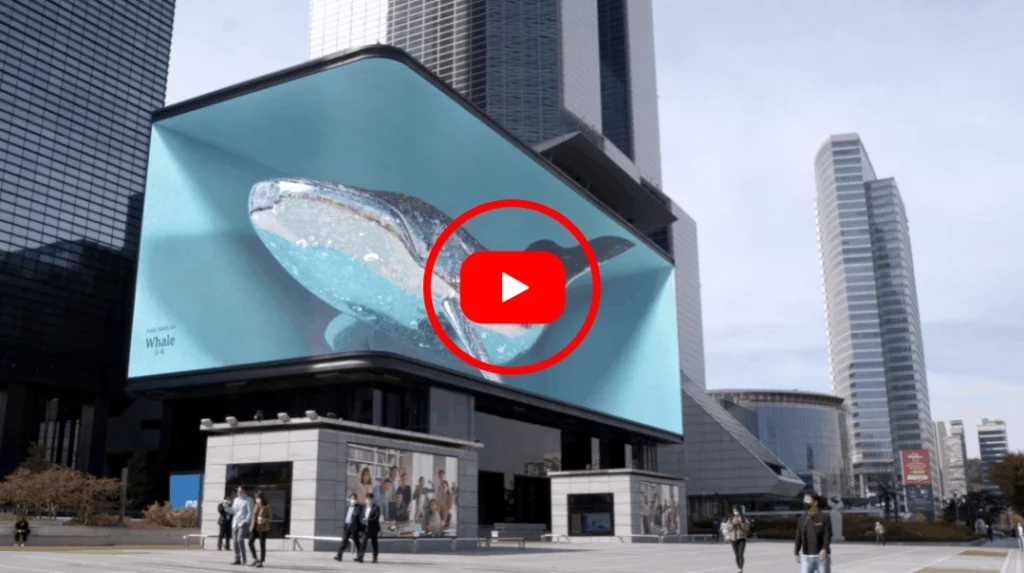
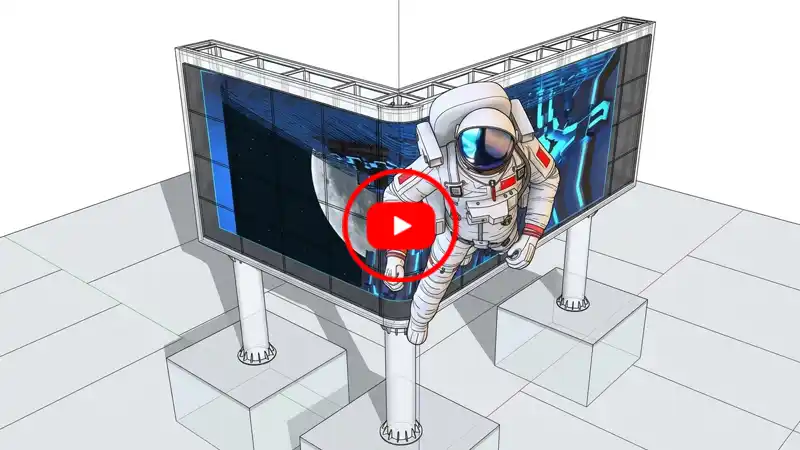
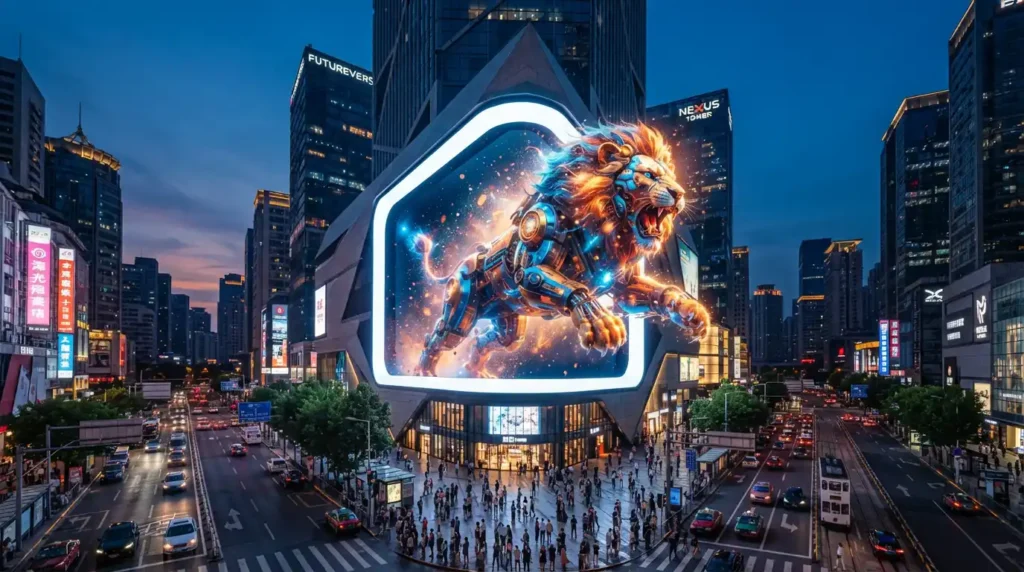
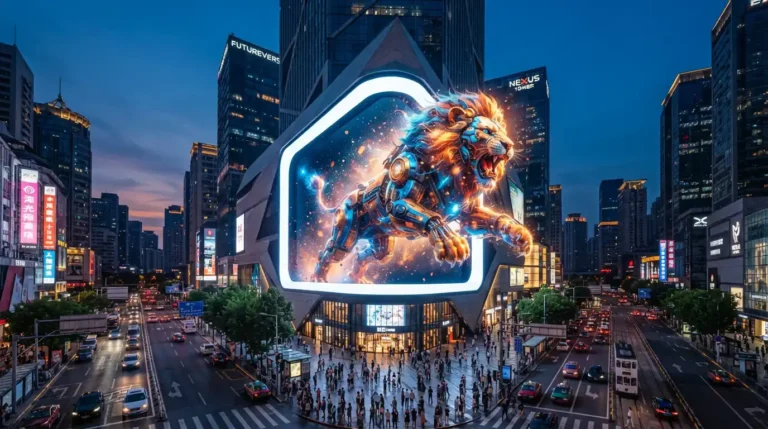
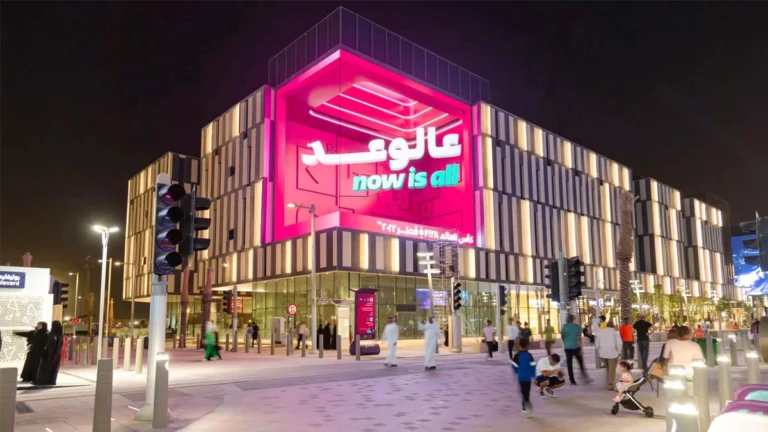
L-shaped (corner) LED Cabinet Screens are two display planes joined at a corner, usually 90 degrees, sometimes 120 degrees on an angled building edge. The joint is made either with dedicated right-angle corner cabinets or with standard cabinets plus a corner module that closes the seam. The most famous outdoor 3D billboards in Seoul, Chengdu, Tokyo, and Shenzhen use this configuration.
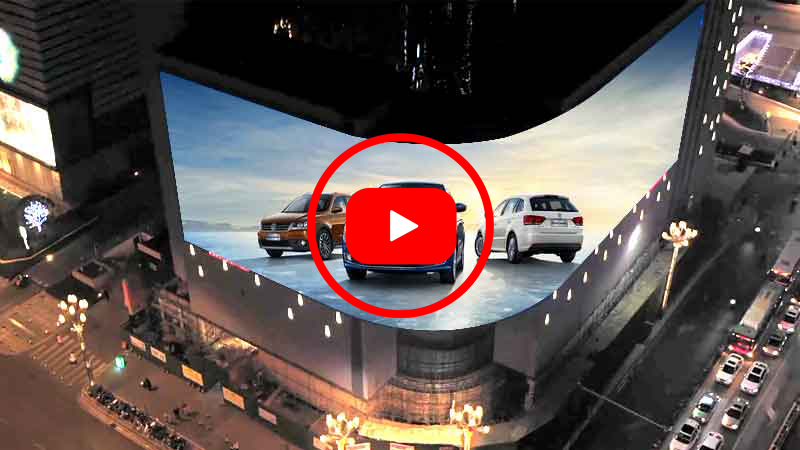
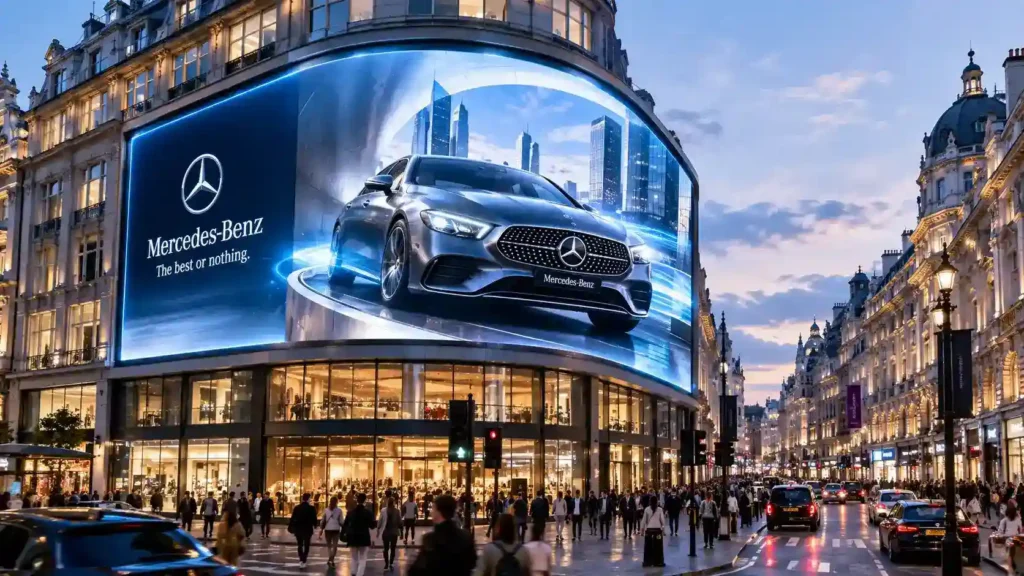
Curved LED Cabinet Displays form a continuous arc. This is achieved with adjustable cabinet locks that allow a few degrees of angle between panels (concave or convex), or with flexible rubber modules for tight radii. Common in retail interiors, lobbies, auto showrooms, and stadium ribbons.
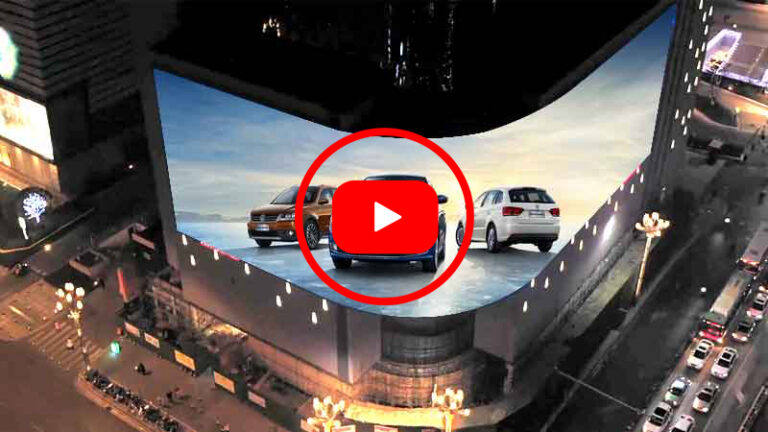
A curved LED display uses a continuous radius rather than a sharp 90-degree corner.
Curved screens are useful when the architectural objective is to wrap content around a building, column, showroom, stage, or other structure. They can produce strong depth cues and immersive visual movement.
However, a curved surface does not automatically create a stronger anamorphic effect. The content has to be mapped to the actual curvature
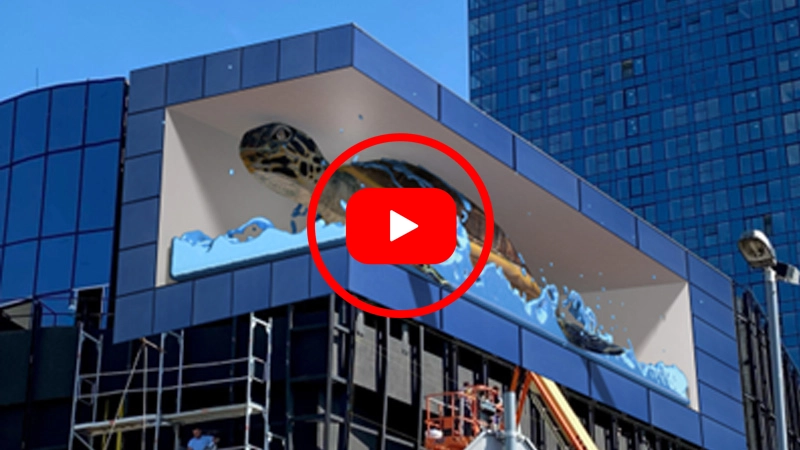
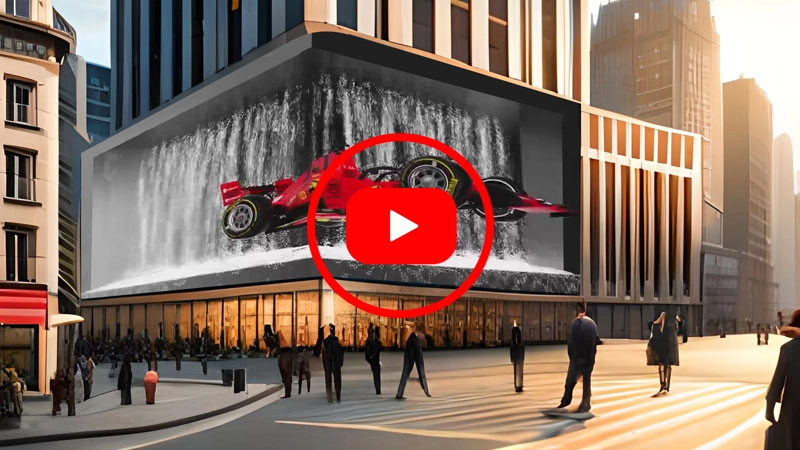
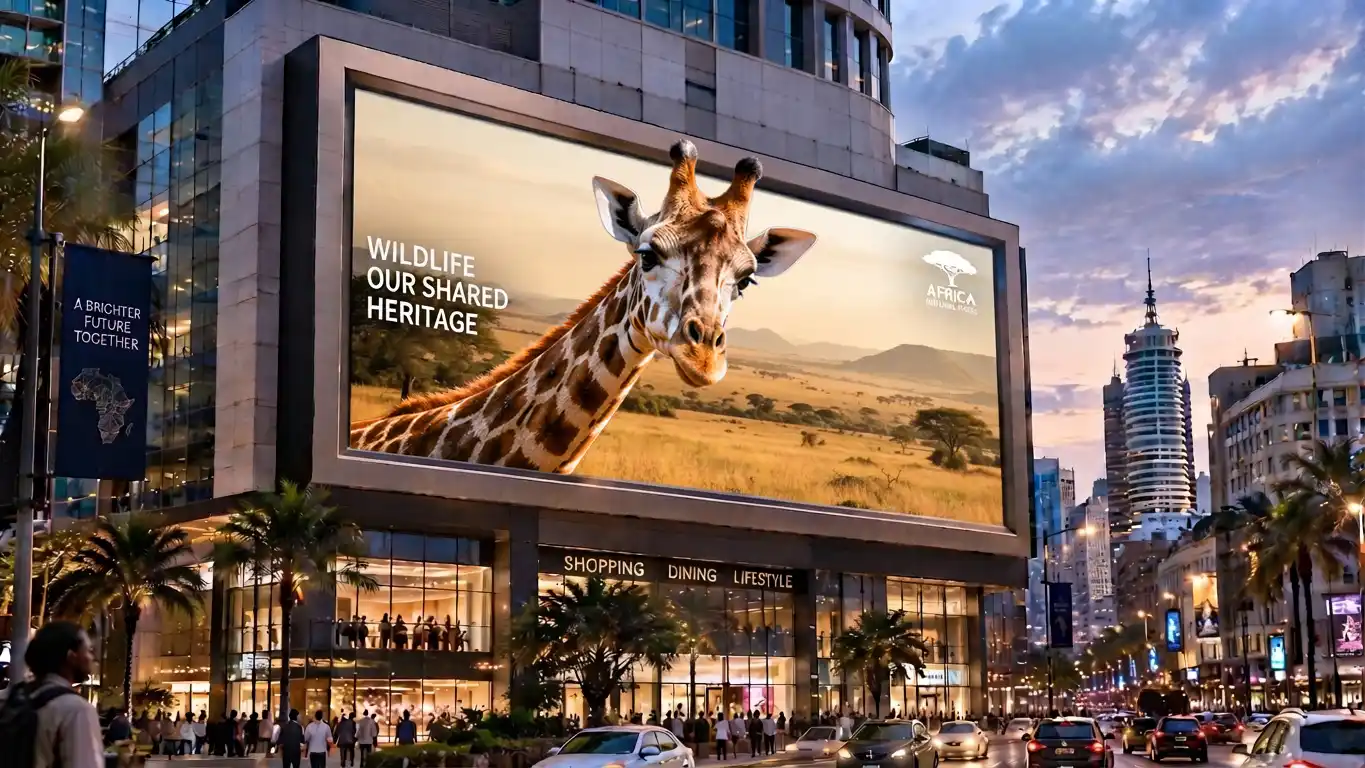
Flat LED Cabinet Screens are the standard rectangular configuration used for most billboards and fixed indoor walls.
A flat LED display provides a single viewing plane.
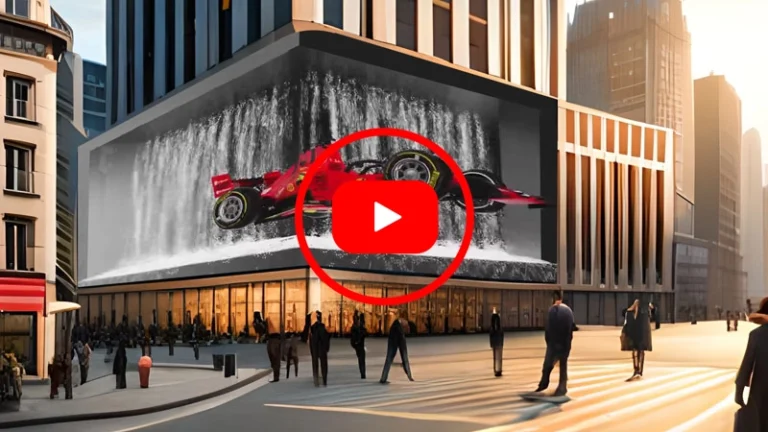
It can still show sophisticated perspective-based 3D video, but the physical screen does not provide the corner transition that helps create the classic “object coming out of the screen” effect associated with L-shaped 3D billboards.
For standard advertising, information display, sports, retail, and many indoor applications, flat LED remains the simplest and most flexible configuration.
One clarification that saves a lot of confusion in RFQs: naked-eye 3D is not a panel type you buy. It is the combination of three layers — the LED hardware, the installation geometry, and the anamorphic content produced for a specific viewing position. A supplier who sells you “a 3D LED screen” without asking about sightlines is selling you hardware only.
Why Does a 90-Degree L-Shaped LED Cabinet Create the Strongest Naked-Eye 3D Effect?
The L-shaped design wins because it gives anamorphic content a physical edge to “break out” of — the two faces of a true 90-degree corner display the front and side of an object at the same time, and the eye interprets both as one volume extending past the building line. A screen without a corner has to fake that volume with perspective alone.
Working with the mechanism in detail (for a fuller technical walkthrough, see Adhaiwell’s guide to how a naked-eye 3D LED screen works):
- Two faces, one object. At a 90-degree corner, one face renders the object’s front view and the other its side view. Viewed from the calibrated position — typically across the street — the brain fuses them into a single 3D form.
- Content must match the corner 1:1. The 3D video is rendered to the screen’s exact dimensions, corner angle, and viewing position. Generic stock anamorphic clips produce a weak effect because they cannot map onto your specific geometry.
- The corner seam is the failure point. Any gap or misalignment where the two faces meet shows up as a visual seam that collapses the illusion, which is why cabinet flatness and splicing tolerance matter more here than on any flat install.
- Size thresholds are physical. Below roughly 4 m × 3 m per face (about 8 m across the L-shape), there is not enough space for forced perspective to compress, and depth reads shallow. Landmark-scale installations start at 10 m × 10 m per face.
- The effect lives in one viewing zone. Parallax is fixed, not tracked. Content is calibrated to a dominant vantage point, and the comfortable viewing distance sits at roughly 1.5–3× screen height.
How Do Curved LED Cabinets Perform — and When Does the Wraparound Design Win?
Curved LED cabinets produce a moderate 3D effect — a continuous, wraparound sense of depth without a hard edge — and they win where the building itself is rounded: cylindrical towers, atrium columns, and rounded retail facades. They trade the sharp corner illusion for a smoother immersion that suits architectural geometry a flat or angled cabinet cannot follow.
- Depth without a seam. A gentle curve wraps the image around the viewer’s field of view, creating continuous parallax across the surface rather than a single explosive corner moment.
- The radius is a content constraint. The bend radius must be fixed at the design stage, because content rendered for one radius distorts on another. There is no “adjust later” — the curve, the content, and the viewing positions are locked together.
- Engineering cost runs higher. Custom bending, flexible modules, and more complex splicing push curved projects above equivalent L-shaped builds on both cabinet cost and production time.
- Modular hardware helps. Systems such as the Adhaiwell R3 Series rental LED display use half-arc locks that adjust between -5° and +5° per joint, so concave, convex, and cylindrical walls can be configured without fully custom tooling — useful for staged events and temporary 3D installations.
Can a Flat LED Screen Ever Deliver a Convincing 3D Effect?
A flat LED screen cannot deliver true corner depth — it is the weakest of the three designs, because all depth cues have to come from content perspective with no physical edge supporting them. Flat installs can still run carefully angled “3D-style” video, but the effect reads as a visual trick rather than a structural illusion.
- Perspective does all the work. On a flat surface, anamorphic-style content relies on line convergence and scale exaggeration alone; move off the calibrated axis and the illusion fades faster than on a corner screen.
- It is a budget decision, not a 3D decision. Flat cabinets use standard billboard structures and carry the lowest engineering cost, which is exactly why they appear on walls without corners and on tight budgets.
- Where flat still makes sense. Walls without corners, ceiling-hung indoor screens, and media facades where the building geometry cannot accept an L-shape are legitimate flat applications — for advertising impact rather than viral 3D moments.
Which Cabinet Geometry Fits Your Building — and What Does Each Cost to Engineer?
Match the geometry to the building first: corner buildings and landmark billboards suit L-shaped cabinets, rounded architecture suits curved cabinets, and plain walls get flat screens. Engineering cost follows the same order — flat is lowest, L-shaped is moderate, and curved is highest.
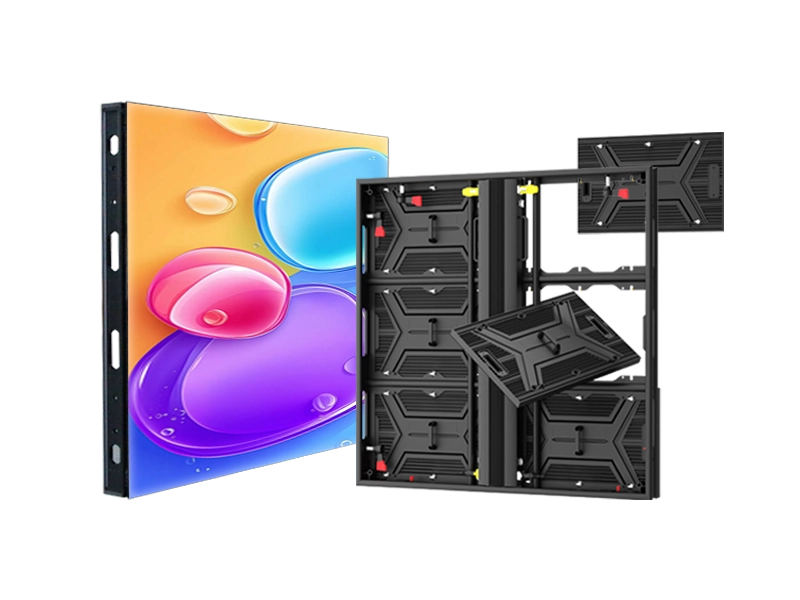
- L-shaped — moderate cost, structural review required. The asymmetric wind load on an L-shaped facade needs an engineered steel frame; reputable suppliers provide free custom steel-structure CAD drawings before fabrication.
- Curved — highest cost. Custom bending, flexible modules, and complex splicing add cost at both the cabinet and installation stages.
- Flat — lowest cost. Standard billboard structure, no special engineering beyond normal wind and mounting loads.
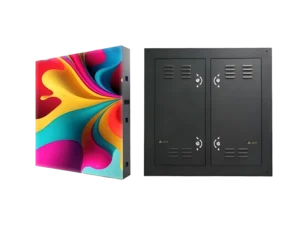
- Corner flatness decides the illusion. Precision die-cast aluminum outdoor LED display cabinets are produced in molds with tolerances under ±0.1 mm and weigh 30–40% less than steel, which keeps large corner walls aligned and reduces structural load — a real advantage where accumulated error across dozens of cabinets would show as visible steps at the corner.
- Spec the optics to the viewing distance. For outdoor 3D work: P3.91 suits 10–15 m viewing, P4.81 for 15–25 m, P6.25 for 25–40 m, and P8–P10 beyond 40 m. Brightness should sit at 5,500–8,000 nits outdoors with automatic dimming, and the refresh rate should be 3,840 Hz minimum so phone cameras record the screen without scan lines.
What Should Buyers Verify Before Ordering a 3D LED Cabinet?
Verify the corner, the content pipeline, and the structure before the price — the most common failure point in 3D LED projects is not the screen hardware but treating structure, hardware, and content as three separate purchases.
- Corner splicing tolerance. Ask how the two faces meet and what the seam tolerance is; demand factory photos or a sample corner, because any visible gap breaks the illusion.
- Content produced for your geometry. Confirm the supplier or their content partner renders the 3D video to your exact dimensions, corner angle, and dominant viewing position — not a generic asset.
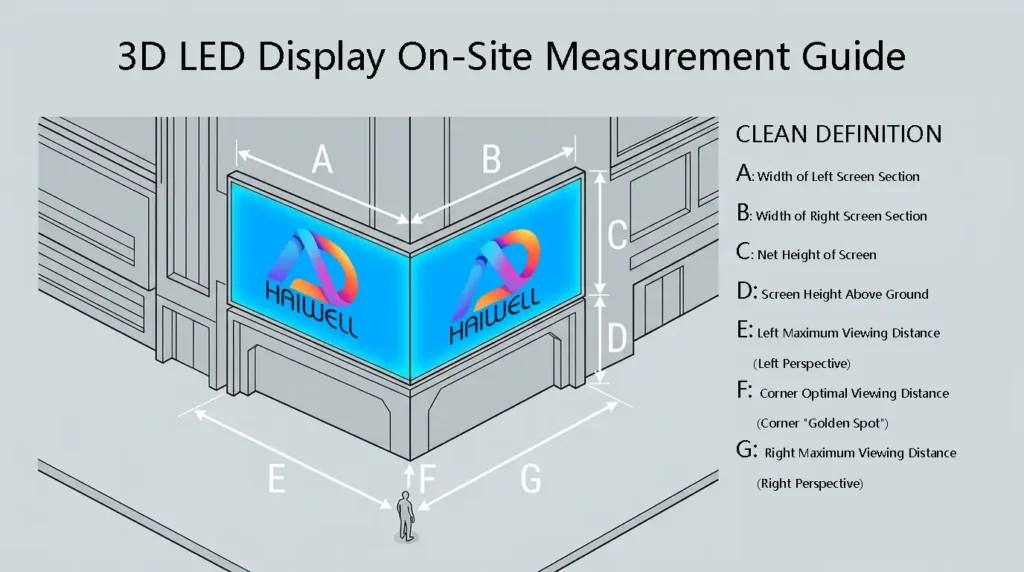
- Viewing-zone survey. Provide site photos, video, screen size, building structure, and viewing distance before quoting; the effect must be calibrated to where people actually stand.
- Brightness and refresh for the site. 5,500–8,000 nits outdoors, 3,840 Hz refresh minimum, IP65 sealing front and rear, and an operating range that covers your climate (Adhaiwell’s outdoor cabinets are rated -20°C to +65°C).
- One accountable supplier. The strongest supplier position is a manufacturer that handles cabinet engineering, steel-structure design, control-system commissioning, and content-effect guidance under one project plan — evaluate on engineering depth and reference installations, not unit price. Production on this model runs 25–35 working days with a 72-hour burn-in test before shipment, plus 15–35 days of ocean freight.
What is the practical difference between L-shaped, curved and flat LED 3D?
The practical difference is where the depth comes from: physical screen geometry, curved geometry, or visual content.
| LED Configuration | Main Source of 3D Effect | Typical Strength | Main Consideration |
|---|---|---|---|
| L-shaped LED | Physical 90° corner + anamorphic content | Strong physical depth reference | More structural and content-mapping requirements |
| Curved LED | Curved physical surface + perspective content | Smooth architectural depth | Curve radius and content mapping are critical |
| Flat LED | Anamorphic content + forced perspective + visual frame | Flexible and easier to integrate into conventional facades | Effect depends heavily on viewing position and content quality |
There is no single screen shape that fits every project.
An L-shaped display can provide a stronger physical depth cue, but it may not be practical for a building with a flat facade. A curved screen can follow architecture beautifully, but the curve adds its own structural and content requirements. A flat screen can deliver a strong visual illusion with the right 3D video while keeping the physical installation straightforward.
For many commercial projects, the best solution is the one that produces the required visual effect without adding unnecessary structural complexity.
Where Is the Market for 3D LED Cabinets Headed?
The market is scaling steadily, and outdoor corner installations are driving it. PW Consulting estimates the worldwide naked-eye 3D LED display market at US4.45 billion in 2025, rising to US11.14 billion by 2032 — a 14.0% CAGR — with outdoor LED displays accounting for 70.2% of the 2025 installed base and commercial advertising 55.3% (third-party estimate; the figure comes from a commercial research report whose methodology is not published, so treat it as directional context rather than a forecast for any single screen). The broader DOOH backdrop supports the shift: the World Out of Home Organization (WOO) puts global digital out-of-home revenue at US25.5 billion in 2025, rising to about US28 billion in 2026.
The reference deployments also explain why corner geometry keeps winning. Seoul’s COEX K-pop Square — the screen that restarted the category with d’strict’s “WAVE” in April 2020 — measures roughly 80.8 m × 20.1 m, about 1,600 m² of 8K LED assembled from more than 31,000 panels (figures per d’strict and CNN coverage, 2020). At the emerging-market end, Adhaiwell delivered an outdoor L-shaped 3D billboard in Mozambique using an 8 mm pixel pitch across roughly 78 m², 8,000-nit brightness, 3,840 Hz refresh, and IP65 die-cast aluminum cabinets specified for coastal salt-fog conditions (operator-reported, not independently audited). A 3D installation at a major Kuala Lumpur intersection is reported to pass roughly 500,000 pedestrians per day (operator-reported). More deployment geography and site-selection logic is covered in Adhaiwell’s analysis of where naked-eye 3D LED displays are deployed.
FAQ: Frequently Asked Questions About 3D LED Cabinet Design
As a Shenzhen-based LED display manufacturer with more than 16 years of production experience and 3D LED projects delivered across Africa, the Caribbean, and Asia, Adhaiwell answers the cabinet-design questions buyers ask most often before specifying a naked-eye 3D screen.
Do all naked-eye 3D LED screens need a 90-degree corner? No, but the 90-degree corner is the standard and most economical geometry because nearly all anamorphic content libraries are authored for it. Curved screens also work when you re-render content for the exact radius. A flat screen can play 3D-style video, yet it cannot produce true corner depth.
How large does an L-shaped 3D screen need to be? Plan on roughly 4 m × 3 m per face — about 8 m across the L-shape — as the minimum for the perspective to read as depth. Landmark installations that generate social-media reach start at 10 m × 10 m per face. Below the minimum, forced perspective has too little physical space to compress.
Why does curved 3D content cost more to produce? Because the video must be rendered to the screen’s specific bend radius and viewing positions, and content made for one radius distorts on another. The radius is locked at the design stage, so curved projects carry both higher hardware and higher content costs than equivalent L-shaped builds.
What pixel pitch should a 3D LED cabinet use? Match pitch to the dominant viewing distance: P3.91 for 10–15 m, P4.81 for 15–25 m, P6.25 for 25–40 m, and P8–P10 beyond 40 m. Brightness should reach 5,500–8,000 nits outdoors, with a 3,840 Hz minimum refresh rate so smartphone footage stays clean.
How long does a 3D LED cabinet project take? Expect 25–35 working days of production, including a 72-hour burn-in test before shipment, plus 15–35 days of ocean freight. The 3D content is produced in parallel with manufacturing, so lock the screen geometry and viewing zone early to avoid re-rendering delays.
Choosing Between L-Shaped, Curved, and Flat: The Procurement Bottom Line
L-shaped cabinets are the default for buyers who want the strongest 3D effect and have a corner building; curved cabinets are the right answer when the architecture is rounded and the budget absorbs custom engineering; flat cabinets are an advertising investment, not a 3D one. Before requesting quotes, prepare site photos and video, target screen size, building structure, viewing distance, and your city and country — then evaluate suppliers on corner-splicing tolerance, content-rendering capability, and steel-structure design under one accountable project plan. That checklist, more than any single spec sheet, is what separates installations that hold the illusion for years from screens that quietly become ordinary billboards.
At Adhaiwell, we build custom L-shaped, curved and flat LED cabinets for outdoor advertising, retail and integration projects, and we run site simulation before the structure is fabricated. If you send a photo of your site and the audience standing position, we can tell you honestly whether a corner screen is worth the premium.
Why can Adhaiwell provide practical guidance on 3D LED display selection?
Adhaiwell’s experience combines LED display manufacturing, outdoor engineering and real-world 3D LED projects rather than treating 3D as a content-only product.
That experience is useful because 3D LED procurement is not only about choosing a screen. The final result depends on the relationship between cabinet geometry, structural design, viewing position, display specifications, content production, installation and long-term maintenance.
For a new project, start with the site rather than the product catalog. Once the viewing geometry and installation conditions are clear, the appropriate LED cabinet configuration becomes much easier to define.