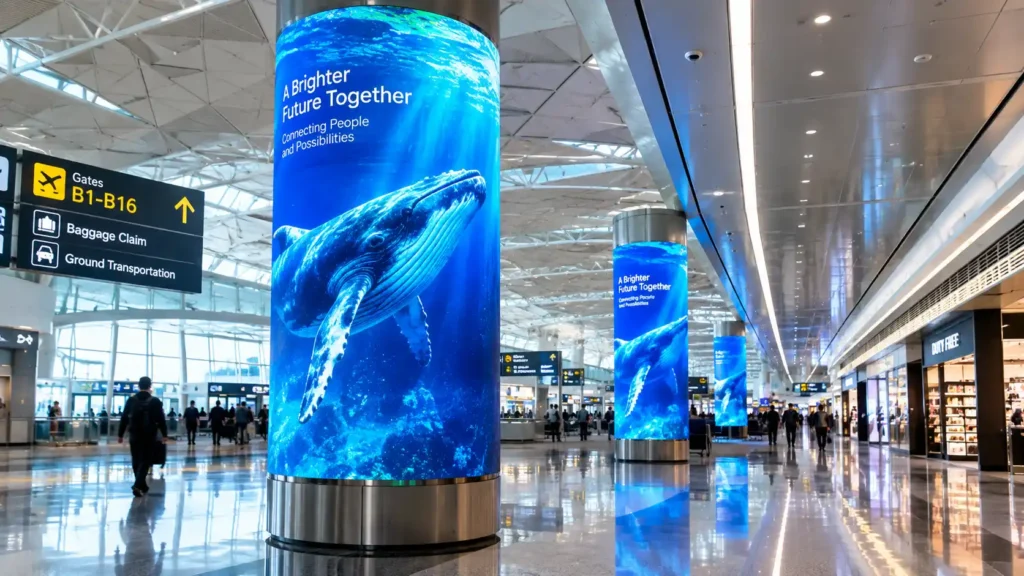
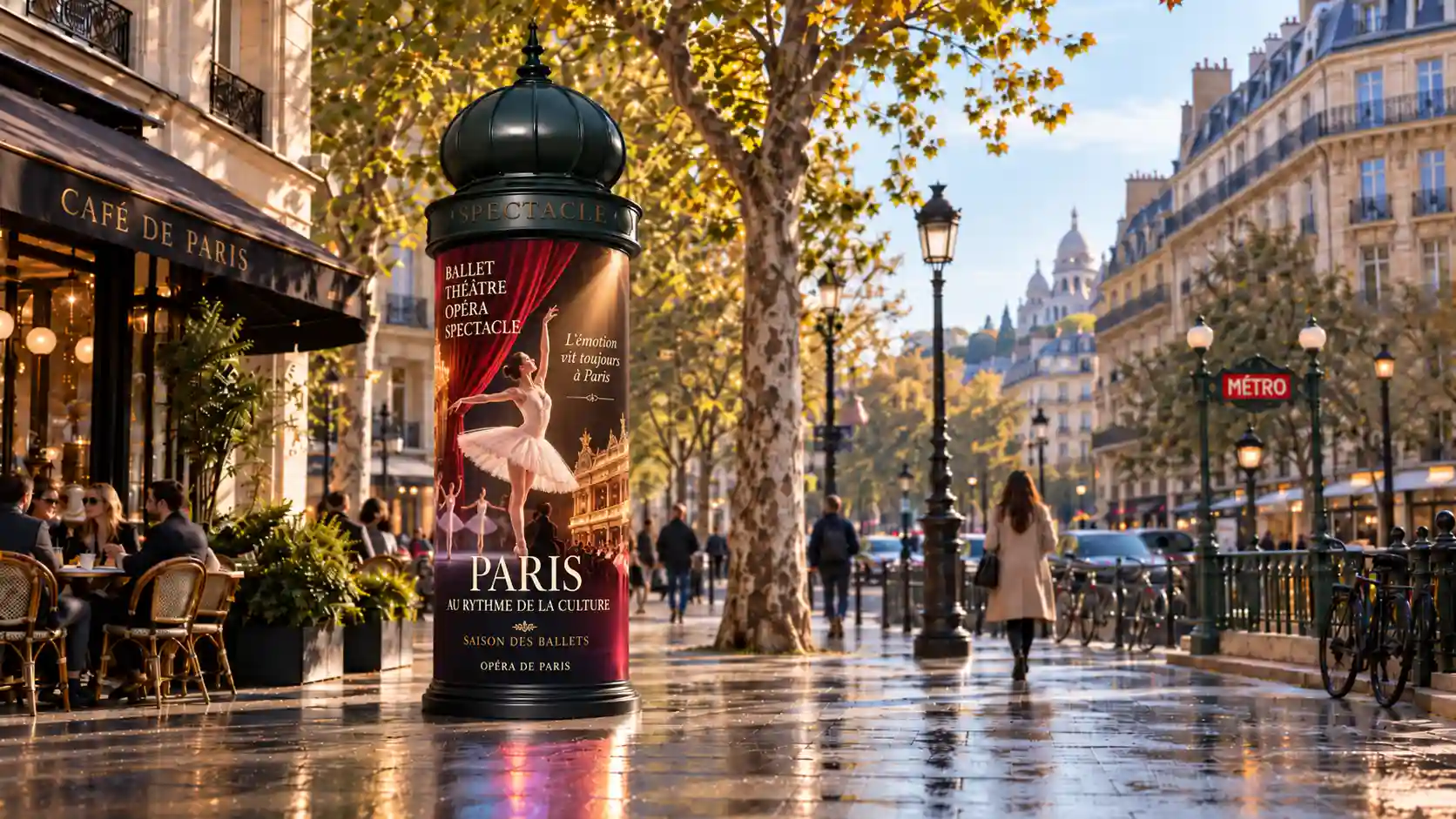
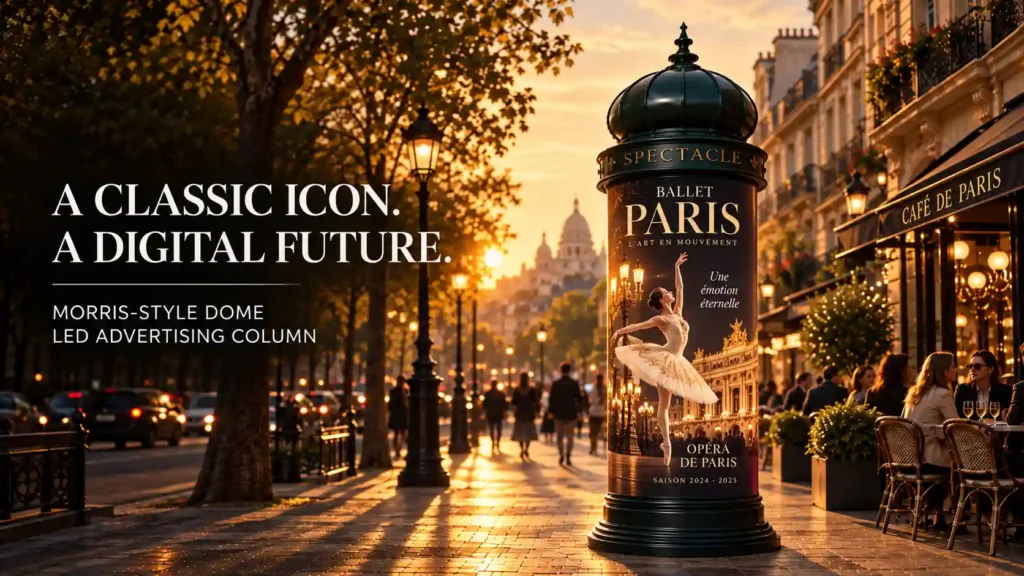
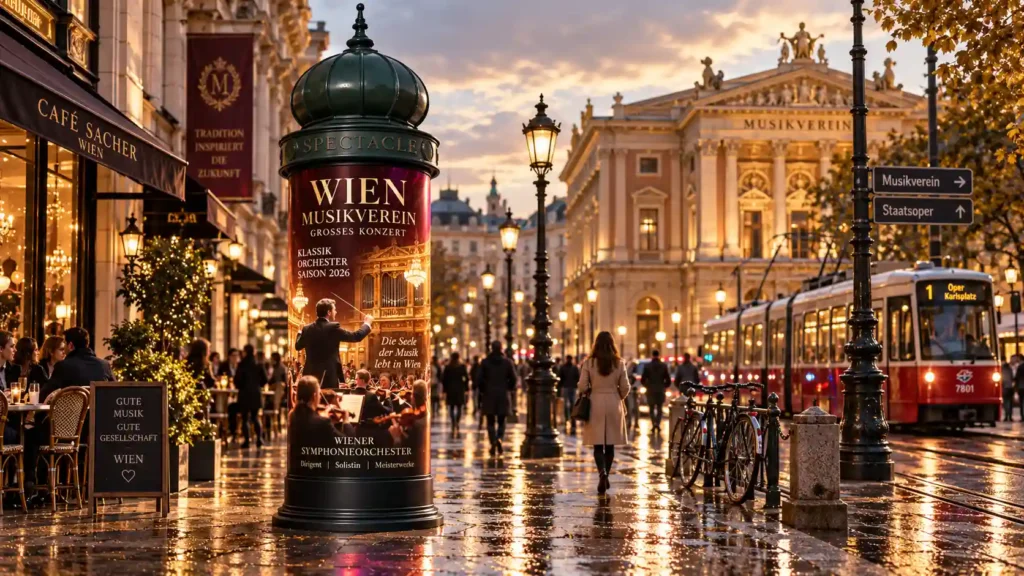
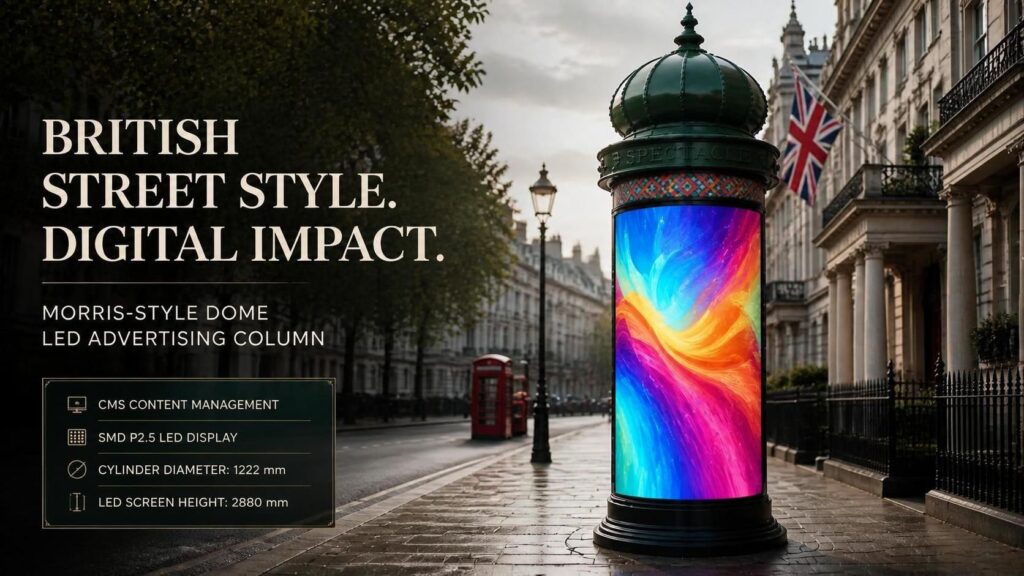
A Digital Morris Column LED Display is a cylindrical outdoor LED advertising column that replaces the printed posters of the classic European street column with a wrap-around LED screen made from flexible modules. The concept under development by Adhaiwell keeps the dome-topped column silhouette that pedestrians have recognised for more than a century, and converts its advertising surface into a digital, remotely managed one.
This article introduces the design concept, its stated dimensions, how content works on a cylindrical screen, and the points a project buyer should confirm before requesting a quotation.
Key Takeaways
- A Digital Morris Column LED Display adapts a familiar piece of European street furniture to digital out-of-home use by wrapping flexible LED modules around a cylindrical surface.
- The concept shown here: 4,780 mm overall height, 2,880 mm LED display height, P2.5 pitch, 12 × 18 module layout, 1,536 × 1,152 px resolution.
- Content must be designed for a cylinder, not a flat rectangle: mapping, seam alignment, and safe areas decide whether the screen looks continuous.
- Before requesting a quotation, buyers should confirm site conditions, structure, power, CMS requirements, permits, and the final engineering specification.
Why Is Adhaiwell Exploring a Digital Version of the Classic Morris Column?
The answer is that the Morris column is one of the few street furniture forms whose entire purpose is advertising, which makes it a natural candidate for digitisation as out-of-home media moves to screens.
Retaining a Recognisable Street Furniture Design
The traditional advertising column has been part of European street scenery since the mid-nineteenth century, when column-style poster structures first appeared in Paris and Berlin. Cities kept them because they are compact, pedestrian-scale, and visually distinct — a vertical object that signals “advertising here” without dominating the street.
The new concept takes inspiration from that column form. It is not an officially approved replacement for any existing municipal advertising system; approval depends on the local authority and the project’s permits.
Moving from Printed Posters to Digital Content
The progression from static paper posters to backlit poster cases, and now to cylindrical LED screens, mirrors the wider shift in outdoor advertising. The World Out of Home Organization estimates global digital out-of-home revenue at US$25.5 billion in 2025, rising to US$28 billion in 2026 — third-party estimate, based on industry-reported DOOH figures whose methodologies differ, so treat it as directional context. As more of that spend moves onto screens, column-shaped formats become part of the digital street furniture mix.
A cylindrical LED surface can carry:
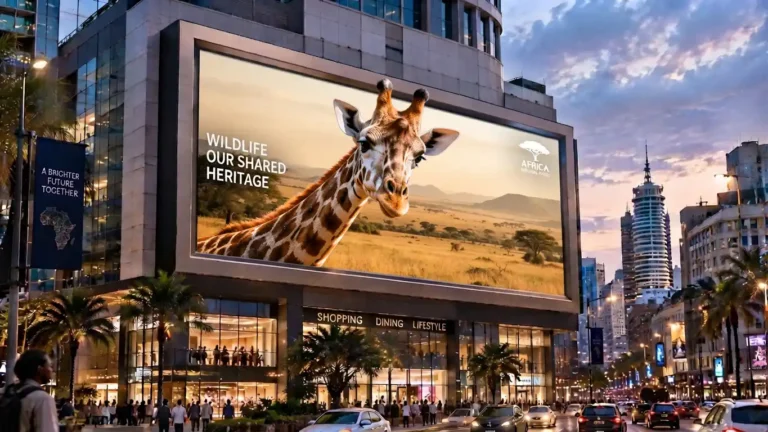
- Video and animated graphics for brand campaigns at street level.
- Scheduled campaign updates changed from a central content system instead of a print run.
- Event and cultural messaging rotated by time of day or day of week.
Two prerequisites apply. Remote publishing needs compatible playback hardware, network connectivity, and content management software — the screen is only the display end of that chain. And each installation remains subject to local advertising and planning rules.
What Are the Key Dimensions and LED Specifications of the Proposed Design?
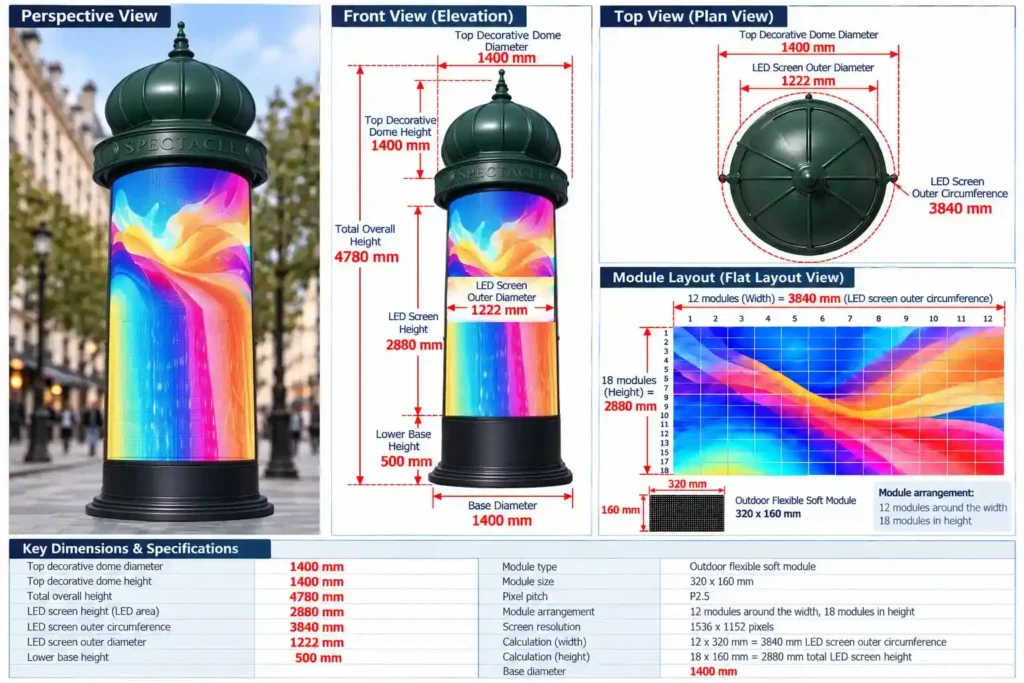
The stated design values are as follows. All figures are taken from the supplied design drawing and must be confirmed against the final engineering specification before ordering.
| Specification | Stated design value |
|---|---|
| Total overall height | 4,780 mm |
| Decorative top dome diameter | 1,400 mm |
| Decorative top dome height | 1,400 mm |
| LED display height | 2,880 mm |
| LED screen outer diameter | 1,222 mm |
| LED screen outer circumference | 3,840 mm |
| Module size | 320 × 160 mm (outdoor flexible soft module) |
| Module arrangement | 12 around the circumference × 18 in height |
| Nominal pixel pitch | P2.5 |
| Stated screen resolution | 1,536 × 1,152 pixels |
The arithmetic behind the layout is straightforward: 12 modules × 320 mm = 3,840 mm of screen circumference, and 18 modules × 160 mm = 2,880 mm of screen height. The P2.5 pitch yields the stated 1,536 × 1,152 px resolution across the developed surface.
How Does the Cylindrical Screen Layout Work?
A cylindrical LED screen uses flexible LED modules that bend around a structural cylinder. The 320 × 160 mm soft modules in this design follow the curve because their PCB and mask are flexible, while the supporting steel structure stays rigid.
Three things decide whether the result looks like one continuous image:
- Screen mapping. The controller must know the exact pixel geometry of the 12 × 18 module grid so content plays in the right position around the cylinder.
- Module alignment. Seams between modules must stay even; an offset module shows as a visible discontinuity in horizontal lines.
- Content safe areas. Designers should keep critical text and logos away from module seams and the top and bottom rows.
Buyers should also note that the developed circumference (3,840 mm) is not the same as the viewing width of a flat rectangular screen. A pedestrian sees roughly half the cylinder at a time, so the effective readable band is narrower than the full 3,840 mm — content must be composed for the curve.
What Should Buyers Confirm About Image Quality?
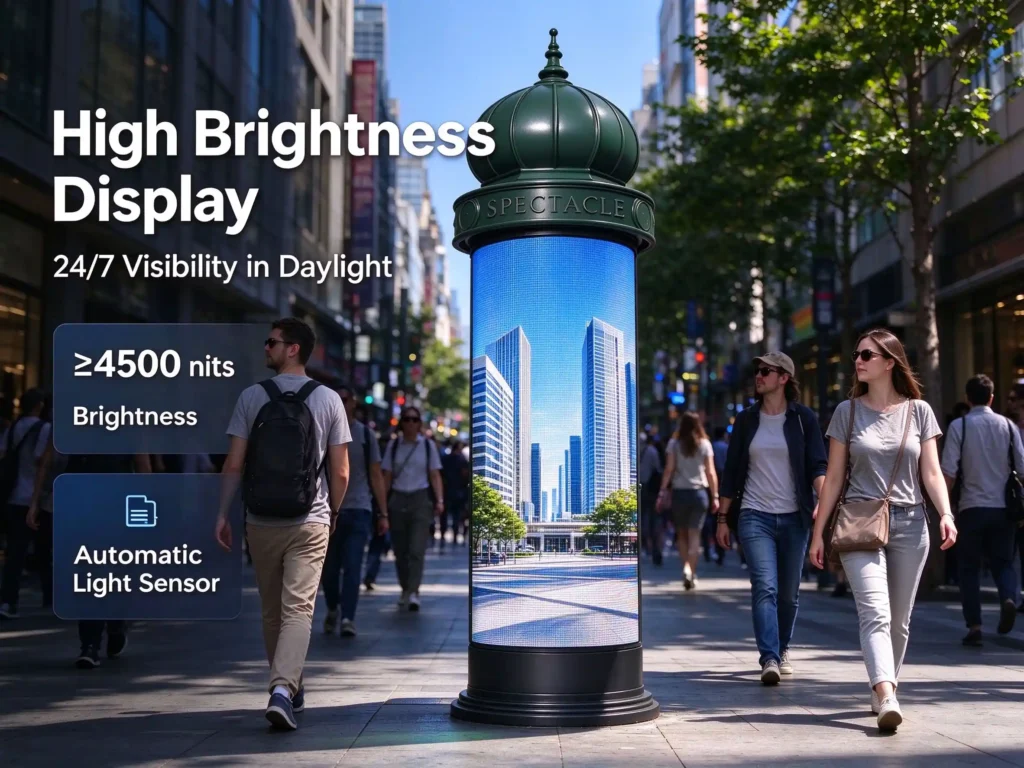
Buyers should confirm viewing distance, brightness, refresh rate, colour performance, outdoor readability, and the actual operating environment before fixing the specification, because none of these values are universal.
- Viewing distance. A P2.5 pitch is aimed at close viewing; the general rule of thumb is that pixel pitch in millimetres approximates the minimum comfortable viewing distance in metres, so P2.5 suits viewers a few metres away.
- Brightness and readability. Outdoor daylight readability and night-time dimming compliance need to be verified for the specific site, not assumed.
- Refresh rate and colour. Higher refresh rates matter for on-screen filming and broadcast; colour calibration should be checked across the cylindrical surface.
- Environment. Wind, rain, temperature range, and vandalism exposure differ by city and change the engineering answers.
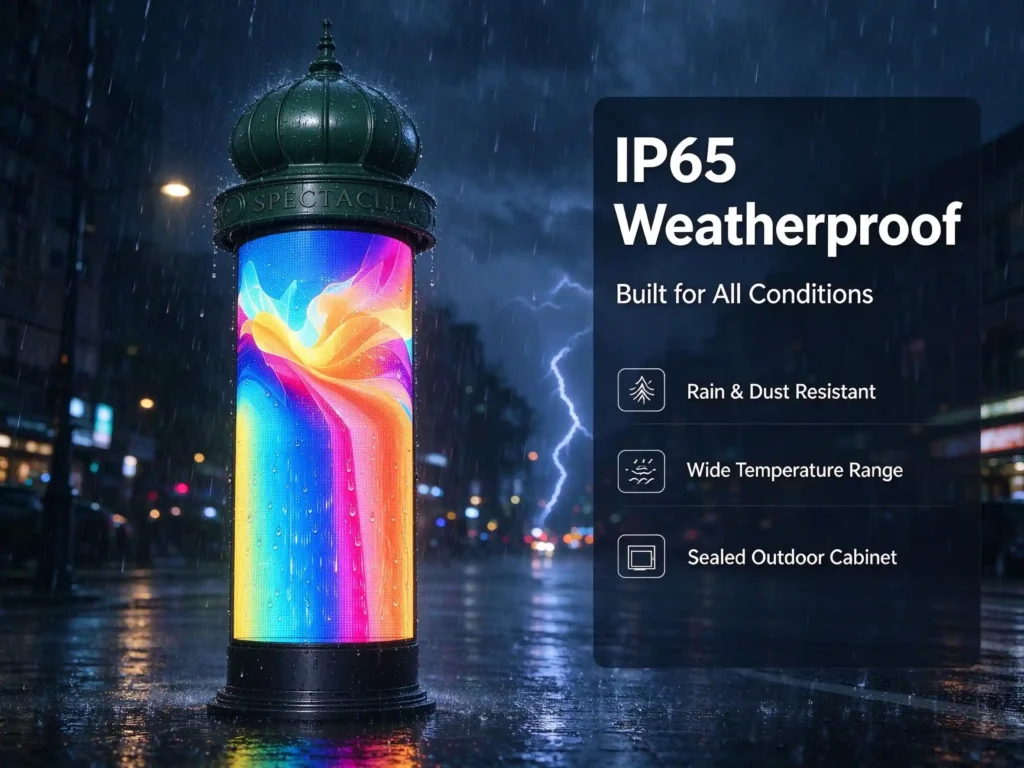
Adhaiwell has not verified specific brightness, refresh-rate, or IP-rating values for this concept in this article; request the final engineering datasheet and test reports for the confirmed figures. For the underlying display vocabulary, the site’s guide to LED display terminology covering pixel pitch and nits explains these terms in detail.
Which Advertising Applications Could Benefit from a Digital Column Design?
Potential applications are pedestrian shopping streets, commercial districts, shopping centres and hotels, and tourism or cultural public spaces — each subject to local advertising and planning rules. These are potential applications, not confirmed customer installations.
Pedestrian Shopping Streets and Commercial Districts
Column displays sit at eye level where foot traffic concentrates, which suits brand campaigns, retail promotions, and seasonal advertising. Because the format is compact, several columns across a district can share one content system and run coordinated campaigns.
Shopping Centres, Hotels, and Commercial Developments
A column-style display can also work as one node in a wider digital signage network — at entrances, plazas, or drop-off areas of commercial developments. Buyers planning multi-site networks can compare how a cylindrical LED column complements other outdoor formats such as the aluminium-profile outdoor LED display range used for larger roadside screens.
Tourism, Cultural Events, and Public Spaces
Event information, cultural promotions, and location-based campaigns fit the format, subject to local advertising and planning rules. Heritage districts often have stricter exterior-equipment rules, so early dialogue with the local authority is part of the project plan, not an afterthought.
What Should Project Buyers Confirm Before Requesting a Quotation?
Buyers should confirm site conditions, display requirements, structure and power, the content management chain, compliance, and commercial terms before asking for a quotation — because a cylindrical column project is a custom-engineered product, not a catalogue item.
- Installation location and environment. Ground conditions, wind loading zone, temperature and rain exposure, and whether the site is pedestrian or vehicle-adjacent.
- Dimensions and display area. Overall height, LED display height, and any site-specific height restrictions.
- Image requirements. Pixel pitch, brightness target, viewing distance, and the type of content to be shown.
- Structure and services. Foundation design, electrical supply, drainage, and maintenance access around the column.
- Content system. Playback hardware, network connectivity (fibre, 4G/5G), CMS compatibility, and remote-management requirements.
- Compliance and support. Local permits, product compliance certificates, warranty terms, and spare-parts availability.
- Commercial scope. Project quantity, delivery destination, and who is responsible for installation and commissioning.
Buyers who want a general framework for evaluating outdoor LED projects can use the site’s six-factor guide to choosing the right outdoor LED display for DOOH advertising, which covers brightness, pixel pitch, weather protection, refresh rate, build quality, and energy efficiency.
How Can Buyers Discuss a Custom Digital Morris Column Project with Adhaiwell?
Buyers should share their project requirements first, because the final configuration and quotation for a custom column depend on the site and the content plan. Adhaiwell works with outdoor advertising operators, street furniture suppliers, and project integrators as a China-based manufacturer, and a column of this type is configured per project — module count, structure, control system, and compliance documents are all specified at quotation stage.
Useful information to include in the first enquiry:
- Target location and intended application.
- Expected quantity and project timeline.
- Technical requirements (dimensions, pixel pitch, brightness, control system).
- Any local compliance or permit constraints already known.
The same engineering discipline applies as for any outdoor LED purchase — ask about cabinet and structure design, weather protection, ageing tests, and after-sales support, and evaluate the supplier on documented specifications and export experience rather than on price alone. For related background, Adhaiwell’s article on cylindrical naked-eye 3D LED screens covers how cylindrical LED geometry is used for anamorphic content, and the site’s guides-how-to section collects the practical outdoor LED guides.
Closing
The Digital Morris Column LED Display concept offers a way to explore digital advertising within a familiar column-style form. Its suitability for a specific project will depend on the final engineering configuration, content management requirements, installation conditions, and local regulations.
For project-specific information, contact Adhaiwell to discuss the required dimensions, LED specifications, control system, and customisation options.
Suggested CTA: Discuss Your Digital Advertising Column Project with Adhaiwell
Frequently Asked Questions About Digital Morris Column LED Displays
These answers come from Adhaiwell’s work as a Shenzhen-based LED display manufacturer with more than 15 years of production experience, supplying outdoor LED formats to project buyers and integrators; figures specific to this concept are drawn from the supplied design drawing.
What is a digital Morris column LED display?
It is an advertising column in the classic European street-furniture form that uses a cylindrical LED screen instead of printed posters. In the design shown here, 216 outdoor flexible LED modules (12 × 18) form a 2,880 mm-high display surface with P2.5 pitch. The column silhouette and dome remain decorative elements around the screen.
How is content displayed on a cylindrical LED screen?
Content is mapped to the exact pixel grid of the cylindrical surface, so the controller plays media correctly around the curve. Designers keep key text and logos away from module seams and compose for the fact that a viewer sees about half the circumference at once. Standard video is adapted, not played unedited.
What pixel pitch suits a street-level advertising column?
Pedestrians read a column from a few metres away, so a fine pitch such as the P2.5 in this design is appropriate. A common rule of thumb equates pixel pitch in millimetres with minimum viewing distance in metres. Confirm the pitch against the site’s closest realistic viewing position.
Does a digital column need planning permission?
In most jurisdictions, yes — outdoor advertising structures typically require local permits, and heritage districts add further restrictions. Rules differ by country and city, so the buyer or the local media operator should confirm requirements with the authority before manufacture. Adhaiwell supplies documentation to support the permit process.
What should be confirmed before requesting a quotation?
Site conditions, overall dimensions and display area, image requirements, foundation and electrical provisions, CMS and network needs, permits and compliance, and commercial scope (quantity, delivery, installation responsibility). Providing these points upfront shortens the quotation cycle considerably.