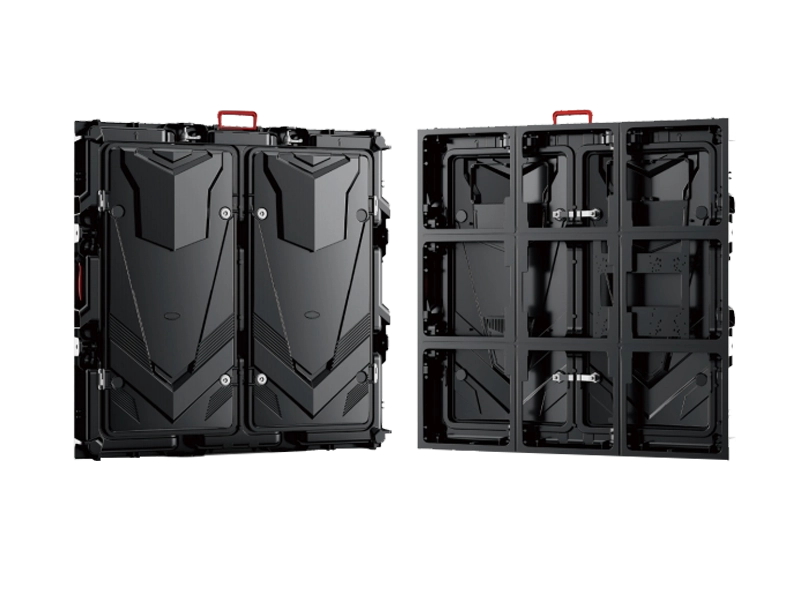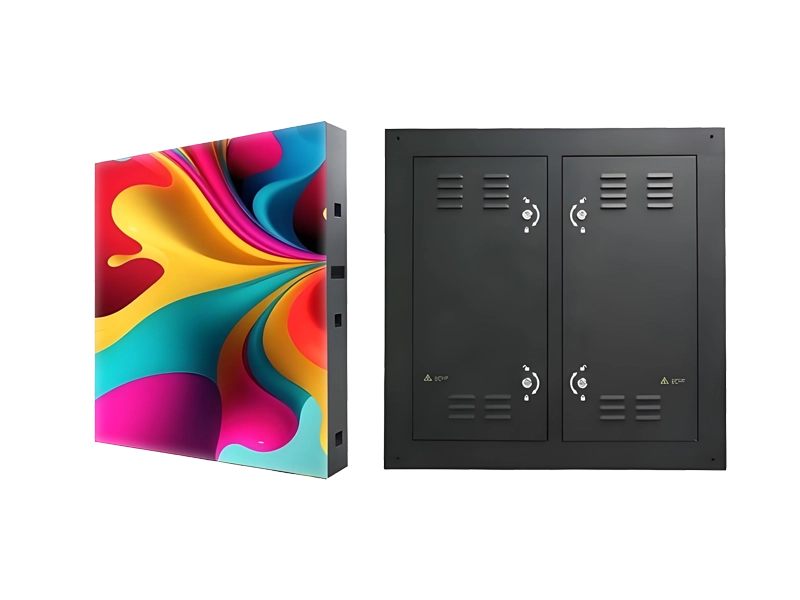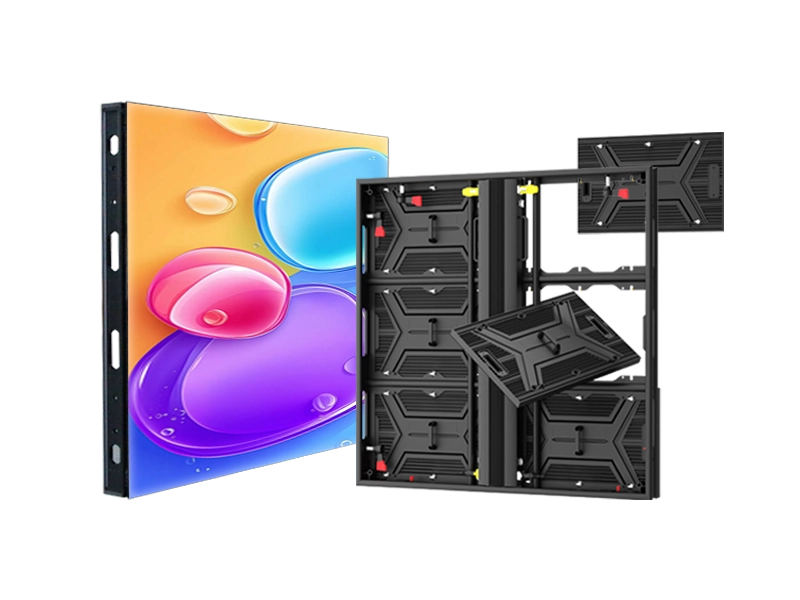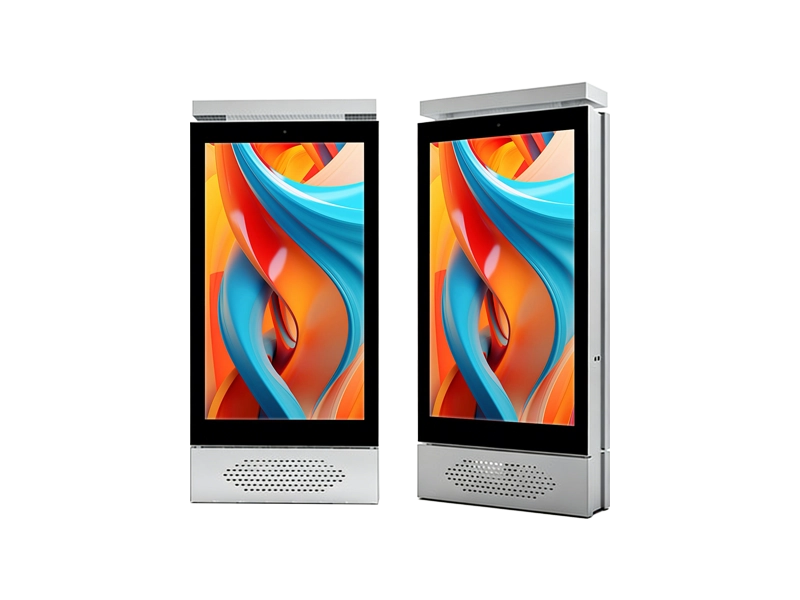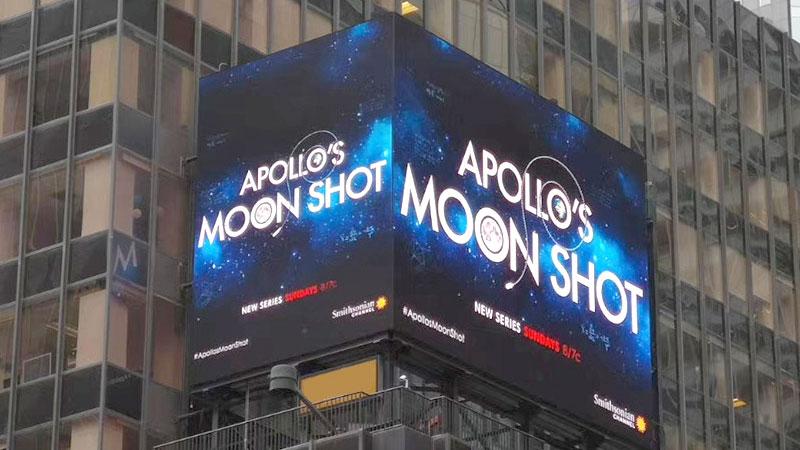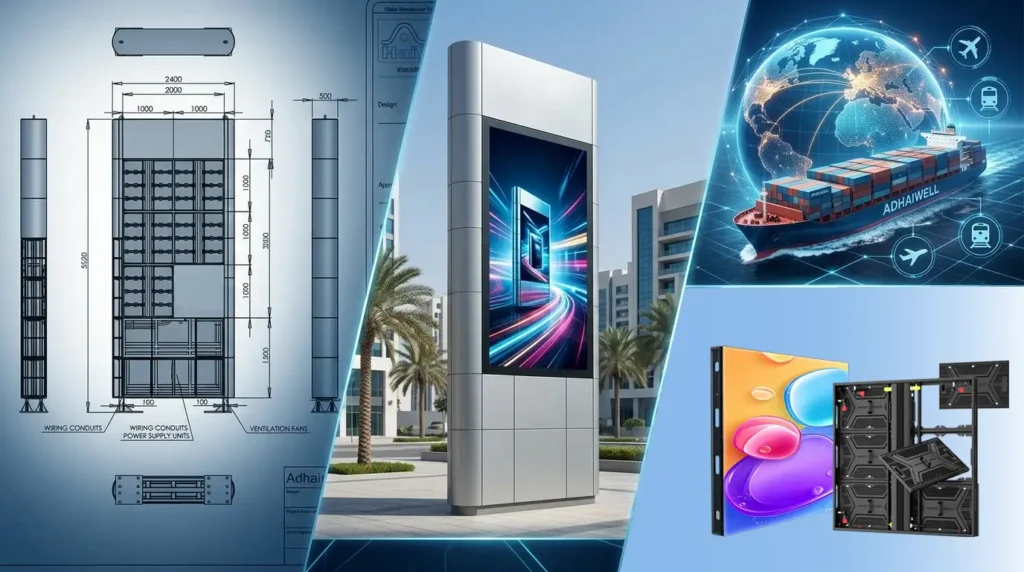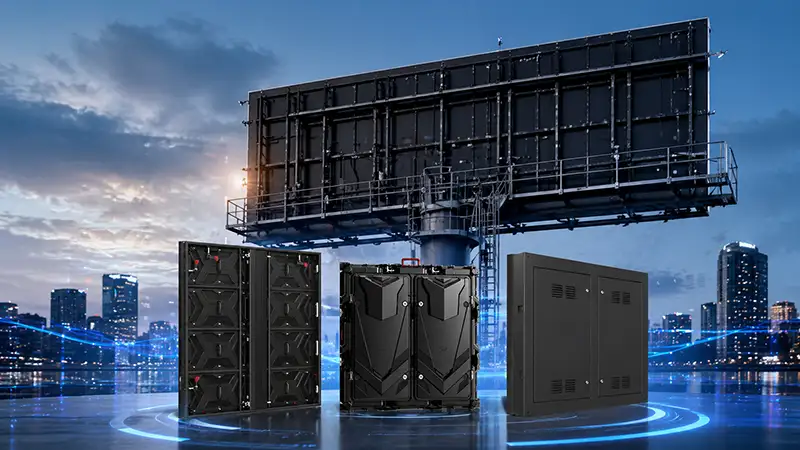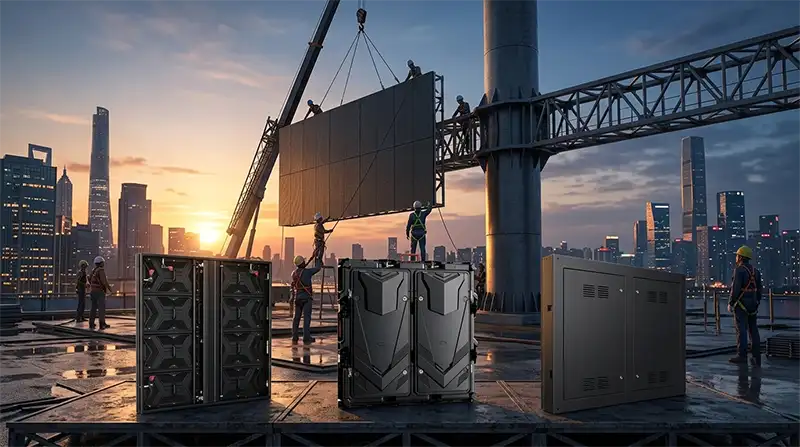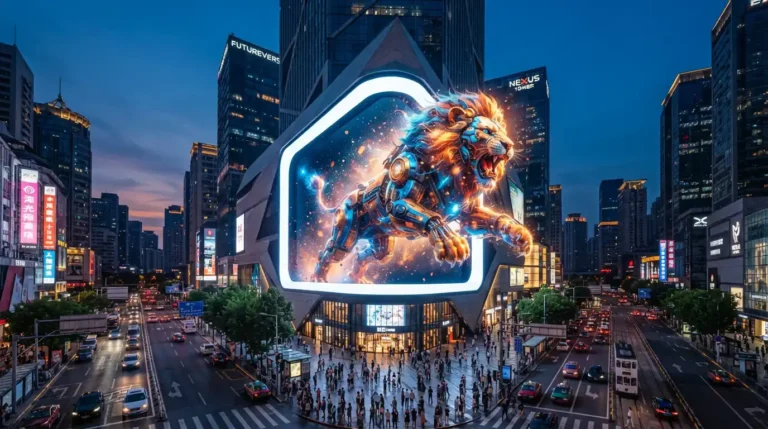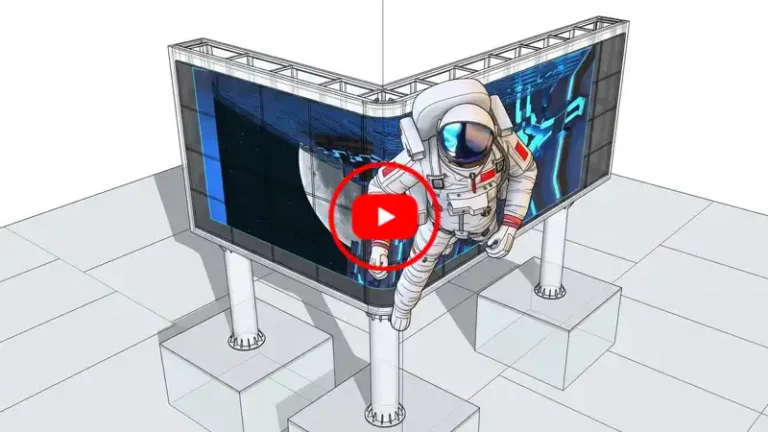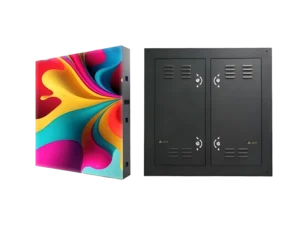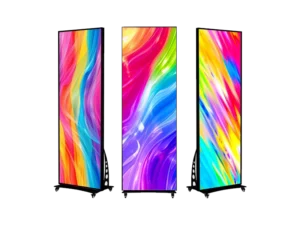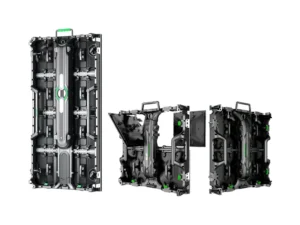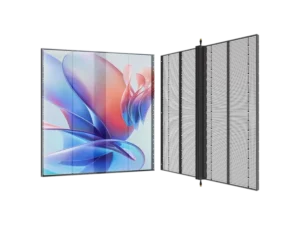
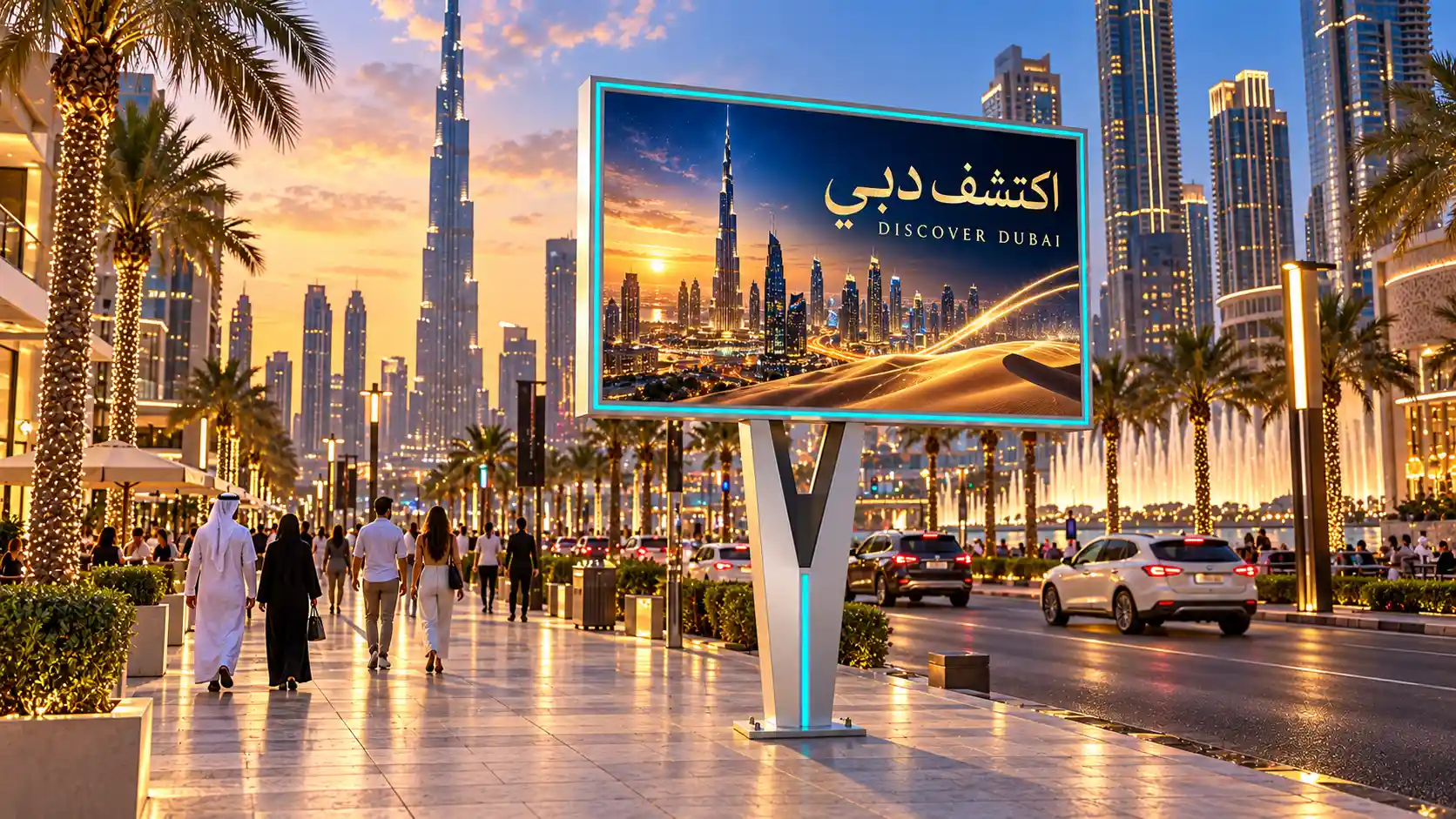
A digital LED mega board is a 4 × 3 m roadside structure on a single column in which one or both faces carry an outdoor LED display instead of a printed poster. For operators across the Gulf and the wider Middle East, the upgrade from a printed mega board is no longer a question of whether screens sell better — it is a question of whether a screen survives the site. Heat management, remote publishing and the choice between one or two LED faces decide that, in that order.
This article is written by the Adhaiwell Display engineering and export team. Adhaiwell has manufactured LED and LCD displays in Shenzhen for more than 16 years, and supplies both the display and the steel structures and cladding its screens are mounted on.
Key Takeaways
- A digital LED mega board is a retrofit, not a new structure class. The 4 × 3 m face, the single column and the site permit usually stay; the printed face and its manual-change routine are what get replaced.
- Heat, not resolution, decides whether a Middle East upgrade survives. Field-service guidance published by LED Craft (2026) holds that every 10 °C above a rating can roughly halve component life — enough to separate a five-year screen from a fifteen-year screen on the same road.
- A 4G-connected NovaStar TB-series player removes the poster round. Cloud publishing and remote monitoring are what convert a printed network’s labour cost into a screen’s electricity and service cost.
- Double-sided does not mean LED on both faces every time. Mixed sites — one LED face plus one printed face — are a normal way to hold capital back for the sites that will earn most.
- Shaped aluminium cladding is a structure decision as much as a design one. It is the same material family as the display cabinet, and it is where a supplier with in-house structural design saves a retrofit from becoming a rebuild.
Why Are Printed 4 × 3 m Mega Boards Being Replaced With Digital LED Faces?
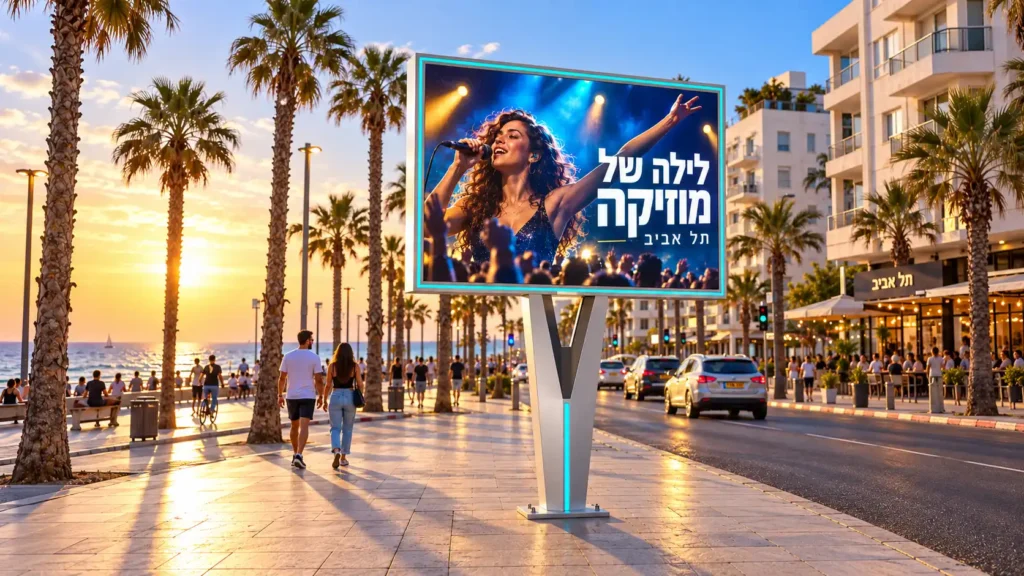
Because the printed format cannot sell a second advertiser for the same site, and the operator pays for that limitation every month. A digital LED mega board is a 4 × 3 m roadside structure — usually on a single column with roughly a 2.2 m ground clearance — in which one or both faces carry an outdoor LED display. The steel, the foundation and the media location stay; the vinyl and the crew that changes it go.
The commercial case is regional rather than theoretical. MarkNtel Advisors (2026) values the GCC digital out-of-home advertising market at US$572 million in 2025, US$612 million in 2026 and US$952 million by 2032, a 7.64% CAGR, with digital billboards and LED screens taking about 48% of that spend and Saudi Arabia holding roughly 43% of the region. ResearchAndMarkets, in its March 2026 Middle East and Africa DOOH forecast, sizes the wider region at US$0.36 billion in 2025 rising to US$0.75 billion in 2031 at a 12.95% CAGR, and notes that outdoor formats still carried 72.65% of that market in 2025 with billboards at 52.10% — the outdoor road network is where the conversion is happening.
These are commercial research estimates whose methodologies differ; treat them as directional context for a category, not as a revenue forecast for any single network.
What changes on the operator’s side is the unit economics of one site:
- One structure, several advertisers. A printed face holds one campaign until someone climbs the column. A screen rotates campaigns by daypart — the same 12 m² can serve three or four clients a day. A comparison of the two formats is set out in Adhaiwell’s breakdown of DOOH versus static billboard ROI.
- Poster production and installation disappear. Printing, shipping, a crane or ladder crew and a wasted afternoon per face, per campaign change — replaced by a file upload.
- The maintenance budget changes shape, not size. Annual maintenance contracts on outdoor LED faces typically run 5–10% of initial installation cost, with energy at US$5,000–15,000 per year for a 14 × 48 ft face (LumenMatrix electronic billboard cost guide, 2026). The budget moves from labour to hardware service, and it becomes predictable.
- Proof of play becomes sellable. Digital logs let an operator bill on delivered plays instead of estimated traffic.
A media operator in Israel rebuilding a printed 4 × 3 m mega board network for the Gulf-adjacent climate is a useful example of why the next section matters more than the pixel pitch.
What Actually Kills an Outdoor LED Cabinet in 45–50 °C Ambient Heat?
Sustained internal temperature kills it — and a cabinet with two fans and no thermal design does not remove enough of it. Dust-clogged filters, a fan selected on its free-air rating, solar gain through an aluminium face at midday and electronics that sit above their rated ambient all push the same way, and the failure sequence is predictable: brightness loss and colour shift first, then dead lamps, then driver and power-supply failures.
Three published reference points frame the problem:
- Life halves per 10 °C. Field-service guidance from LED Craft (2026, supplier-published) puts it as an approximation: every 10 °C above the rated operating temperature can roughly halve component life. It is not a law, but it explains why one screen model lasts years in a mild city and one summer on a desert road.
- Power supplies are the first casualty. Commercial-grade switching supplies are rated 50,000–80,000 hours, entry-level units 30,000–50,000 hours (Pixelight, 2026). Where a unit lands in that band depends mostly on the air temperature it lives in.
- A fan’s installed airflow is not its datasheet airflow. ANSI/AMCA Standard 210-25 with ASHRAE Standard 51-25 (2025) sets the laboratory rating methods, and ASHRAE’s fan chapter (ASHRAE Handbook, 2024) states that installed performance almost always differs from the laboratory figure because of system configuration. In a worked example published by Adhaiwell’s engineering team, a fan rated at 5,300 m³/h delivers roughly 4,500 m³/h once it sits behind a filter, a louver and a narrow cabinet. The design method behind that number is set out in Adhaiwell’s guide to forced-air cooling design for LED displays.
What a heat-ready cabinet therefore looks like, in procurement terms:
- A cabinet designed around heat load, not a fan count. The airflow follows from the heat load and the allowable temperature rise; the fan count falls out of the calculation.
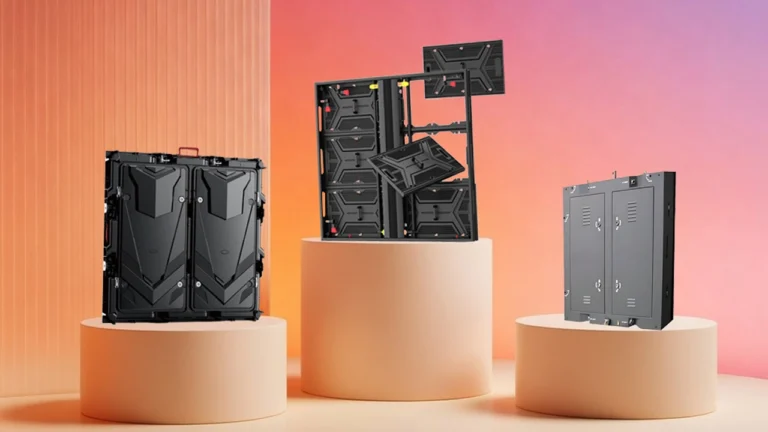
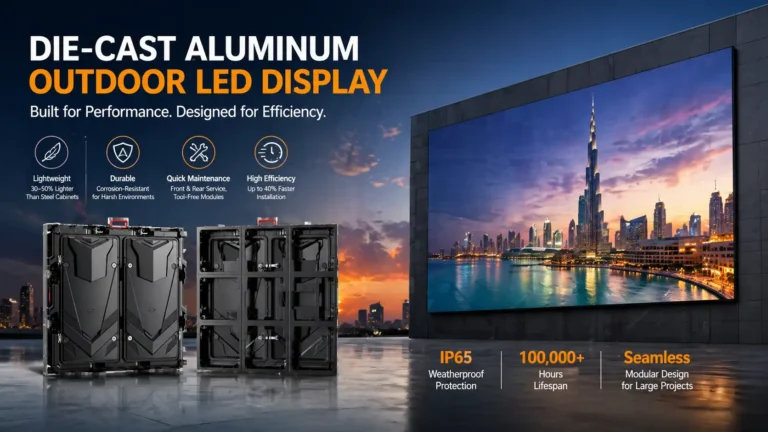
- Aluminium as the heat path. Aluminium-profile cabinets are published at 200 W/m² average and 650 W/m² maximum consumption with passive extruded-fin cooling and a −20 to +65 °C operating range — no fans, no filters, no filter maintenance. Higher-density sites move to the dual-fan die-cast platform at 300 W/m² average and 800 W/m² maximum, also published at −20 to +65 °C.
- Shading and surface treatment. A light-coloured aluminium face and correct solar shading reduce the heat the cabinet has to reject; PVDF-coated aluminium holds its colour under high UV instead of fading into a heat absorber.
- Redundancy on critical sites. N+1 fan groups and variable-speed control rather than continuous full-speed running, which loads filters faster and worsens condensation cycles in cool humid months.
- A 72-hour burn-in before shipment with the thermal loop exercised, not just the display.
Both cabinet families are described with published figures on the aluminium-profile outdoor LED display page — pixel pitch P3.91 to P10.42, IP65 front and rear, 3,840 Hz, 6,000–8,000 nits, 1,000 × 1,000 mm cabinets at about 23 kg — and on the die-cast aluminium outdoor LED cabinet page. Which one fits a given site is a calculation, not a preference.
How Does a 4G-Connected Controller Remove the Poster-Changing Workforce?
By moving publishing, scheduling and fault detection off the street and into a browser. The display is the visible half of a digital mega board; the player and the cloud account behind it are the half that changes the operator’s cost structure.
The NovaStar TB Plus series — TB10 Plus through TB60 — is the digital-signage family built for exactly this duty: quad-core ARM A55 processors, H.264/H.265 decoding to 4K at 60 Hz, pixel loads from 650,000 to 2.3 million, Android 10/11, built-in 4G module support and ambient-light-sensor compatibility. The cloud layer is Screen Genie for program publishing and Screen Boss for remote operations and monitoring, so a distributed network can be updated in batches and monitored for faults from one dashboard. Controller selection across the TB, TU and VX Pro families is compared in Adhaiwell’s NovaStar TB-series controller guide.
What that changes for a billboard operator running 20 to 200 faces:
- No site visit to change a campaign. Files are published to individual faces or a whole group; no printing, transport or crew.
- Dayparting becomes routine. Morning inventory, evening inventory and event-triggered creative sell at different prices from one structure.
- Faults are reported, not discovered. Screen Boss alerts turn a black face from a three-week revenue hole into a same-day ticket.
- Brightness follows the light. An ambient light sensor adjusts output through the day — necessary both for legibility in noon glare and for night-time dimming that keeps a residential-adjacent site compliant.
- Proof of play is stored. The same platform that publishes the campaign logs when it ran.
Network-level infrastructure also matters: building automation, dimming and scheduling are being standardised across the region, and research covering the Middle East and Africa market names renewable-powered LED arrays and AI scheduling among the climate-resilient technologies gaining traction there (ResearchAndMarkets, March 2026).
Which Double-Sided Configuration Should a Site Get?
The one its traffic, permit and budget can support — full LED on both faces is the ceiling of the range, not the entry point. A 4 × 3 m double-sided mega board can be specified in four ways, and a network upgrade normally mixes them:
| Configuration | Best suited to | What it changes commercially |
|---|---|---|
| LED / LED, double-sided | High-traffic arterial roads, city gateways, junctions with two approach directions | Highest revenue per structure; highest capital and power draw |
| LED / printed poster | Sites with one strong approach and one low-value direction | Roughly half the display capital; keeps rotation on the paying direction |
| LED / blank or branded back panel | Sites where the rear faces buildings or a service area | Lowest cost way to put a screen on a site that only ever sold one direction |
| Printed / printed (deferred) | Sites awaiting permit, power or a rent renegotiation | Holds the location on a printed contract until the digital case is proven |
Practical constraints that decide the mix on Middle East roads:
- Power and supply. A 12 m² face at published averages of 200–300 W/m² is a modest load, but the site’s supply capacity, not the screen, is usually the binding constraint on a two-face conversion.
- Light spill and permits. Double-sided LED on a residential edge invites restrictions; sensor-driven dimming and a lower night-time brightness profile are usually the answer, and the local advertising authority’s rules differ by emirate, city and country — verify them per site rather than assuming a regional standard.
- Cabinet space. Retrofit cabinets have to fit the existing frame or replace it; front-service designs keep a roadside column maintainable without a lane closure.
- Structure. A screen is heavier and presents more wind area than a printed panel, so the column, foundation and cladding all need a load check. Site-by-site criteria are covered in Adhaiwell’s six-factor framework for choosing an outdoor LED display.
What Should the Column Cladding Be — and Why Aluminium Panels?
Shaped aluminium panels are the practical choice because they are the same material system as the cabinet, they can be folded into almost any profile, and they carry the structure’s branding at street level. The column is the part of a mega board that a pedestrian actually sees; leaving it as a bare galvanised tube wastes the asset.
- Form flexibility. Vertical flutes, faceted facets, a twisted ribbon or a perforated lattice are all produced from folded aluminium sheet, so the column can be designed as a landmark rather than a pole.
- Coating life. PVDF fluorocarbon finishes are specified for outdoor aluminium precisely because colour retention and UV stability are the failure points in high-sun markets; a light or metallic finish also reflects rather than absorbs solar gain.
- Repairability. Individual cladding panels can be replaced after impact without touching the display cabinet or the steel core.
- Structure in one hand. The cladding is not cosmetic — it is a wind-loaded element on a column whose steel core is already carrying the display. This is where a supplier that also engineers and fabricates steelwork removes a coordination problem: the display, the column, the cladding and the installation sequence come from one engineering desk.
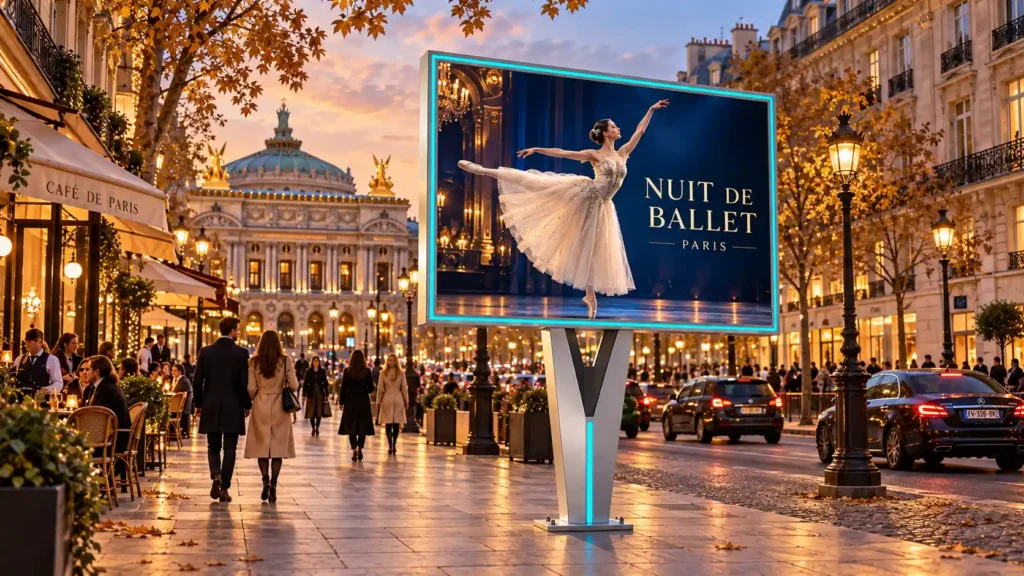
For a Gulf or Mediterranean-coast site, the same package should include corrosion-grade fasteners, drainage paths that do not run water across the cladding joints, and a maintenance route that does not require dismantling the column.
Where Is the Digital Mega Board Upgrade Happening, and What Should Buyers Verify?
Across Gulf and wider Middle East road networks, on existing printed sites — which is why the retrofit specification, not the landmark specification, is the one to prepare. Regional fragmentation means the same structure meets different rules in each market: the GCC market is described as highly fragmented, with the five largest operators holding about 25% of it (MarkNtel Advisors, 2026), and approval processes for outdoor advertising vary by jurisdiction.
A retrofit checklist that holds up across the region:
- Cabinet material and service access — aluminium profile or die-cast, front or rear service, and the spare-parts list shipped with the order.
- Controller and connectivity — the exact player model, its 4G module support, and whether the cloud platform carries licence fees.
- Structure and cladding drawings — column, foundation, wind load and cladding details suitable for a municipal submission.
- Brightness strategy — maximum nits for noon legibility plus a dimming schedule that satisfies night-time restrictions.
- Energy and finance treatment. Efficiency retrofit capital is commonly estimated at US$12,000–18,000 per face, while solar-powered panels and carbon-offset campaigns have been observed commanding 10–15% CPM premiums from ESG-focused advertisers (Market Research Future, 2026) — a pricing lever, not a guarantee.
- One supplier or several. A LED-only supplier leaves the operator to find structural design, cladding fabrication and installation support elsewhere; that coordination is where retrofit schedules usually slip.
How Does a China OEM/ODM Partner Add Value Beyond the Screen?
By covering the parts of the project that a display-only vendor cannot: the structure, the cladding, the commissioning sequence and the technical support after shipment. Adhaiwell has manufactured LED and LCD displays in Shenzhen for more than 15 years and is one of a small group of Chinese suppliers that also designs and fabricates the steel structures its screens sit on.
What to look for when qualifying that partner:
- In-house structural engineering. Can they produce column and foundation drawings, wind-load calculations and cladding details for a permit submission — or only a cabinet datasheet?
- Both cabinet families. A supplier with aluminium-profile and die-cast platforms can recommend against its own most expensive option when the site calls for it. The trade-offs are laid out in Adhaiwell’s comparison of energy-saving outdoor LED displays and their die-cast equivalents, and in the wider guidance on matching an outdoor LED cabinet to its installation environment.
- Component baseline disclosed. Named LED and controller brands, certificated power units, and a stated burn-in protocol — not just a brightness figure.
- Installation and commissioning support. Assembly drawings, remote guidance for the local contractor, and a documented acceptance test, as covered in the outdoor LED display installation and maintenance guide.
- Spares and response. A spare-parts kit sized to the network, and a response commitment in writing.
None of this replaces a site survey. It determines whether the survey produces a buildable specification.
Frequently Asked Questions About Digital LED Mega Boards
Adhaiwell has manufactured outdoor LED and LCD displays in Shenzhen for more than 15 years, including retrofit projects where existing billboard columns, permits and power supplies had to be reused rather than replaced. The answers below come from that project record and from the vendor specifications and third-party research cited above.
Can a printed 4 × 3 m mega board be converted to LED without rebuilding the column?
Usually yes, with a structural check. The existing steel column and foundation are assessed for the higher weight and wind area of a display cabinet, and cladding is replaced or refitted around the new load path. A rebuild is only required when the foundation or the column cannot be certified.
Is a double-sided LED mega board worth it on a low-traffic site?
Rarely as a first move. Mixed configurations — LED on the paying direction, printed poster or blank panel on the other — capture most of the rotation value at roughly half the display capital. Move the second face to LED once the site’s inventory is selling.
How much heat can an outdoor LED cabinet tolerate before life suffers?
Design to the published operating range rather than a rule of thumb; Adhaiwell’s outdoor cabinets are published at −20 to +65 °C. Beyond that, field-service guidance suggests every 10 °C above the rating can roughly halve component life (LED Craft, 2026), which is why a heat calculation matters more than an extra fan.
What does 4G add over Wi-Fi or a wired link on a billboard?
Independence from site infrastructure. A 4G module lets the player publish and report without a landline or a local network, which matters on roadside columns where the only available connection is cellular. NovaStar’s TB Plus series supports built-in 4G modules with cloud publishing and monitoring.
Do cloud CMS platforms for LED billboards carry licence fees?
It depends on the vendor and the platform tier, so ask for it in writing. NovaStar’s TB Plus family works with Screen Genie and Screen Boss for publishing and remote operations; any recurring fee should appear as a line in the procurement documentation rather than as a surprise in year two.