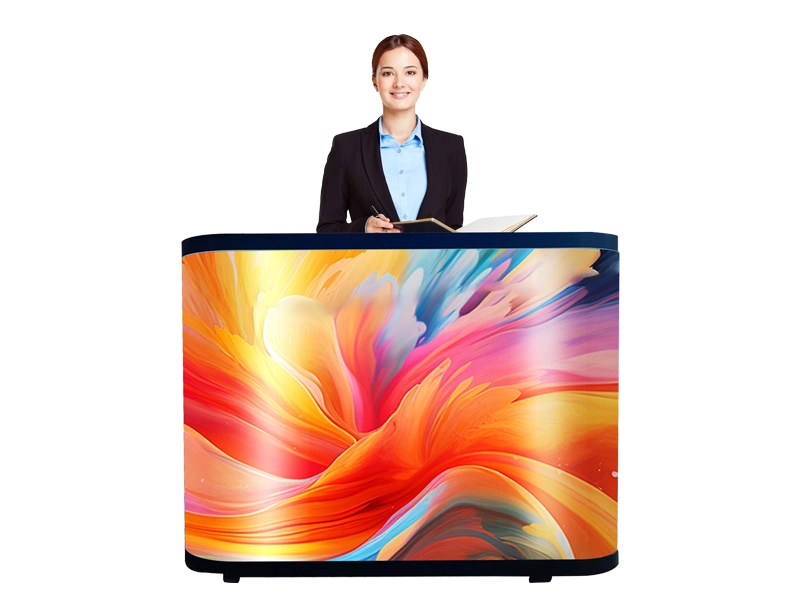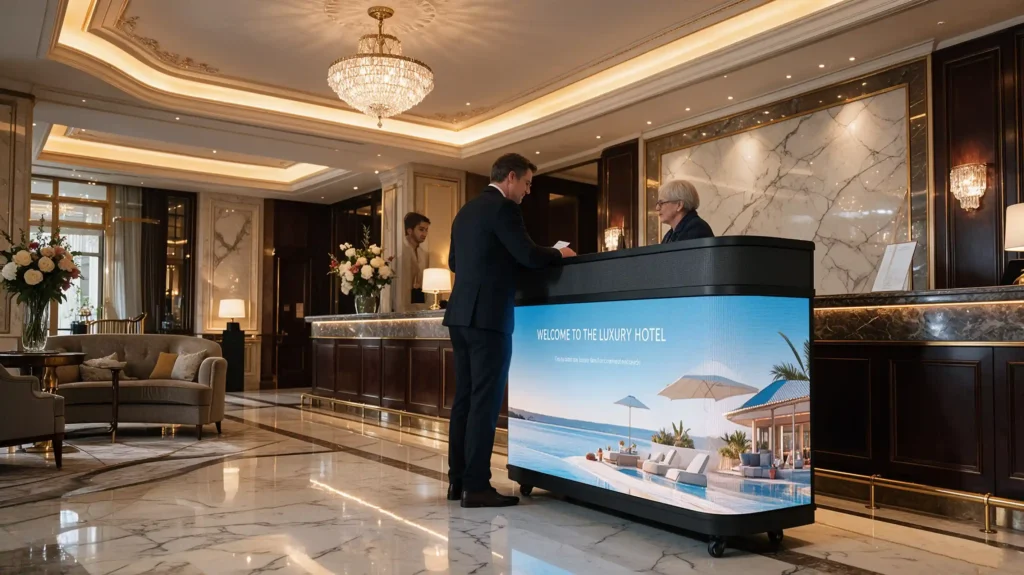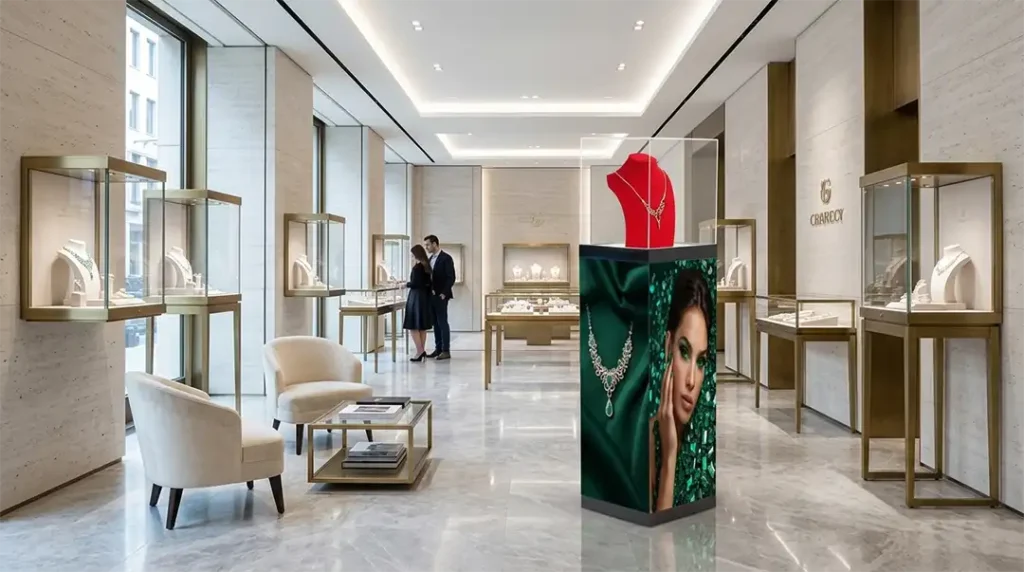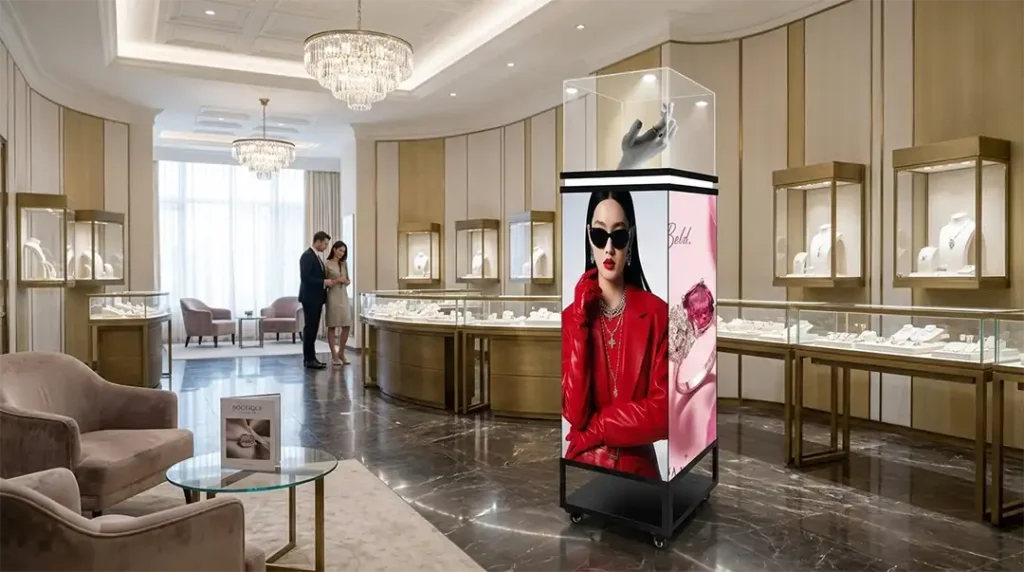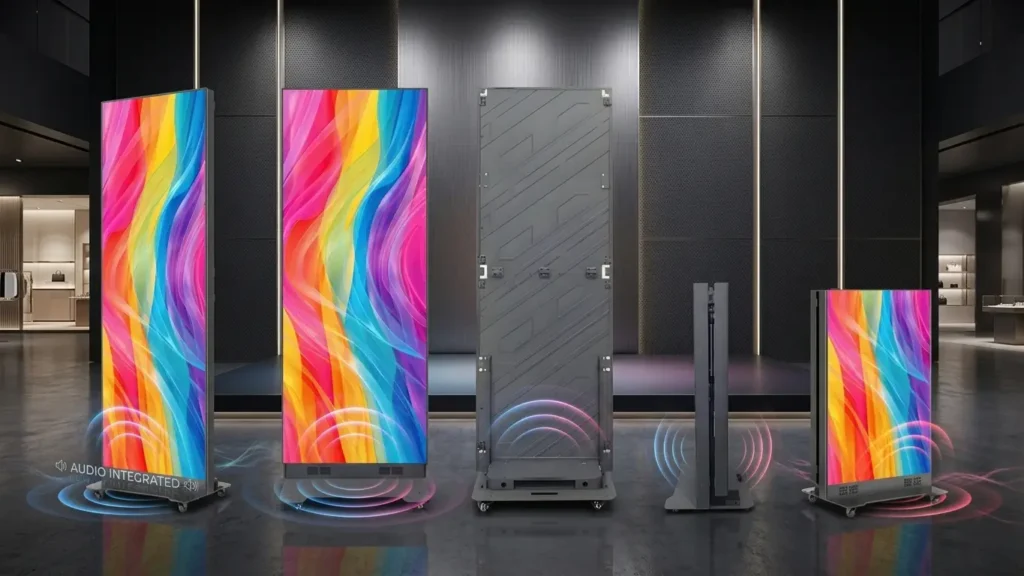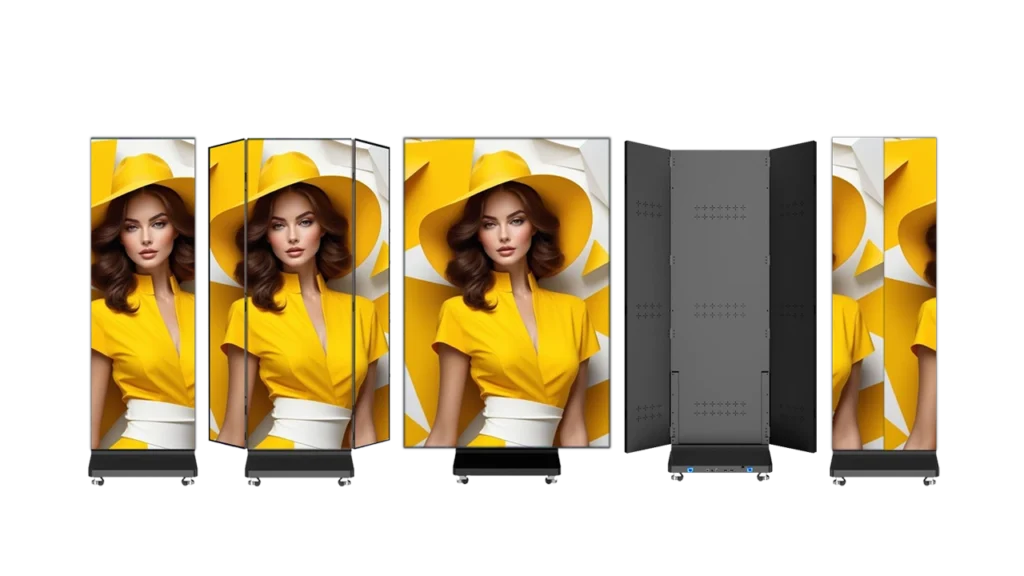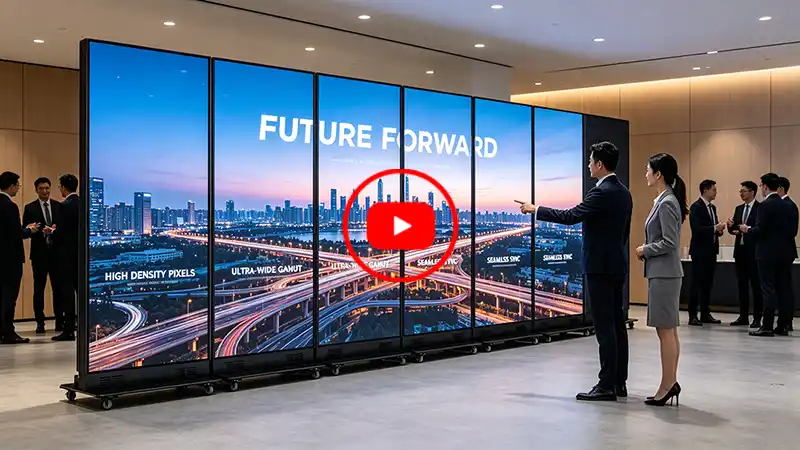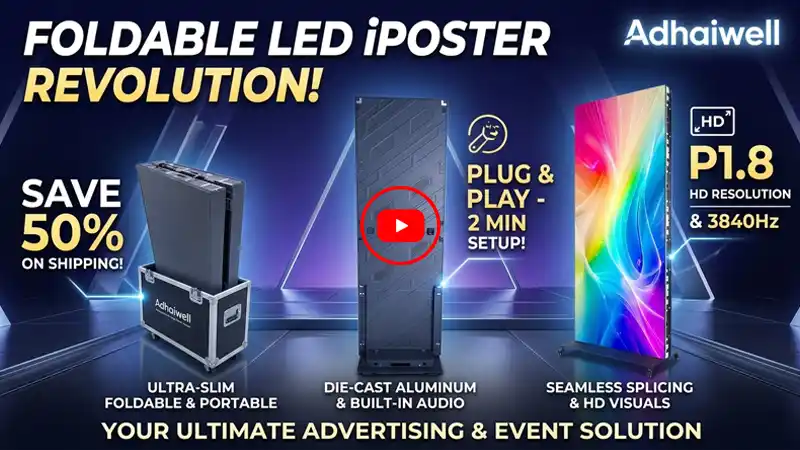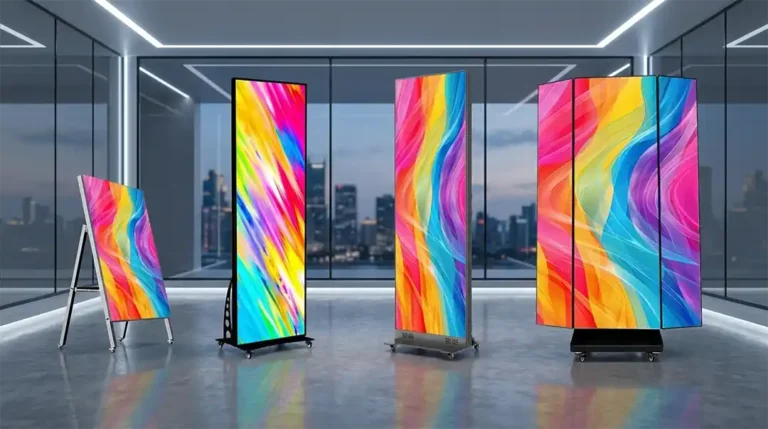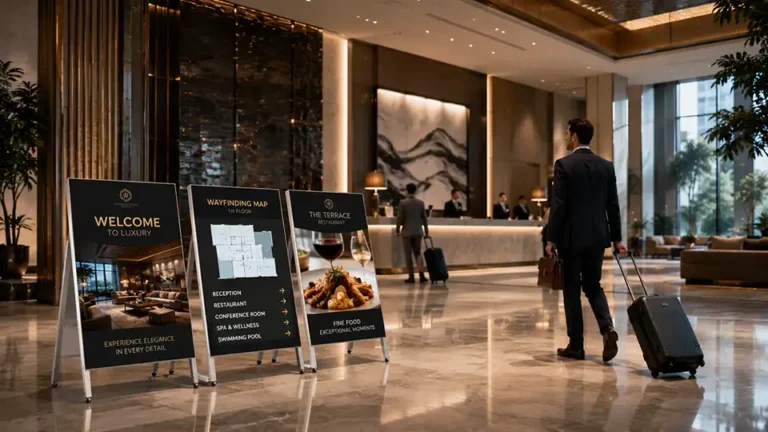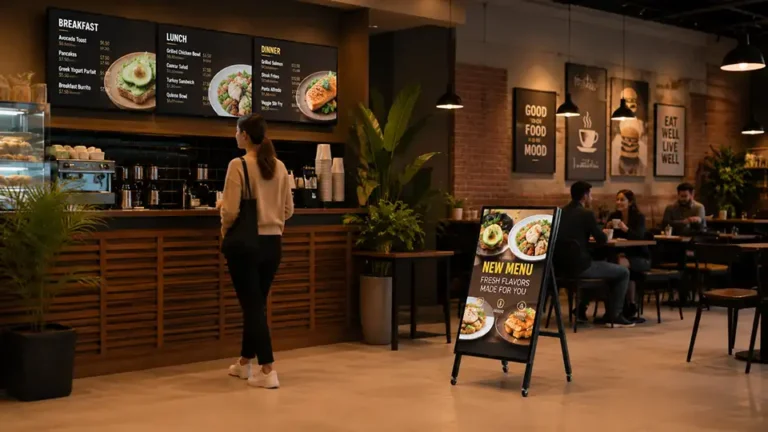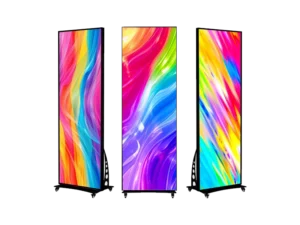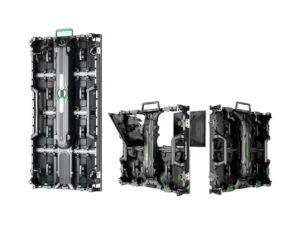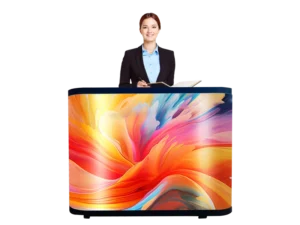
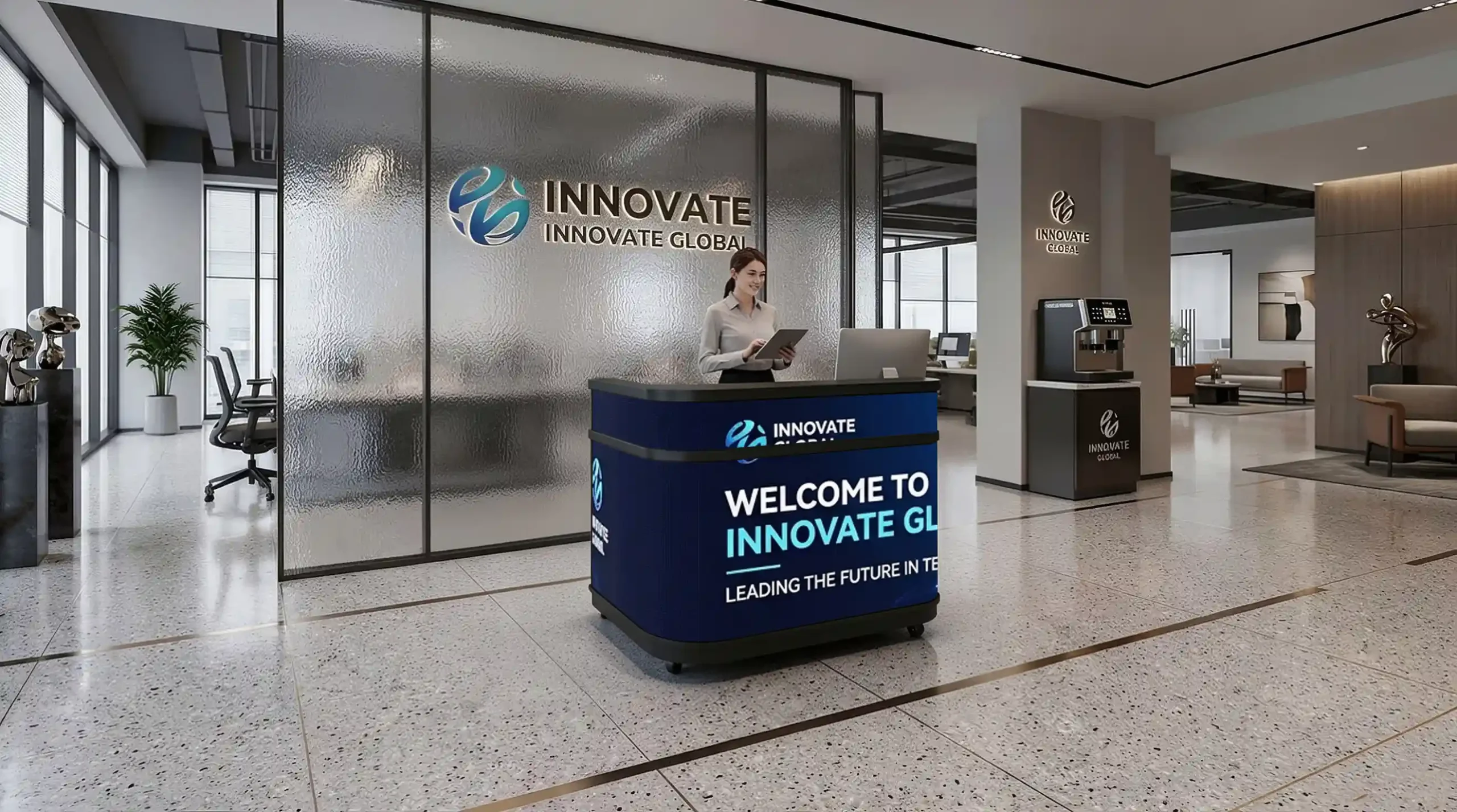
An LED Reception Desk is a reception counter whose front face is an integrated fine-pitch LED screen rather than a printed panel or a display mounted on the wall behind it. Four variables decide whether a product fits a venue: pixel pitch, brightness, curvature and surface protection.
Corporate lobbies and hotel front desks are the core applications. Trade show counters and DJ booths are conditional — they work when the unit stays indoors, stays in one place for most of the year, and the specification is adjusted for cameras and heat. Numbers below are labelled by origin: manufacturer specification, calculated value, or standards definition. None of them is a performance guarantee for a particular room.
LED Reception Desk Buying Guide: Corporate Lobby, Hotel, Trade Show & DJ Booth
Key takeaways
- The screen is the counter face, not a wall behind it. The display is integrated into the front panel of the reception unit, so guest-facing content appears on the surface visitors already look at.
- Corporate lobbies and hotel front desks are the core applications. A lobby buys brand consistency and a service route that does not stop the working day; a hotel buys close-range legibility, quiet operation and a maintenance window that fits around check-in.
- Trade shows and DJ booths are conditional, not core. They work when the unit stays indoors and stays put for most of the year; beyond roughly ten shows a year or on any outdoor stage, a rental or stage product is the correct purchase.
- Pitch follows measured reading distance, and the distance rule is a planning reference, not a guarantee. Legibility also depends on font size, contrast and viewing angle, so test the actual content before fixing pitch.
- Refresh rate, not GOB, decides whether the screen looks right on camera. 3,840 Hz or higher is the recommendation for camera-facing installations, verified against the camera that will actually be used.

Front Desk LED Display | Indoor Curved Reception Counter LED Screen
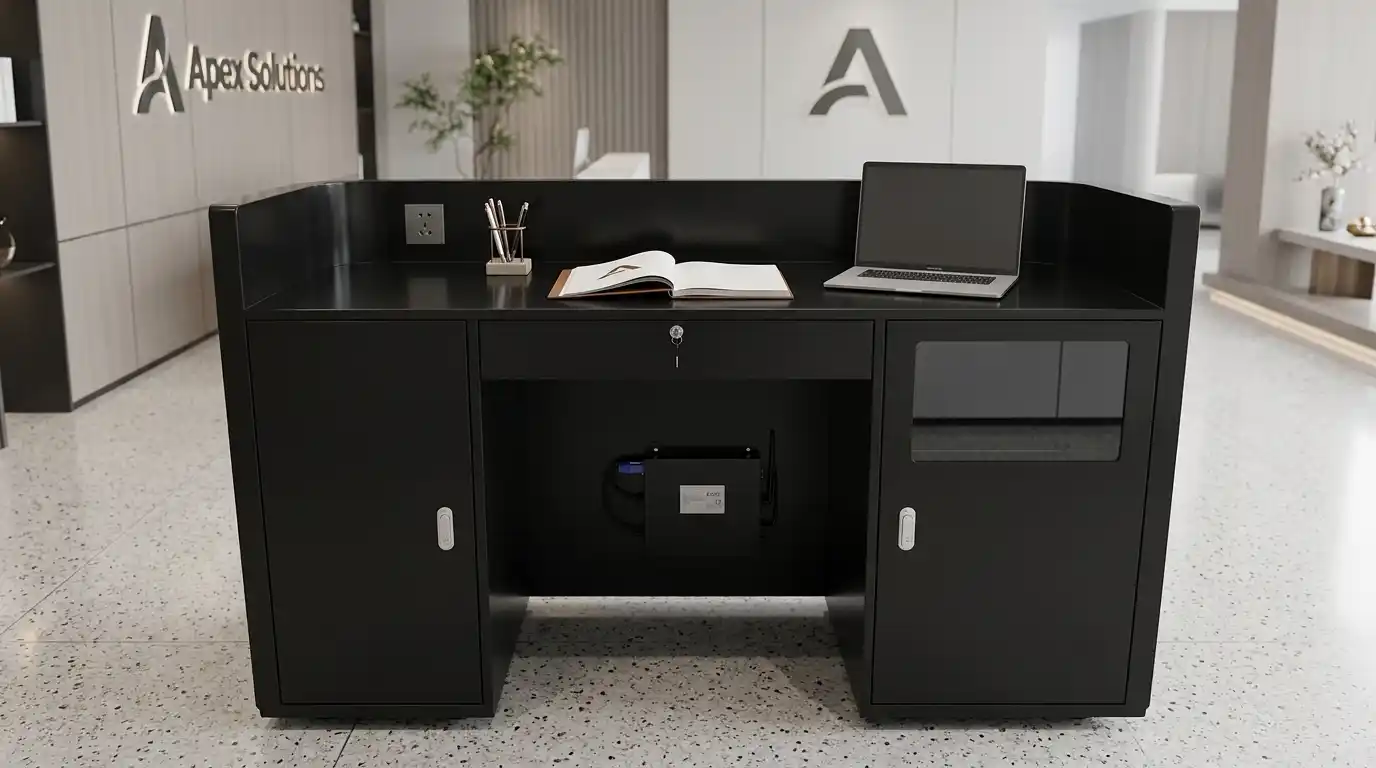
Staff Workstation & Mobile Curved LED Reception Counter
An enclosed staff workstation pairs with a curved LED display counter. The workstation hides front-desk hardware in cabinets and cable pathways; the LED counter rolls in on casters and puts your branding on screen.
Before install, match the two sets of dimensions — and check door and elevator widths if the unit will move.
What Is an LED Reception Desk?
An LED reception desk is furniture and display hardware in one unit. The screen occupies the front panel of the counter, so messages appear on the surface a visitor already faces while they wait or check in — which separates the category from a digital poster, a video wall or a freestanding LCD kiosk.
- Fine pitch, because the reader stands close. Module options are P1.25, P1.53, P1.86 and P2.5; P1.86 is the usual choice for counters read at 1.5-3 m.
- The electronics sit inside the counter. A built-in Android player takes content by USB or Wi-Fi, so the front desk can change a message without a PC.
- Service access is from the visitor side. Modules release with a magnetic tool from the front — necessary, because the counter usually backs onto a wall or joinery with no rear corridor.
- Protection is a surface, not a weather rating. A GOB (glue-on-board) epoxy layer covers each LED against knocks, dust and light spills; the enclosure is IP43, an indoor rating.
- The display is wider than the desk. A typical unit is 1,675 × 585 × 1,100 mm at about 130 kg with a 2,560 × 960 mm display area, so the screen wraps past the counter footprint.
Every section below either changes one of those points for a venue or explains why it should not be changed. The specification behind the numbers is published on Adhaiwell’s flexible curved GOB LED reception display page.
Which LED Reception Desk Works Best for a Corporate Lobby?
The right configuration is a fixed, front-service counter at P1.86-P2.5, running 600-800 nits, with a colour temperature the brand can match and a service route that does not stop the working day. Brand consistency and uptime create the value; peak brightness does not.
- Match the brand before the spec sheet. Selectable 5,000-12,000 K and 10,000:1 contrast let the screen sit inside a corporate palette instead of glowing beside it. Ask for the corporate colour rendered on the panel, not a paper swatch.
- Pitch from where visitors stand. Clients wait 1.5-3 m back, so P1.86 is normally enough; P1.25 is justified only for a staff-facing second face or small regulatory text.
- Buy front service deliberately. Name in the RFQ which of the four serviceable items — module, receiving card, power supply, media player — is reachable from the front.
- Duty cycle is mild. 10-12 hours a day on business days means passive, low-noise cooling is usually adequate.
- Respect the integration boundary. Visitor registration, access control and room booking are separate systems with their own data rules, and those rules differ by country.
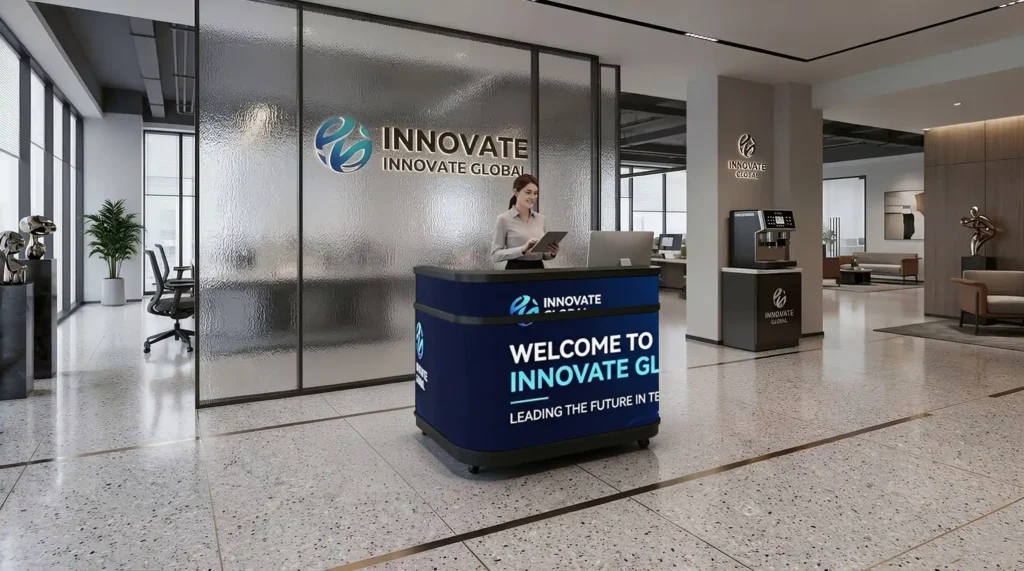
A lobby does not need outdoor brightness or IP65: over-specifying adds cost and weight, and 800 nits at full output in a dim reception is uncomfortable to stand next to.
What Should Hotels Consider When Choosing a Curved LED Reception Desk?
Hotels choose for close-range legibility, cleaning, quiet operation and a maintenance window that survives check-in — and the curve has to be settled while the joinery is still on paper.
- Read distance is the shortest of any venue here. Guests stand 0.8-1.2 m from the counter and queue at 1.5-3 m. At 0.8 m, P1.86 may show pixel structure on small text depending on font size and contrast, so test the real welcome message at the real distance before fixing pitch.
- Brightness works against you past the optimum. 600-700 nits suits controlled lobby light; a brighter panel washes out the guest and flattens evening black at the same time.
- Curvature is fixed at design. Minimum radius here is R500, and radius, content and viewing positions are locked together — content rendered for one radius distorts on another.
- Cleaning is a specification item. GOB takes a dry microfibre cloth; some solvents and abrasive pads damage the encapsulation, so write the method into the front-office SOP.
- Choose the service window before the hardware. Schedule module swaps outside the 15:00-19:00 arrival peak and keep spares on site. Get the scope in writing: a sealed plinth can still hide the power supplies, receiving cards and media player.
- Live hotel data is a separate project. Scheduled welcome messages and multilingual notices play out of the box; PMS-driven rates need their own integration scope.
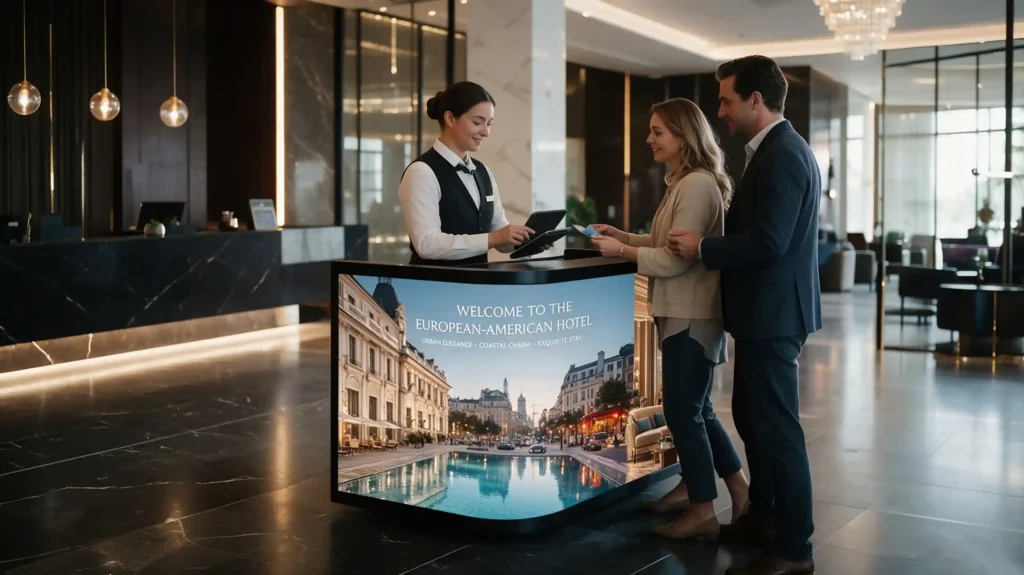
Properties specifying the counter during a refurbishment should work through Adhaiwell’s curved LED reception desk planning guide for hotels alongside this page; that article carries the hotel-specific site, content-ownership and RFQ detail a four-venue comparison cannot.
Is an LED Reception Counter Suitable for Trade Shows and Exhibitions?
Yes, when the unit is built for repeated transport and the show calendar is modest. It is a conditional application, and the dividing line is the transport cycle.
- Ask about load-in cycles, not the flight case. The unit ships in a heavy-duty airline case with a loading ramp, but handling still works the cabinet corners, fasteners and connectors. The useful question is how many cycles the hardware is designed for, and which parts are consumable.
- Pitch for the aisle. Attendees read from 1.5-3 m as they pass, so P1.86-P2.5 is the working range; finer pitch buys resolution nobody stands close enough to see.
- Refresh rate belongs in the contract. 3,840 Hz or higher is recommended for camera-facing installations, because hall footage reaches social media the same day. Whether a lower rate actually bands depends on shutter speed, frame rate, scanning method and driver settings, so verify with the camera that will be used.
- Keep spares on the stand. Two or three modules and one receiving card turn a mid-show failure into a ten-minute interruption.
- Where this product is the wrong answer. At ten or more shows a year the duty cycle is a rental cycle, not occasional transport: rental cabinets run roughly 8-12 kg per 500 × 500 mm, with hard connections, corner protection and curving in defined increments.

The rental LED display buying guide sets out the cabinet weight, IP rating and spare-parts conventions that separate a touring panel from an installed one.
Can a Curved LED Reception Desk Be Used as a DJ Booth?
Yes, for a fixed booth in a controlled indoor room, provided refresh rate and a real thermal path are specified. GOB protection, which gets the attention, is the least decisive of the three.
- Refresh rate decides how the booth looks on camera. The unit is rated ≥3,840 Hz with 16-bit grey. 3,840 Hz or higher is the recommendation for camera-facing installations, but verify the result with the intended camera setup — shutter speed, frame rate, scanning method and driver settings all change whether banding appears.
- Brightness should go down, not up. 600-800 nits suits a dark room, and 10,000:1 contrast does more there than peak output; an over-bright panel turns dark scenes grey.
- IP43 and the control chain are the boundary. Vibration, haze residue and spilled drinks are survivable at the surface; humidity, rain and hose-down are not. The built-in player handles scheduled and music-reactive content, but timecode, DMX or a frame-synchronised media server is a different signal path — confirm it with the integrator before the booth is built.
- Where this product is the wrong answer. Outdoor stages, festival booths and semi-open party spaces need IP65 panels with outdoor brightness, and a haze-heavy weekly schedule is a case for a dedicated stage product.

What Pixel Pitch, Brightness and Protection Should You Specify?
Pitch follows measured reading distance, brightness follows ambient light, and protection follows how the surface will be treated. Each is easy to over-buy.
| Pitch | Native resolution at 2,560 × 960 mm | Pixel density (calculated) | Planning reading distance | Typical fit |
|---|---|---|---|---|
| P1.25 | 2,048 × 768 | 640,000 px/m² | from about 1.2 m | Staff-side faces and small statutory text |
| P1.53 | 1,673 × 627 | 427,000 px/m² | from about 1.5 m | Concierge or second faces read at 1-2 m |
| P1.86 | 1,376 × 516 | 289,000 px/m² | from about 1.8 m | General choice for lobbies, check-in and exhibition aisles at 1.5-3 m |
| P2.5 | 1,024 × 384 | 160,000 px/m² | from about 2.5 m | Larger counters and booths read from 3 m or more |
The distance rule is a planning reference, not a guarantee. A common starting point is roughly 1 m of viewing distance per millimetre of pitch, with some suppliers working at 0.8-1.0 m. What it cannot tell you is whether a specific message is legible: that depends on font size, contrast, the angle the viewer stands at and how much the content moves. P1.86 at 1.5 m reads comfortably for 20 mm headline text and less comfortably for 8 mm statutory wording, so test the real content before fixing pitch.
Pixel density is calculated from pitch as (1,000 ÷ pitch)², which is why P2.5 lands at 160,000 px/m² rather than the 250,000 px/m² printed in some comparison tables — that figure belongs to P2.0. Confirm density and native resolution against the factory module specification, because module counts and edge trimming shift both.
Brightness must suit the room, and dimming matters more than the peak. 600-800 nits with 10,000:1 contrast suits controlled indoor light; a counter facing a glazed entrance or sunlit atrium needs its own assessment, because reflected daylight becomes the limiting factor. Check the dimming floor, not only the peak.
Curvature is locked once built. Minimum radius here is R500, and curved cabinets cost more per square metre than flat ones for the same area because of custom bending, flexible modules and more complex splicing. Curve where the architecture already curves; keep a straight face straight.
GOB buys physical durability, not an environmental rating. It does not raise tolerance of heat, humidity or water, and it does not change the control interface — three separate questions a club or an exhibition stand will ask. For the definitions, LED display terminology: pixel pitch and nits explains how these units are measured.
When Is an LED Reception Desk the Wrong Choice?
Five identifiable situations, each with a cheaper or more durable alternative.
- The unit moves more than a few times a year. A furniture counter in a flight case is not a touring product.
- The location is outdoor, semi-outdoor or festival-grade. Rain, hose-down and dew exceed an IP43 indoor enclosure; IEC 60529 defines what an IP code measures, and an IP-rated component does not make a ventilation path weather-safe.
- The audience sits more than about 5-6 m away and the counter is one of several surfaces. A larger flat wall costs less per square metre and sits at the right height.
- The counter is a heavy-use working surface. If staff lean, wipe and stack against the screen area, reduce the screened face.
- The requirement is live data. PMS, access-control or POS integration is a project, not a display option.
Curved versus flat versus L-shaped LED cabinets is a useful check on whether the curve is buying anything: on a straight counter face it adds cabinet cost and constrains content for no gain.
What Should Buyers Confirm Before Ordering an LED Reception Desk?
Four groups of questions, answered in writing before the order, remove most of the failure modes above.
| Group | Confirm in writing |
|---|---|
| Site and geometry | Floor plan; measured reading distances at the counter edge and in the queue; day and evening photographs; fixed unit or mobile; counter surface staff must keep clear |
| Display specification | Target pitch and the distance behind it; display area, radius and module joint map; brightness, dimming range and colour temperature; IP rating and test basis; refresh rate as a number, not “high refresh” |
| Power, data and service | Power budget from area × density (490-740 W typical, about 1,970 W maximum for the 2.56 × 0.96 m screen); ventilation clearance; content route and network credentials; spare-part lead times |
| Commercial and after-sales | Content owner plus a backup; front-desk training; warranty and response time; CE (EMC + LVD) and market-specific documents; factory test record and mechanical drawings |
How a China OEM/ODM manufacturer adds value is mostly non-standard mechanical work: chassis dimensions and radius matched to a joinery run, a module layout that keeps joints out of the text zone, service access built around the components that fail, and drawings a fit-out contractor can build from. On the production side, what matters is the 72-hour ageing test, the transport packing and spares availability after the project closes.
Supplier criteria, in the order that reduces risk: does the supplier ask about venue, reading distance and duty cycle before quoting? Can they name each component and its access side in writing? Do they supply drawings, a module map and the power figure in watts for the size quoted? What is the lead time on spare modules after delivery?
Specification sheets are collected on Adhaiwell’s download centre and technical support page, and the maintenance-scope question is answered in the module and cabinet detail of a front-service curved LED reception desk rather than in a headline claim.
LED Reception Desk FAQs
Adhaiwell has manufactured LED and LCD display products in Shenzhen for more than 15 years and builds this counter in-house, including the front-service module design and the 72-hour ageing test each unit passes before packing. The answers below come from production and export enquiries rather than from a catalogue description.
What pixel pitch do I need for a reception desk?
P1.86 covers most counters, because visitors usually read from 1.5-3 m. Go to P1.25-P1.53 only when the screen carries small text or is read from under about 1.5 m, and P2.5 when the nearest reader stands 3 m or more away. Pitch is the starting point rather than the answer: font size and contrast decide whether the text is legible at that distance.
How much does an LED reception desk cost?
Cost follows pixel pitch, display area, bend radius and whether a flight case or rolling base is included, not the counter footprint alone. Ask for an itemised quotation that separates display, cabinet and base, transport protection and spares, so two suppliers can be compared like for like.
Can an LED reception desk show live hotel rates or visitor data?
Not out of the box. The standard unit ships with a built-in Android player running scheduled content from USB or the network. Live rates, PMS-driven content or access-control visitor names require an integration project with defined data ownership and privacy rules for the destination market.
Is GOB protection enough for a nightclub or an outdoor event?
Not on its own. GOB protects the LEDs from knocks, dust and light spills, while the enclosure is IP43 — an indoor rating. A club booth also needs a verified thermal path and a control-compatibility check, and outdoor or festival use needs IP65 panels rather than an indoor counter.
Can a module be replaced while the reception desk is open?
Yes, if the design is front-service and spares are on site: a module releases from the visitor side with a magnetic tool, so the swap takes minutes rather than a service visit. Confirm in the RFQ which components are front-accessible, because the power supply, receiving card and media player are sometimes still behind a sealed base.
Choosing the Right LED Reception Desk for Your Venue
A corporate lobby and a hotel front desk are the same purchase with different priorities: the lobby buys brand consistency and a service route that does not stop the working day, the hotel buys close-range legibility, quiet operation and a maintenance window that fits around check-in. Trade show and DJ booth use changes the specification rather than the product — transport cycles, camera-safe refresh, a designed heat path — and at ten or more shows a year, or on any outdoor stage, a different category is the correct answer.
If your project matches the fixed indoor cases above — controlled light, a permanent counter, a measured reading distance of 1.5-3 m and front service — the mobile flexible curved all-in-one LED counter screen is the platform this guide describes.
For a configuration matched to your site rather than a catalogue page, send four things: the installation scenario, the counter or display size you have to work with, the measured viewing distance at the counter edge and in the queue, and the target pixel pitch if one is already set. Those four answers fix the module layout, the power figure and the service route before price is discussed — and if the unit will move between venues, sit outdoors or take live PMS or access-control data, say so in the first message.