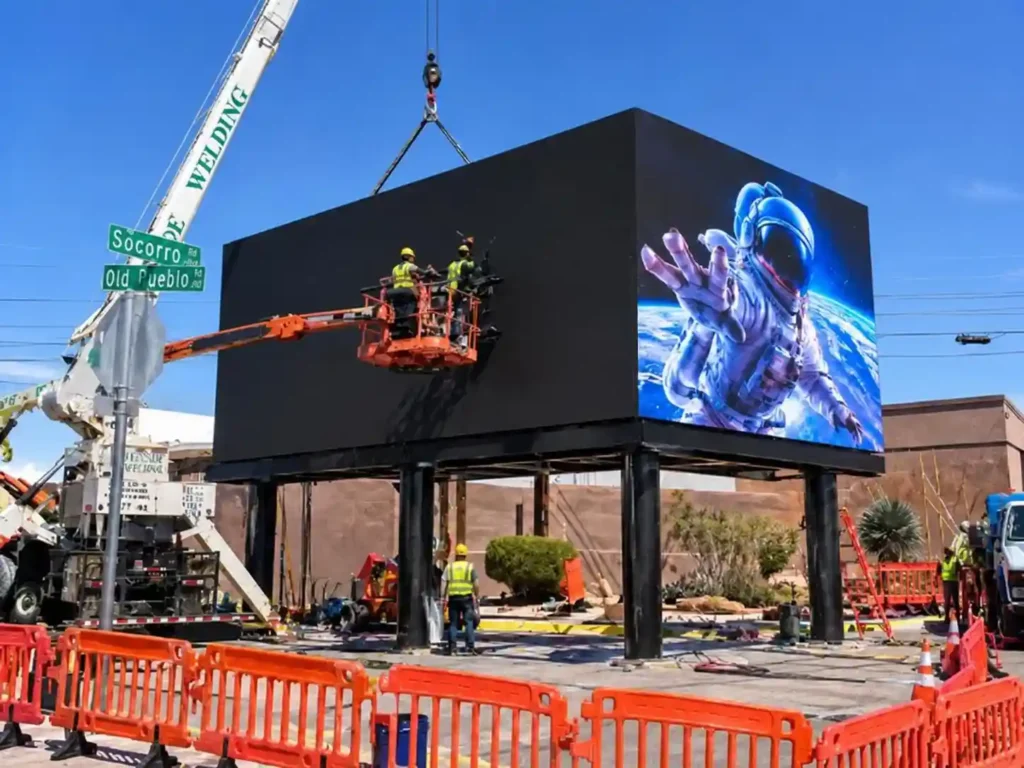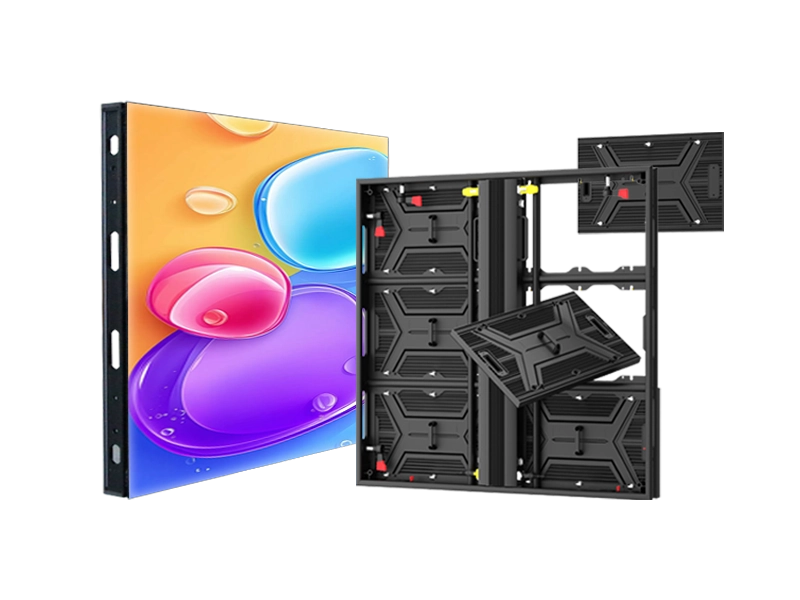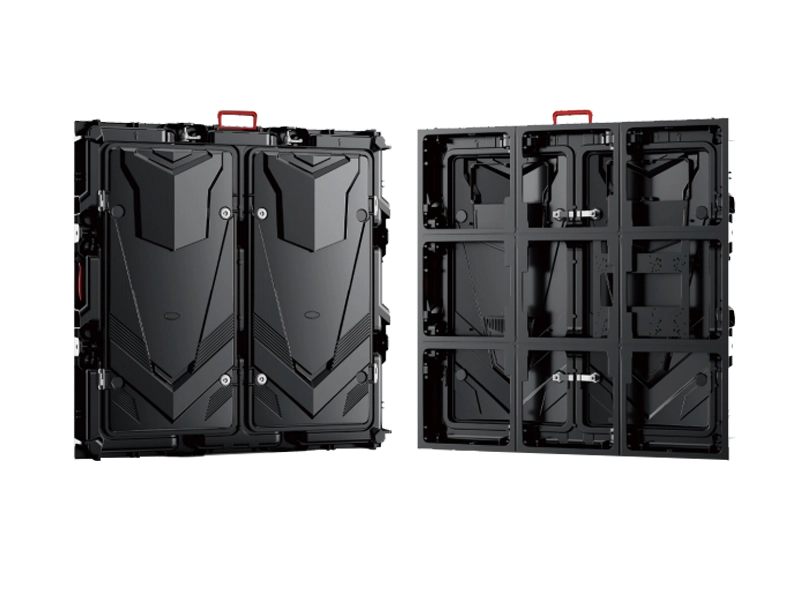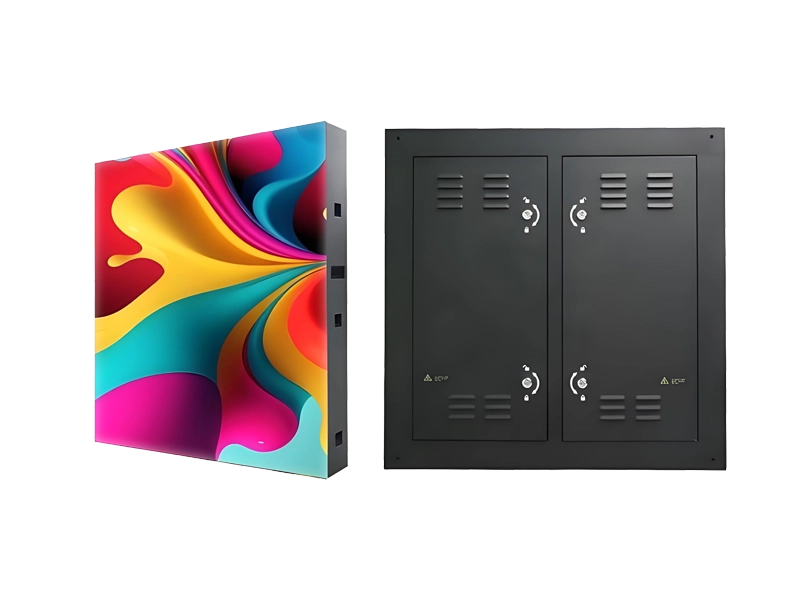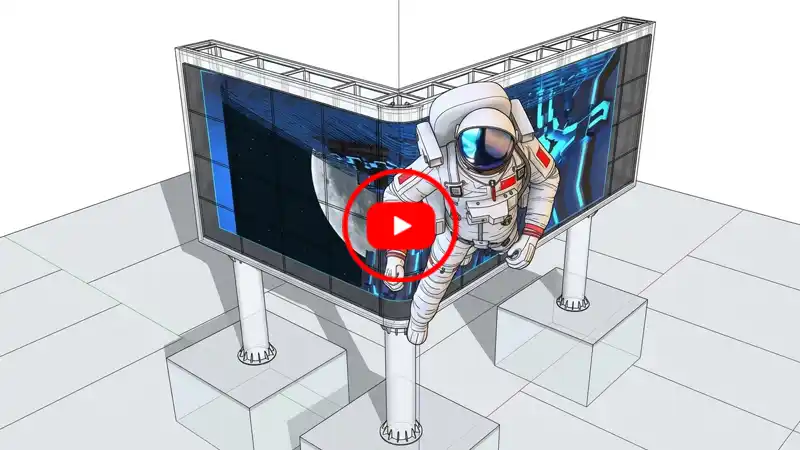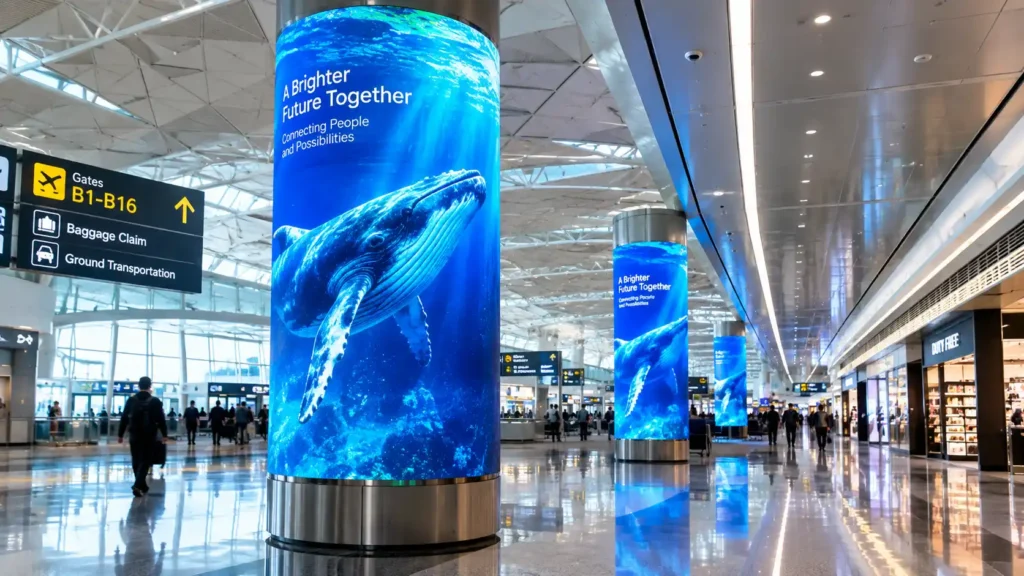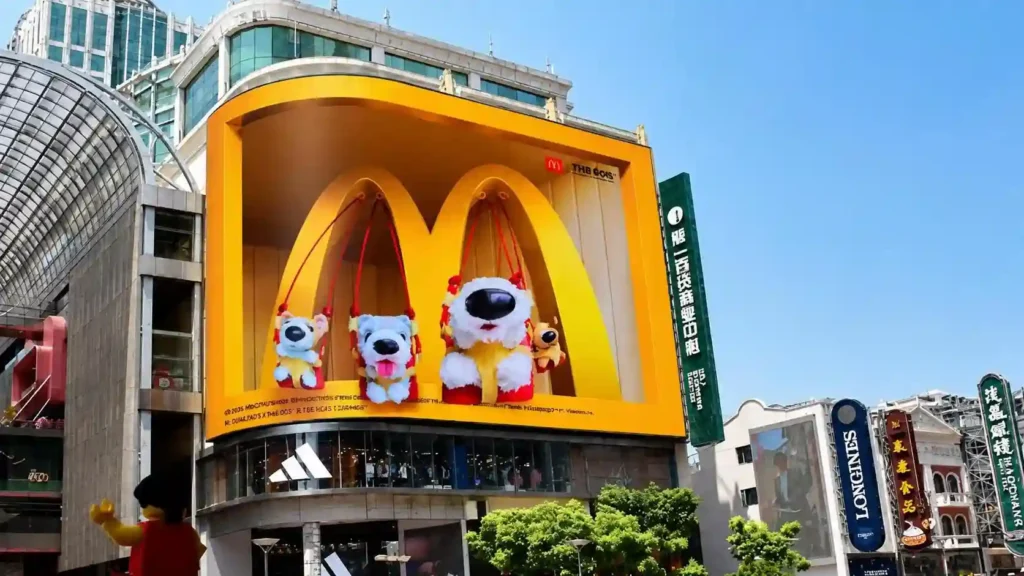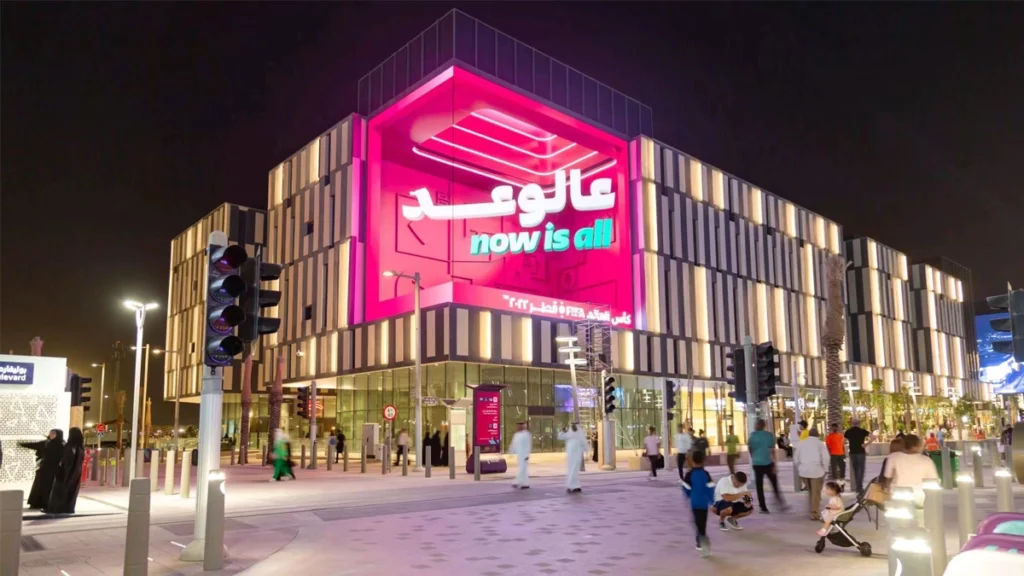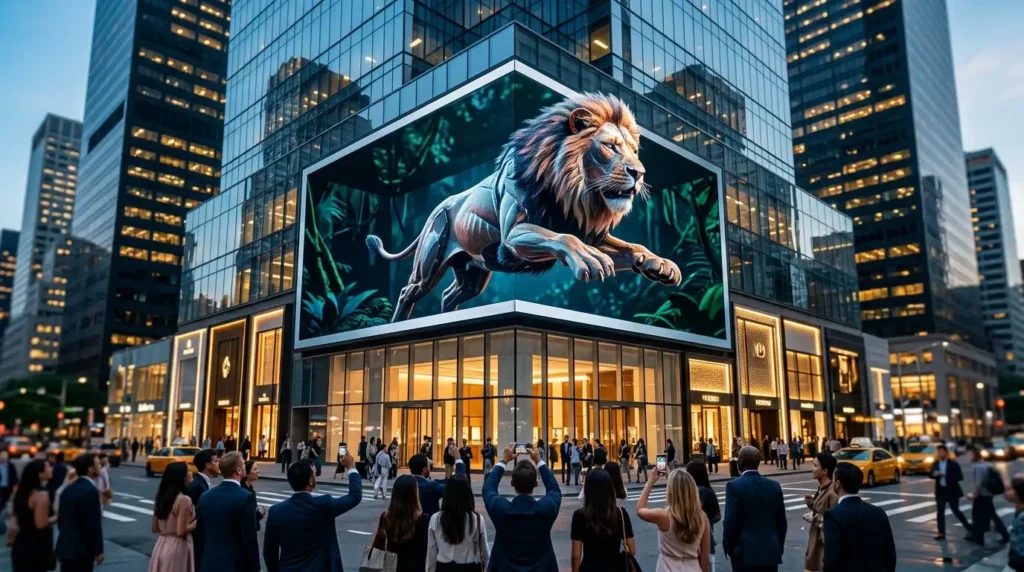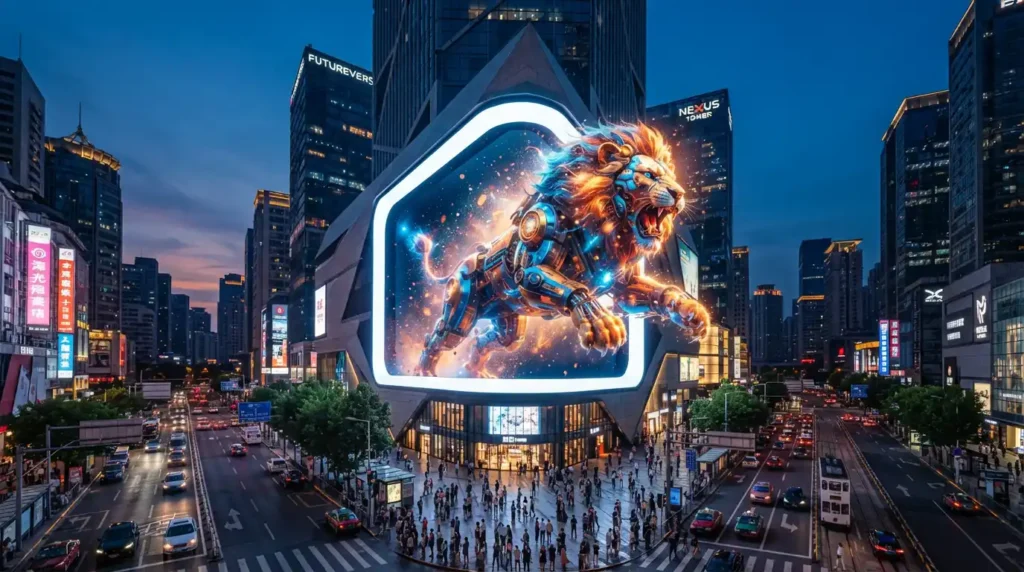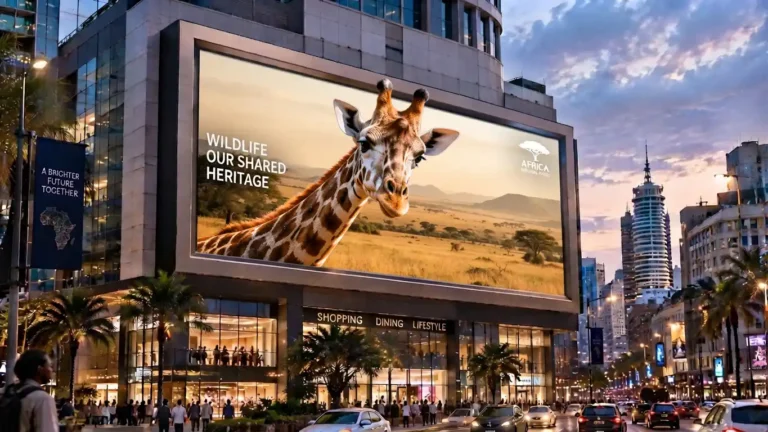
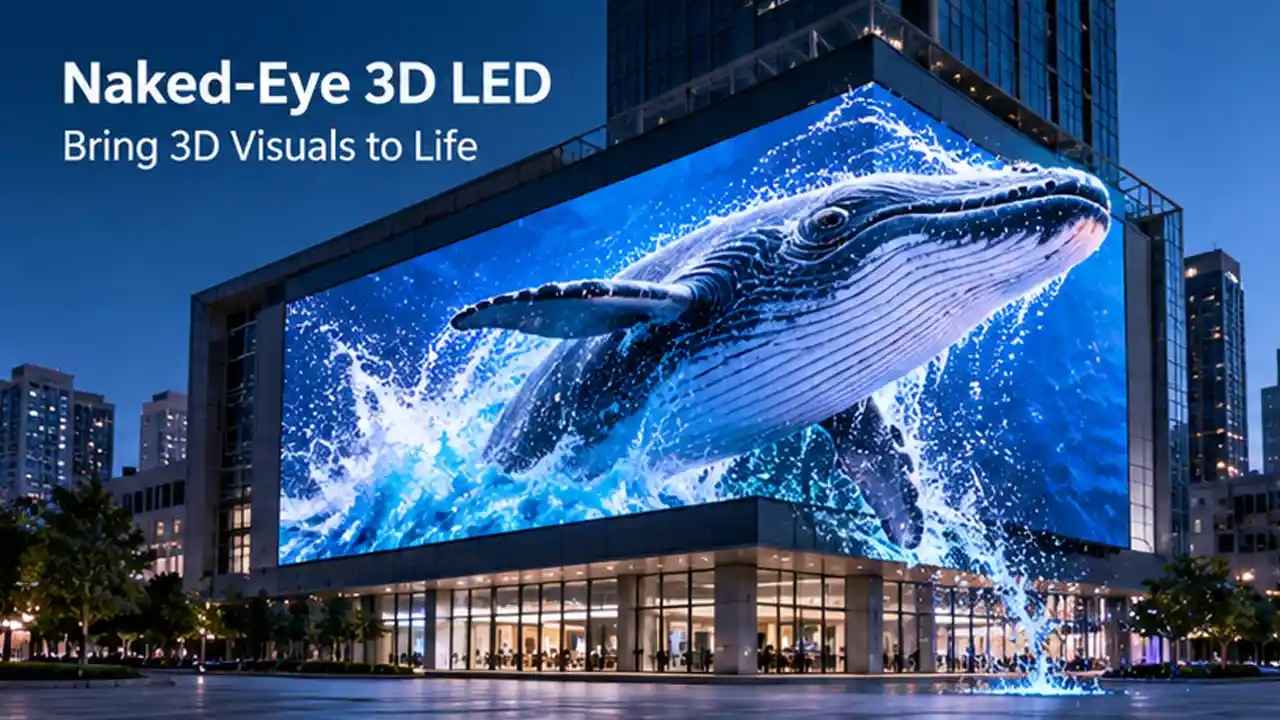
Anamorphic 3D LED content production is the process of authoring video that reads as three-dimensional on a physical LED screen, and generative AI has started to change how that work is done. AI accelerates content creation, but successful anamorphic 3D LED advertising still depends on precise coordination between screen geometry, viewing perspective and human engineering expertise. Context: PW Consulting estimates the naked-eye 3D LED display market at US$4.45 billion in 2025, rising to US$11.14 billion by 2032 at a 14.0% CAGR, with outdoor installations at 70.2% and commercial advertising at 55.3% (third-party estimate, 2025). The World Out of Home Organization puts global DOOH revenue at US$25.5 billion in 2025 and about US$28 billion in 2026 (third-party estimate, 2025–2026). Both are commercial research estimates whose methodologies differ — directional context only.
Key Takeaways
- AI shortens the front half of the pipeline. Concept routes, storyboard variants, reference imagery, matte cleanup, texture passes, upscaling and version exports take fewer hours; geometry and perspective work does not.
- The 3D effect belongs to the installation, not the file. Screen width and height, corner angle, cabinet grid, mounting height and the designated viewing position determine the virtual camera and the 1:1 pixel mapping.
- Ask for the eight-item project information checklist before any content quote. Missing geometry data is the most common reason a video has to be re-rendered after the screen is built.
- Deliverables and cost are contractual, not universal. On-site commissioning, structural work and media-player hardware are separate line items; there is no fixed “AI discount” percentage to quote.
- A single supplier reduces adaptation errors. When the cabinet drawing and the video render come from the same project data, fewer assumptions cross between teams.
1. How Is AI Changing Anamorphic 3D LED Content Production?
AI changes the front half of the pipeline — concept exploration, reference generation and repetitive asset preparation — far more than the geometry-dependent stages that decide whether a 3D illusion works on a real screen. Deloitte’s Technology, Media & Telecommunications Predictions 2026 describes generative video tools as “less about replacing the entire production stack to render fully synthetic content, and more about eliminating costly micro-tasks, compressing the time to create” (Deloitte, 2026).
- Concept and storyboard variants. Text-to-image and text-to-video models produce several visual directions in the time a studio once spent on one; most are discarded before geometry work starts.
- 3D modeling and asset prep. Retopology, texture generation, matte cleanup and upscaling cut manual passes on supporting assets, but do not change the perspective model that places them at a building corner.
- Repetitive production work. Batch transcoding, format versions, language variants, loop trimming and delivery exports suit automation — often the largest hour reduction on multi-campaign screens.
- Timeline and cost structure. Faster concept approval pulls production forward and fewer asset passes reduce billable hours, while review rounds, mapping and playback testing remain.
- Where AI stops. A generated clip knows nothing of corner angle, cabinet grid, mounting height, pixel matrix or viewing zone. For the mechanism, see how a 90° corner and forced perspective produce the naked-eye 3D effect.
AI can propose; it cannot sign off.
2. Why Does Human Engineering Expertise Still Matter in Naked-Eye 3D LED Production?
Because the 3D effect is a property of a specific installation, not of the video file alone. Screen width and height, corner angle, cabinet grid, mounting height and one dominant viewing position determine the virtual camera; those inputs come from drawings and site survey, not a prompt.
Real-World Anamorphic 3D LED Screen Installations & Content Integration
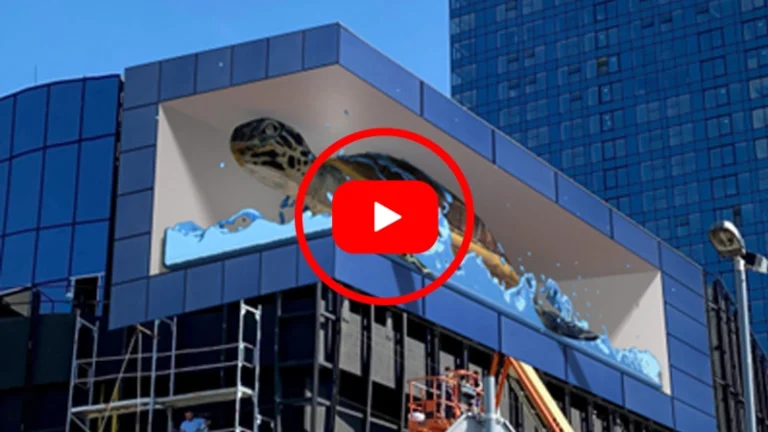
A behind-the-scenes look at the IDB Bank 3D project in Port of Spain, detailing how raw scripting, spatial 3D modeling, and anamorphic perspective mapping transform into a client-approved commercial LED installation.
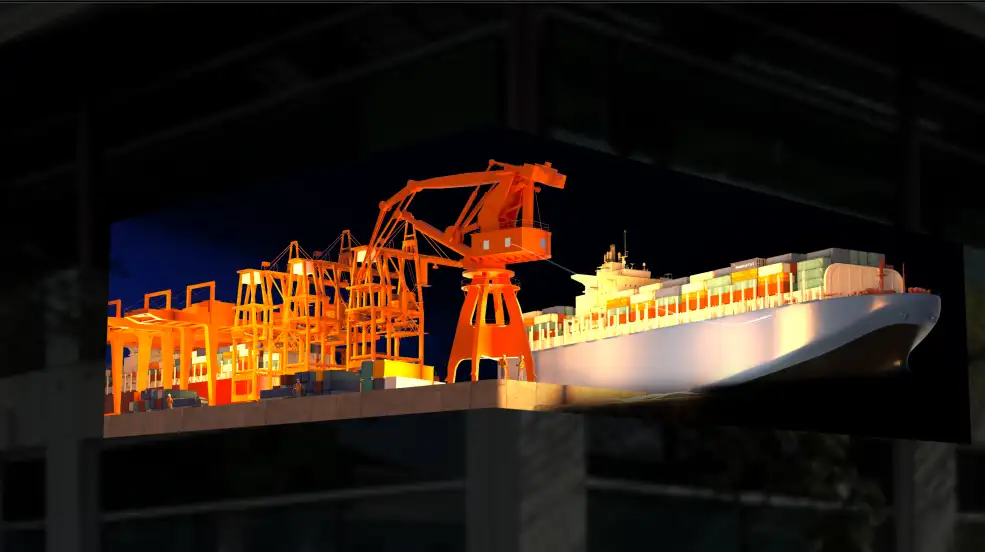
- Screen aspect ratio and physical dimensions. Adhaiwell’s 3D specification shows a corner designed around 12 m × 9 m with 960 mm cabinets resolving to about 12.48 m × 9.6 m after module alignment (2026). Content authored for the nominal size would be stretched against the built grid.
- Corner angle and cabinet geometry. Two faces meet at 90° with CNC tolerance near ±0.1 mm; transparent cabinets offer ±15° arc locks and selected rental cabinets adjust in 2.5° increments from −5° to +5° (Adhaiwell, 2026). Each changes where the halves of an object meet.
- Installation height. A screen 4 m above a plaza and the same screen 12 m up a tower are seen from different downward angles; a camera set at screen-centre height puts floating objects at the wrong elevation.
- Viewing position and distance. The illusion is calibrated to one dominant zone. Adhaiwell’s guidance matches pitch to distance — P3.91 for 10–15 m, P4.81 for 15–25 m, P6.25 for 25–40 m, P8–P10 beyond 40 m — with a minimum near 4 m × 3 m per face and landmark screens around 10 m × 10 m (2026).
- Content perspective and camera positioning. L-shaped builds need separate left- and right-face renders from one shared camera so an object stays continuous across the joint. This is a modelling decision from geometry data, not something a video model infers from text. Custom naked-eye 3D LED screen solutions built around the actual cabinet grid treat it as engineering scope, not a post-installation add-on.
- Screen mapping and real-world verification. Final files are rendered at 1:1 pixel-to-pixel accuracy to the exact resolution and corner aspect ratio, then checked in playback for tearing, scale stretch and joint discontinuity (Adhaiwell, 2026).
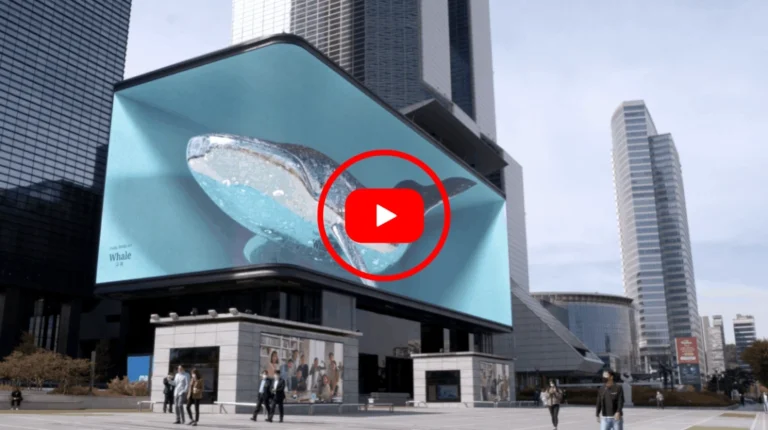
Seoul’s COEX “WAVE” (d’strict, 2020) shows where the effort sits: roughly 80.8 m × 20.1 m, about 1,600 m² of 8K LED from more than 31,000 panels, playing about one minute per hour. Production took roughly four months, three spent on design and field-testing the illusion from multiple viewing angles (d’strict and CNN coverage, 2020, cited in Adhaiwell’s deployment-location analysis of landmark 3D billboards). The hardware was settled early; the long part was human perspective verification.
3. How Does Adhaiwell Structure an AI-Assisted, Human-Controlled 3D LED Content Workflow?
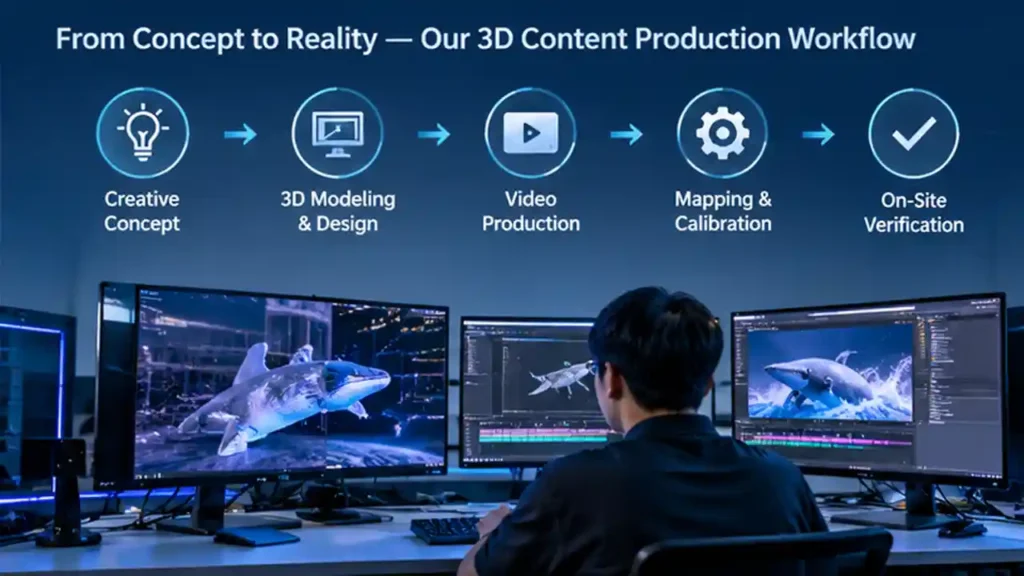
AI tools sit in the early, reversible stages — concept exploration and asset preparation — while geometry, perspective and mapping decisions stay with the engineering and content team. Nothing expensive is built until the physical inputs are confirmed.
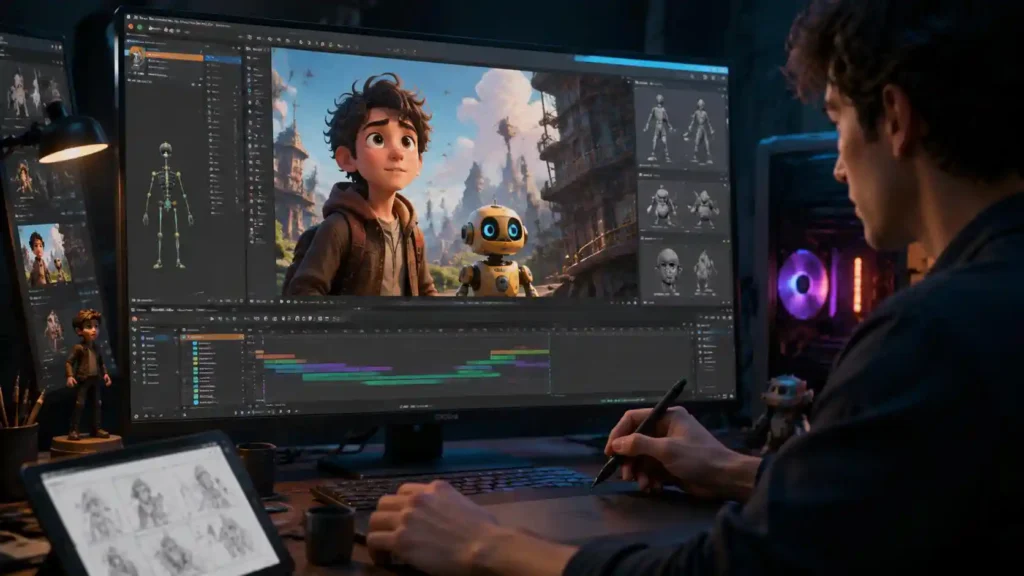
To be precise: Adhaiwell’s custom 3D LED screen specification describes an in-house team using Cinema 4D and Unreal Engine, separate face renders at 1:1 accuracy, and per-project revision rounds (2026). AI assistance is an efficiency layer here, not a replacement for that team or the mapping requirement.
- Requirements and screen information. Site photos or a short video, elevation drawings, dimensions per face, corner angles, viewing-zone constraints and environment data — the set the page says supports a two-day quotation turn (2026).
- Creative concept with AI assistance. Concept frames and storyboard variants are generated, compared and reduced to one approved route; brand assets, colour standards and legal clearance stay under human control.
- Geometry and viewing perspective analysis. Engineers confirm the cabinet grid, corner angle, arc radius, mounting height and viewing zone, with pitch and brightness following from geometry. Published lead times: 15–20 days for standard cabinets, 25–35 days for custom projects from approved drawings, +5–7 days for sizes outside standard tooling grids (Adhaiwell, 2026).
- Anamorphic 3D design and production. Perspective-corrected animation in Cinema 4D and Unreal Engine with separate face renders. For the technique, see the step-by-step guide to designing naked-eye 3D LED videos.
- Human review, perspective adjustment and mapping. Reviewers check the corner joint and apparent depth against the confirmed viewing zone, adjust the virtual camera, and map files 1:1; revision rounds are agreed here.
- Playback testing and final delivery. Files are exported for the controller — Novastar synchronous playback or asynchronous 4G/Wi-Fi scheduling — and checked at the screen’s exact resolution (Adhaiwell, 2026). Hardware validation runs separately: a 72-hour aging test and an explicit 90° corner trial fit before packing.
4. What Information Is Needed Before Producing a 3D LED Video?
A usable content brief needs eight inputs, mostly geometry. Supplying them together avoids a re-render after cabinets are on site.
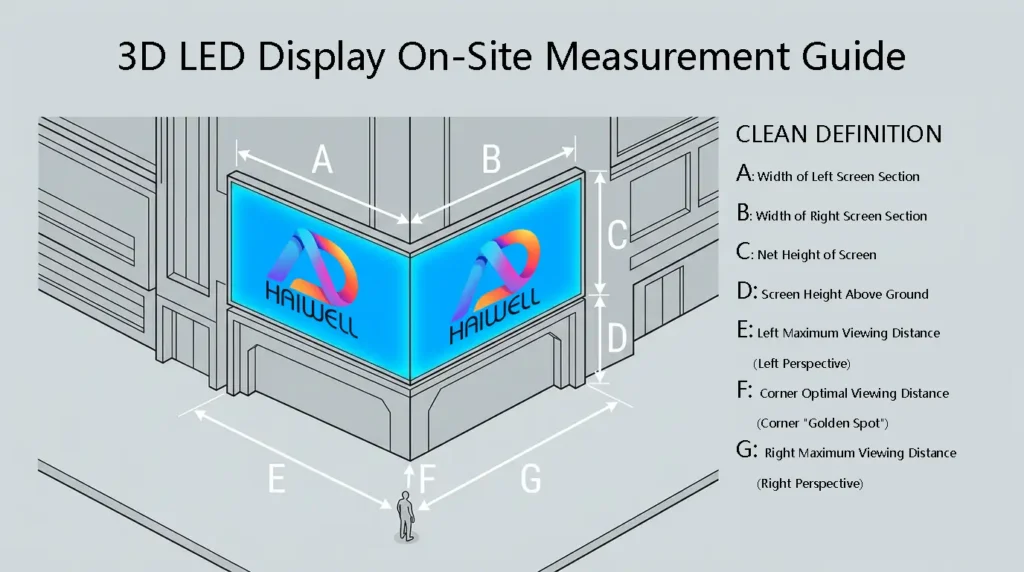
Project Information Checklist
| # | Item | What to supply | Why it changes the video |
|---|---|---|---|
| 1 | Screen width and height | Per face, in confirmed cabinet multiples | Sets the render canvas; 12 m × 9 m may build as 12.48 m × 9.6 m |
| 2 | Screen aspect ratio | Left- and right-face proportions after alignment | Determines anamorphic distortion and object scale |
| 3 | Corner angle and cabinet layout | 90°, bevel or arc radius; transition cabinets; grid; seam | Defines where the two halves of an object meet |
| 4 | Installation height | Lower-edge and centre elevation above ground | Sets the downward angle of the virtual camera |
| 5 | Main viewing point and distance | Dominant position, range, approach angles | Fixes the perspective zone and pixel-pitch choice |
| 6 | Pixel pitch and resolution | Confirmed pitch (P3.91–P10) and exact pixel matrix per face | Enables 1:1 mapping without resampling or tearing |
| 7 | Screen configuration and playback | Controller, sync mode, codec, loop length, scheduling | Determines export format, file size and loading |
| 8 | Creative brief and brand assets | Logos, colours, product files, duration, languages, revisions | Fixes approval criteria and deliverable variants |
A site video plus approximate dimensions and viewing distance is enough for a first geometry proposal; the rest is confirmed before rendering (Adhaiwell, 2026). Avoid authoring final animation against an unconfirmed pixel matrix.
5. What Are the Deliverables of a Professional Anamorphic 3D LED Project?
Six deliverables normally sit inside a content scope; on-site commissioning, structural work and media-player hardware are separate items, not automatic inclusions.
| Deliverable | Standard content scope | Optional / separately quoted |
|---|---|---|
| 3D creative concept and storyboard | One approved route with concept frames and storyboard | Extra campaign routes, seasonal or language variants |
| Screen geometry and perspective reference | Confirmed dimensions, corner angle, cabinet grid, viewing zone | Full site survey, structural load calculations |
| Anamorphic 3D animation | One perspective-corrected animation, left- and right-face renders | Extra bespoke modelling, product variants, VFX passes |
| Screen-matched video files | Exact resolution and corner aspect ratio, 1:1 pixel mapping | Re-mapping for a second screen with different geometry |
| Playback testing and visual review | Factory playback check and agreed review rounds | On-site viewing-zone verification, local attendance |
| Final approved content files | Agreed playback format, loop and scheduling settings | Media player hardware, CMS setup, content refresh |
Scope differs by contract: screen-only, screen-plus-content and turnkey orders do not carry the same deliverables, and Adhaiwell lists installation guidance as a project service rather than a default content item (2026). For hardware-led offers, outdoor 3D LED screens supplied with custom 3D content show the paired configuration.
6. What Affects the Cost of 3D LED Content Production?
Seven variables drive the number, and only the first two are meaningfully reduced by AI.
- Animation complexity and VFX. One object breaking the frame costs less than a scene with fluids, particles, reflections and lighting changes.
- 3D modeling and assets. Bespoke models and licensed assets add cost; adapting a library animation costs less, and AI-assisted texture and cleanup work reduces this line item specifically.
- Duration and resolution. Longer loops and larger pixel matrices increase render and export time.
- Screen geometry and mapping complexity. A flat face is straightforward; a 90° corner needs two matched renders and curved or transparent builds need extra perspective work. AI does not compress this, because it depends on measured drawings.
- Number of revisions. Adhaiwell lists “revision rounds” as a defined content field (2026); late camera changes are effectively a re-render.
- Production deadline. Compressed schedules compete with the 25–35-day custom hardware build and its 72-hour aging test.
- On-site testing and additional services. Viewing-zone verification, local attendance, CMS setup and refresh programmes are quoted separately.
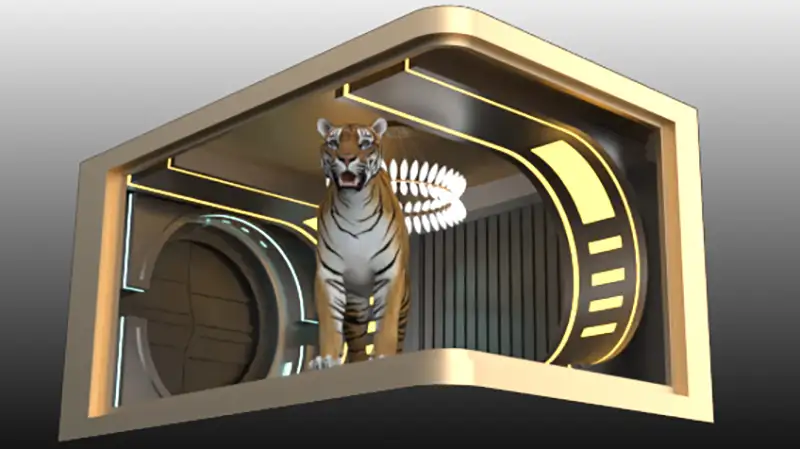
Anamorphic 3D LED Integration:
The Frankfurt Tiger Installation Showcase
An analysis of the Light & Building 2024 trade fair exhibit in Frankfurt, demonstrating how precise curved cabinet engineering, seamless corner structural design, and pixel-mapped anamorphic video synchronization deliver immersive depth realism in live environments.
AI reduces cost on repetitive work — concept variants, matte cleanup, texture passes, version exports — not on measured geometry or files re-rendered after the cabinet grid changes. There is no defensible fixed percentage: Adhaiwell states 3D projects are quoted per project rather than by square-meter rates and lists anamorphic content as one of five price variables (2026). A blanket “AI discount” should prompt one question: which tasks were actually removed?
7. Why Choose an Integrated 3D LED Screen and Content Solution?
Because most content failures are coordination failures: screen and video get specified from different drawings. One supplier holding the cabinet grid, viewing-zone data and render spec means fewer assumptions cross a boundary.
- Screen and content coordination. Geometry is confirmed before the canvas is set, so the 12 m × 9 m → 12.48 m × 9.6 m alignment problem is solved on the drawing.
- Fewer communication gaps. Cabinet angles, transition pieces, seam positions and the pixel matrix come from one project file. Screen, steel structure and anamorphic 3D content engineered under one supplier remove the need to translate an integrator’s drawing into a studio’s assumptions.
- Fewer adaptation errors. Separate face renders are authored against the corner specification the factory trial-fits, reducing tearing and scale stretch.
- More efficient coordination. Content can run in parallel with the 25–35-working-day manufacturing window (Adhaiwell, 2026).
- Better alignment with screen performance. Brightness, refresh rate and controller are known when the export format is chosen.
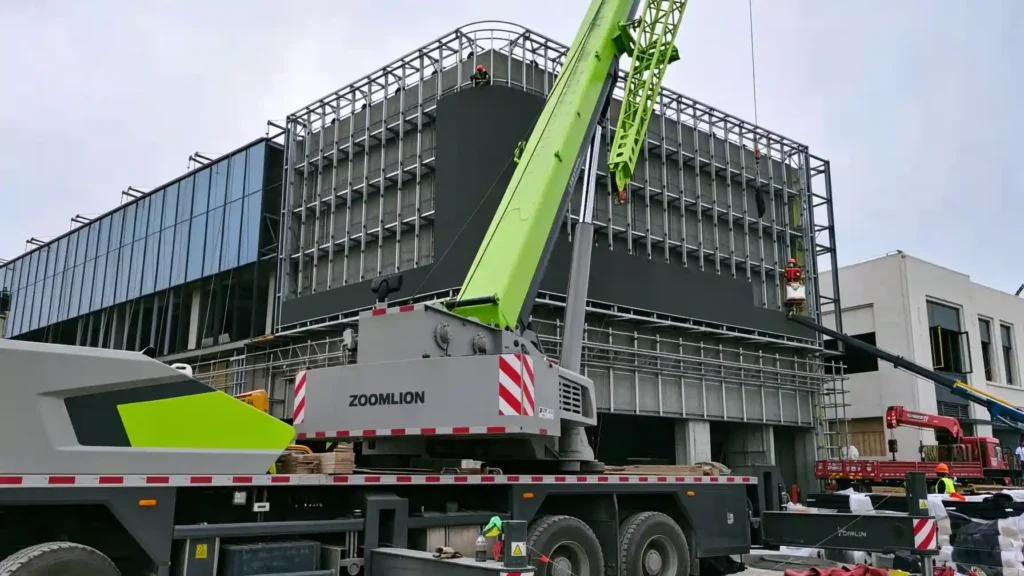
Adhaiwell is a Shenzhen OEM/ODM manufacturer with more than 15 years of LED display production experience. Its published 3D scope brings hardware, structural engineering and content production under one supplier, with free custom steel-structure drawings from site data and remote or on-site installation guidance; local structural engineers retain final sign-off (2026). A documented example is the turnkey 3D billboard project in Fiji covering structural calculations and anamorphic content.
Integrated 3D Billboard Solutions:
From Structural Engineering to Anamorphic Content
An overview of the Fiji outdoor commercial project, detailing an end-to-end delivery framework that combines custom 3D billboard structural design, tender-stage technical support, precision LED screen manufacturing, and pixel-mapped anamorphic 3D visual creation.
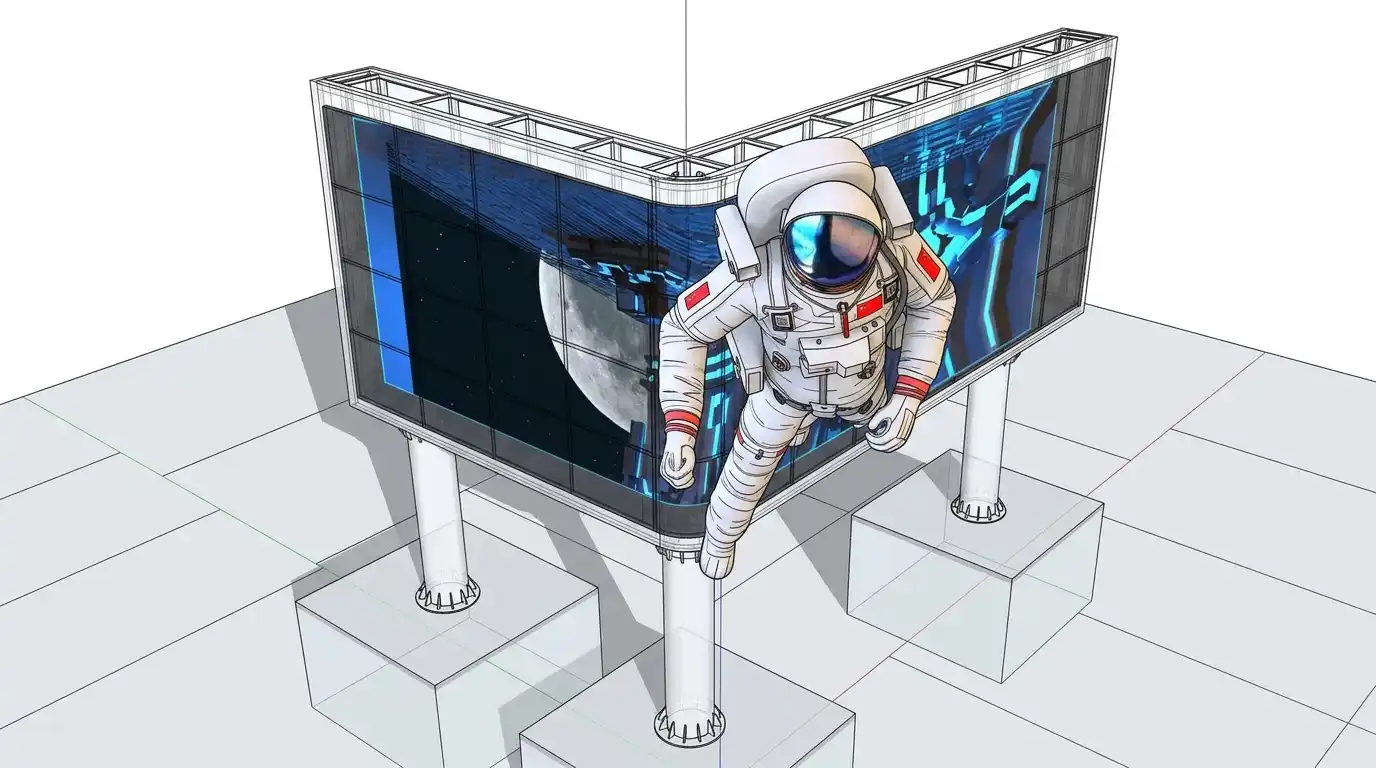
When comparing suppliers, ask five questions: which cabinet grid and corner drawing authored the video; what pixel matrix applies per face; which viewing zone and camera position were used; how many review rounds are included; who signs off as-built geometry if the structure is built locally.
Frequently Asked Questions About AI-Assisted 3D LED Content Production
These answers come from Adhaiwell’s engineering and in-house content team in Shenzhen, with more than 15 years of LED display production experience across L-shaped, curved and transparent 3D export projects.
Can AI create anamorphic 3D LED videos automatically?
No, not for a specific installed screen. AI generates concepts and short clips but knows nothing of corner angle, cabinet grid, mounting height or viewing zone; a usable file still needs the exact pixel matrix and a playback review from the designated position.
Does every 3D LED screen require custom video content?
In practice, yes for a corner or curved build. Stock footage is authored for a flat rectangle, so its perspective lines will not converge at your corner; flat screens running 2D playback are the exception.
Why does the corner angle affect anamorphic 3D content?
Because the two faces form the physical edge an object appears to cross, and the virtual camera must be positioned relative to that joint. At a 90° corner each face carries a different part of the same object, so a 2.5° shift in an arc lock breaks the illusion while the video file stays unchanged.
What information should I provide before requesting a 3D LED video?
Start with eight items: width and height per face, aspect ratio, corner angle and cabinet layout, installation height, main viewing point and distance, pixel pitch and resolution, playback configuration, and a creative brief with brand assets. A site video plus approximate dimensions and viewing distance is enough to begin.
Can the same 3D video be used on different LED screens?
Only if dimensions, corner angle, pixel matrix and viewing position match, which is rare. Reuse usually produces stretched scale, torn edges or weak depth, so ask for a re-mapping quote rather than a new campaign.
Does AI reduce the cost of 3D LED content production?
It reduces cost on repetitive tasks, not on geometry and verification. Expect savings in concept variants, asset preparation and version exports, not in site measurement or playback review; the quote depends on the seven cost variables above.
Can Adhaiwell provide both 3D LED screens and matching video content?
Yes — the published custom 3D LED screen scope combines hardware, structural engineering and anamorphic content under one supplier, with 1:1 pixel-mapped files. On-site installation is quoted separately, so confirm the content deliverables in writing.
Conclusion — Combining AI Efficiency with Human Expertise
AI-assisted workflows change the economics of the front half of anamorphic 3D LED content production, not the physics of the finished effect. Concept work and asset preparation move faster; the decisions that make depth read on a building corner still come from measured geometry and human perspective review. Buyers who treat screen and video as one specification spend less on late adaptation. Send the eight checklist items, request a written content scope, and ask the five supplier-evaluation questions before approving a storyboard. Adhaiwell’s coordinated screen-and-content service follows that sequence.