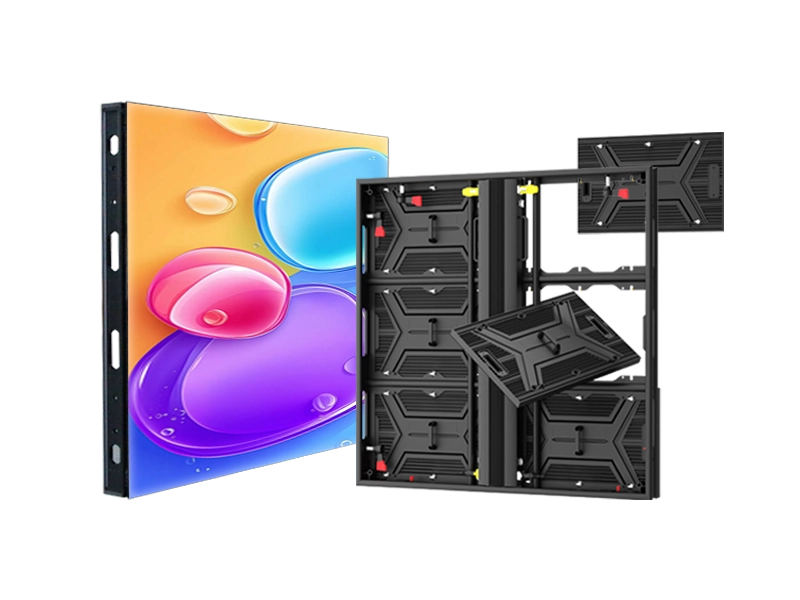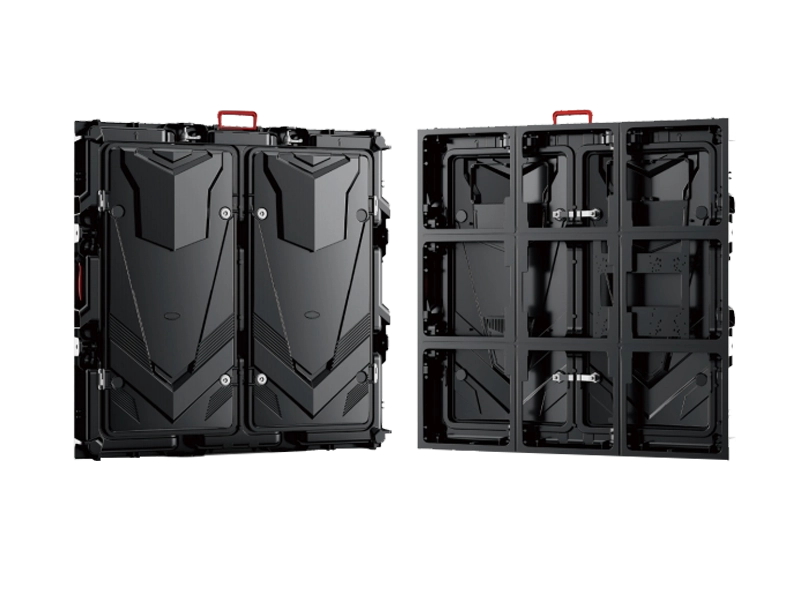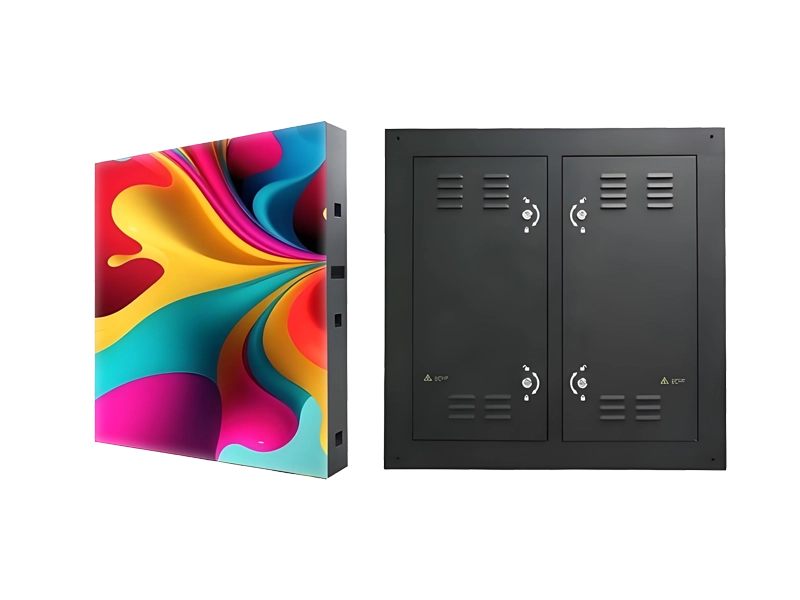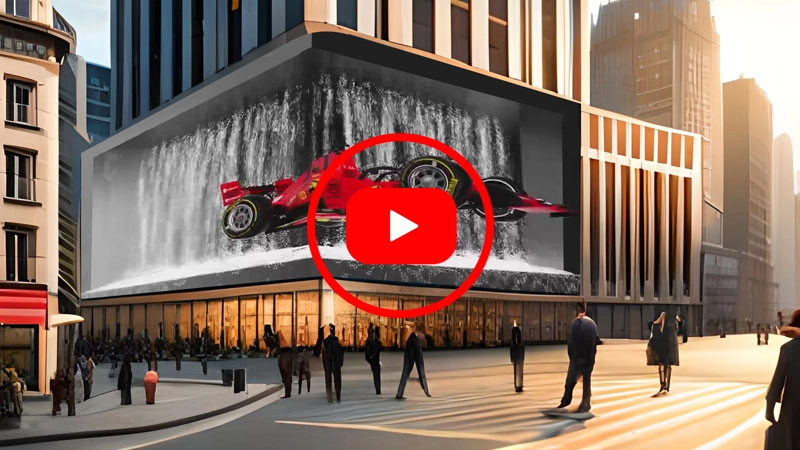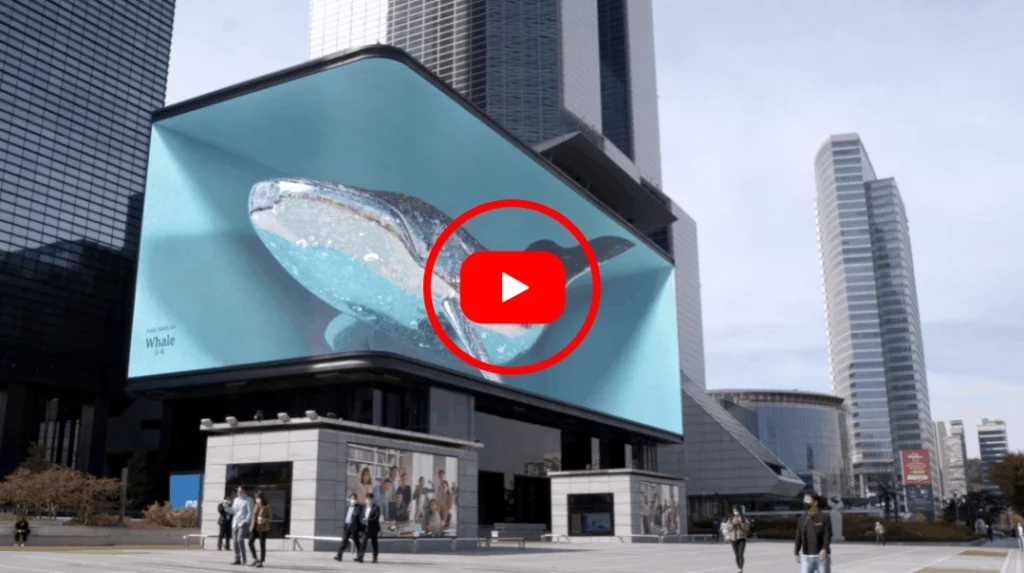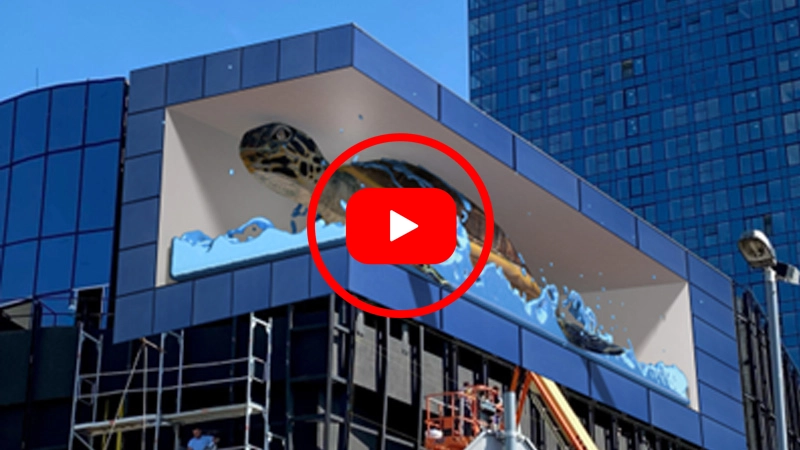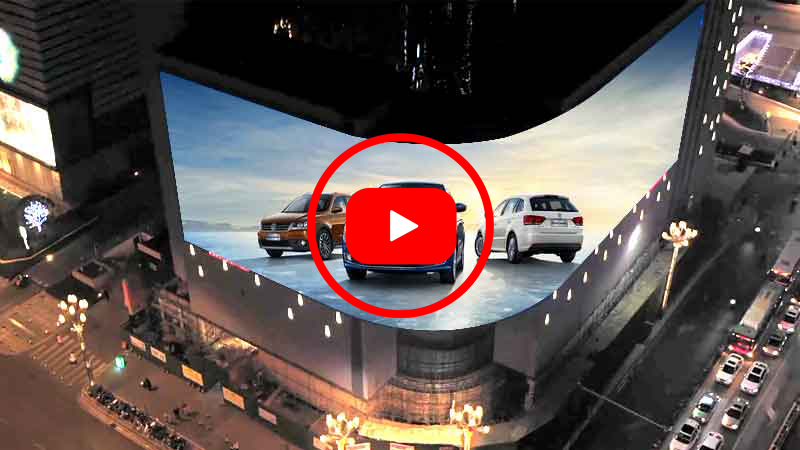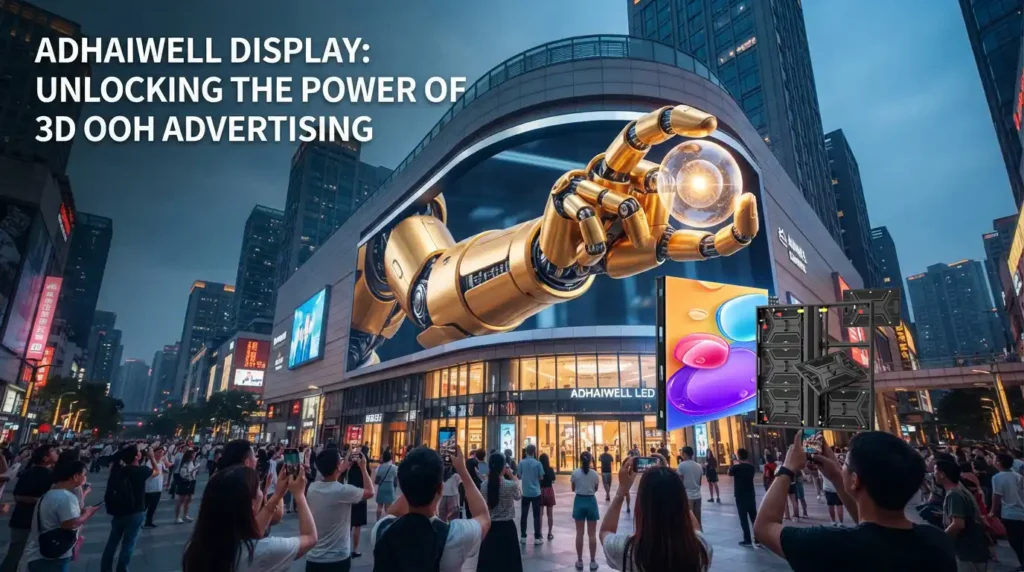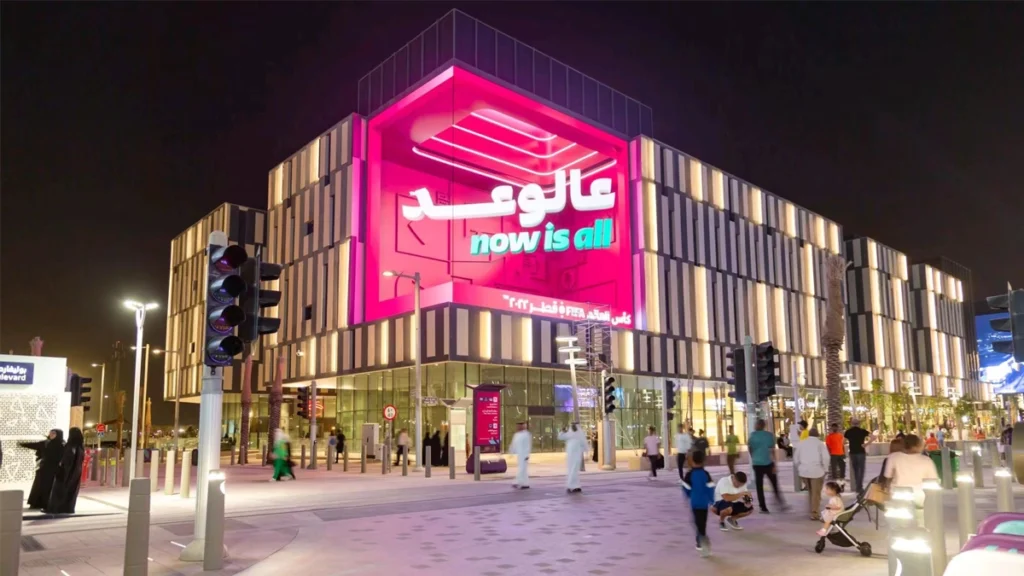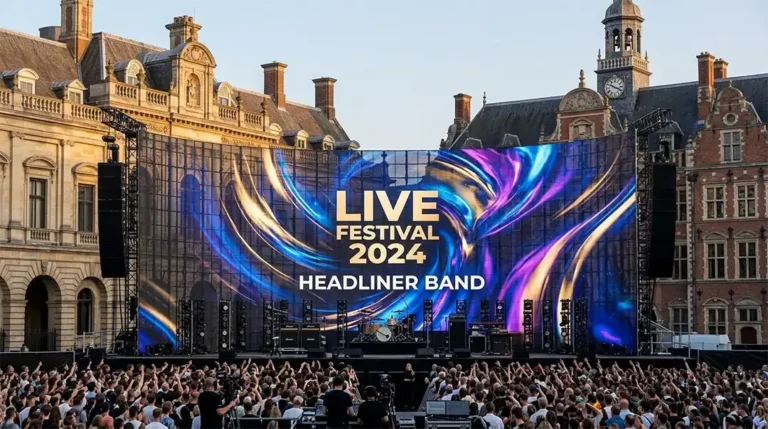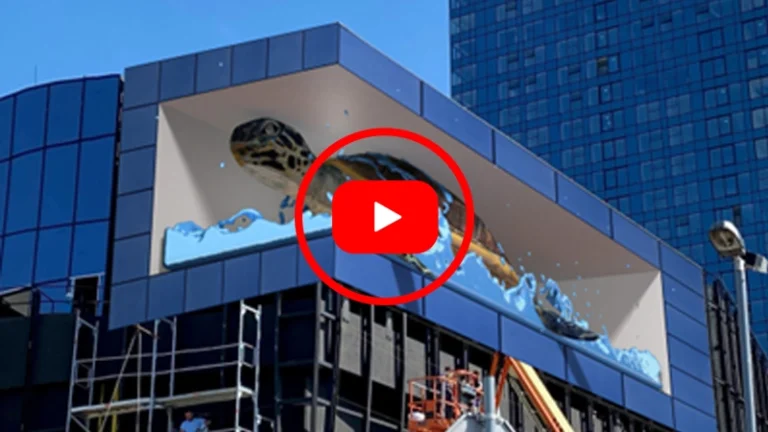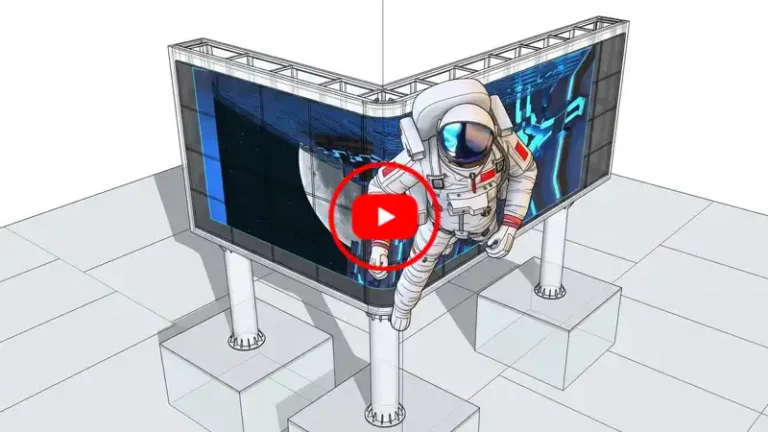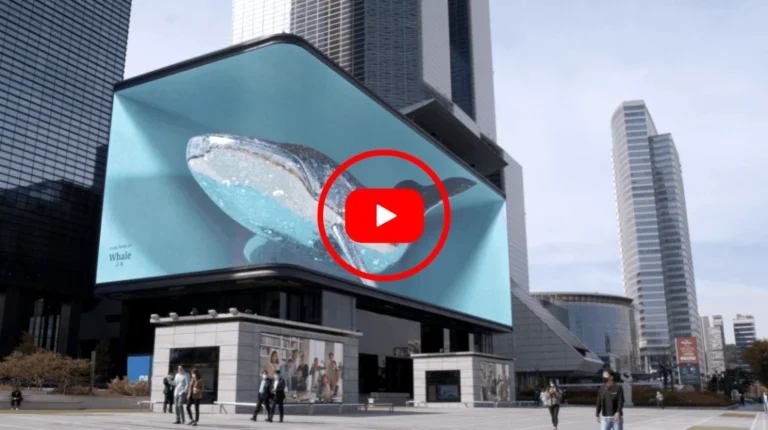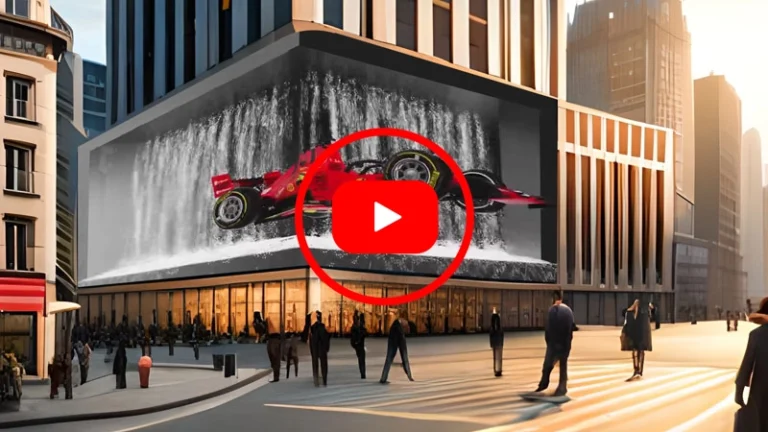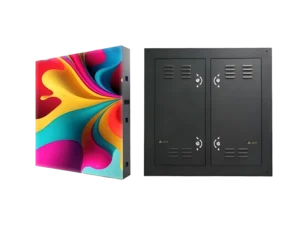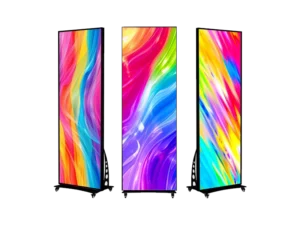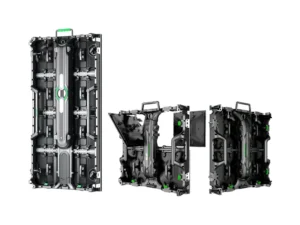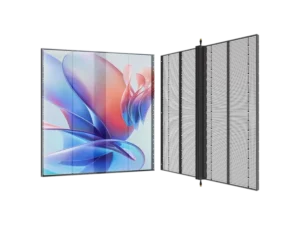
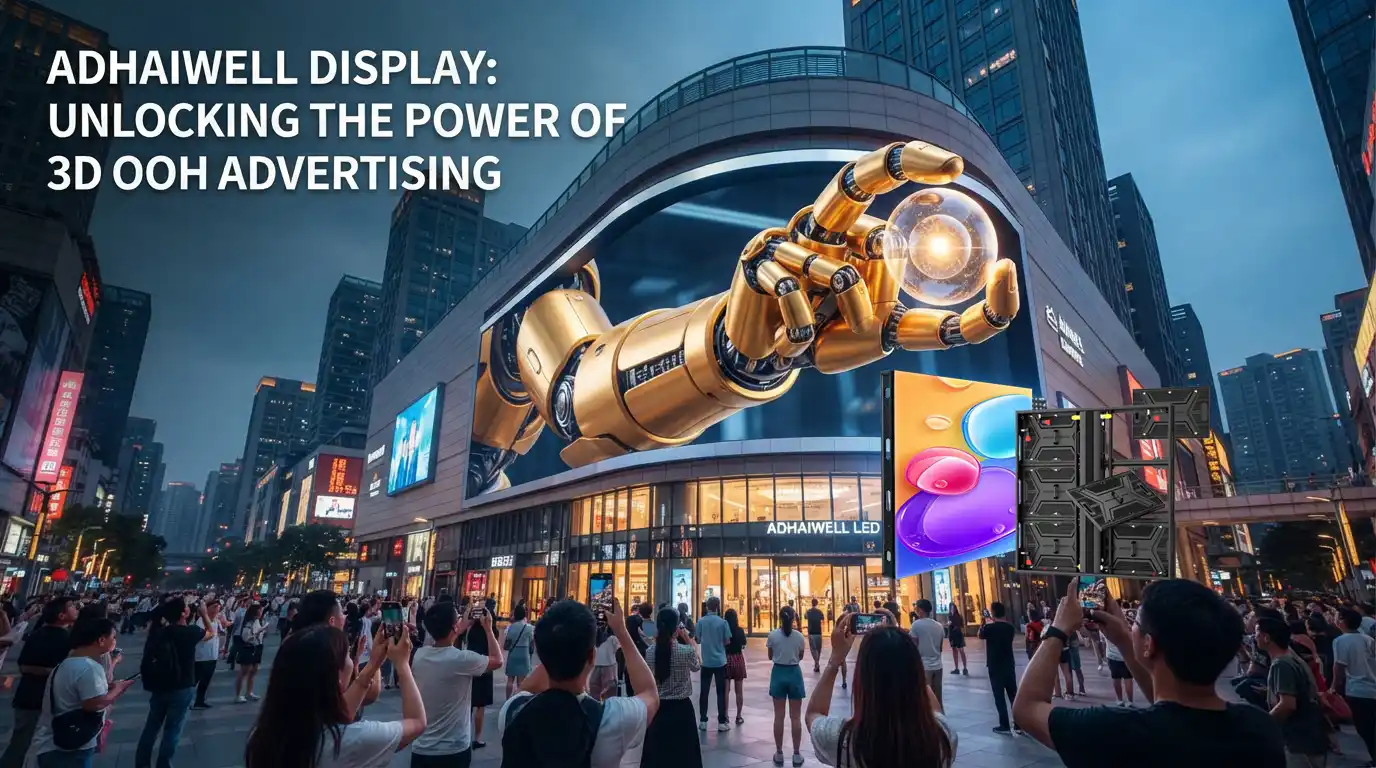
A Naked eye 3D LED display creates a glasses-free 3D effect by combining an L-shaped, right-angle LED screen with anamorphic 3D video and forced perspective. The screen provides the corner geometry, the content provides the illusion, and the two have to be engineered to match. When they do, a flat two-sided billboard reads as a window with objects floating outside the building — no glasses, no headsets, no extra hardware.
If you are sourcing from China — as a media operator, an integrator, or a property developer — the technology is only half the story. This guide covers how the effect works, which hardware and content decisions make or break it, and what to verify before you order.
Key Takeaways
- A glasses-free 3D effect = an L-shaped right-angle LED canvas + anamorphic 3D video + forced perspective; the content and the screen corner must match 1:1.
- Minimum effective size is roughly 4m × 3m per face (about 8m total across the L-shape); landmark screens start at 10m × 10m.
- Outdoor 3D screens need 5,500–8,000 nits, a 3840Hz refresh rate, and 14-bit+ grayscale so the illusion survives daylight and smartphone cameras.
- Generic stock footage produces a weak effect; custom anamorphic content modeled on your screen’s exact geometry is what makes the depth read.
- Budget 25–35 working days of production plus 15–35 days of ocean freight, and confirm CE/RoHS/FCC/EMC certification before shipping.
What Is a Naked-Eye 3D LED Display?
A naked-eye 3D LED display is an LED screen built at a 90-degree corner — usually wrapped around a building facade — that plays video content engineered in anamorphic perspective, so viewers see three-dimensional depth without wearing 3D glasses.
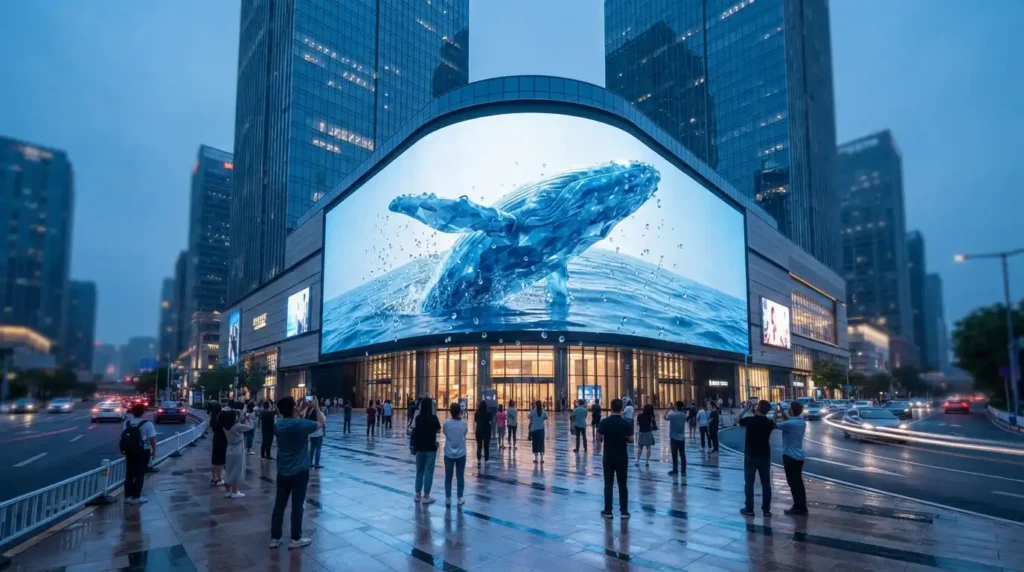
Three components do the work:
- The L-shaped right-angle LED canvas. Two screen faces meet at a true 90° corner with seamless cabinet splicing, giving the content a physical edge to “break out” from.
- Anamorphic 3D video. Content rendered for that screen’s exact dimensions, corner angle, and viewing position, so perspective lines converge correctly for pedestrians on the ground.
- Forced perspective. An optical technique that compresses depth cues into flat imagery; combined with the corner, it convinces the brain that an object occupies space in front of the building.
The category has moved beyond novelty. PW Consulting estimates the global naked-eye 3D LED display screen market at US4.45 billion in 2025, projected to reach US11.14 billion by 2032 — a 14.0% CAGR, with outdoor installations at 70.2% of the market and commercial advertising taking a 55.3% application share. These figures come from commercial research reports whose methodologies differ, so treat them as directional context rather than a forecast for any single project.
How Does the 3D Effect Work Without Glasses?
The effect works through forced perspective and parallax: the content is rendered so that, from the pedestrian’s typical viewing position, the two screen faces read as one continuous space with depth extending outward — and the corner geometry must match the content 1:1 for the illusion to hold.
Breaking it down:
- The corner is the trick. On a flat screen, your brain knows the image is flat. At a 90° corner, one face can show the “front” of an object while the other shows its “side,” so the eye interprets the two faces as a single three-dimensional volume extending past the building line.
- Forced perspective supplies the depth cues. Content designers exaggerate scale and convergence so that objects near the corner appear closest to the viewer, and objects rendered to “leave” the screen appear to float over the street.
- Parallax is fixed, not tracked. Unlike headset 3D, the effect is calibrated to one dominant viewing zone — typically across the street. Stand inside it and the depth reads correctly; stand at a steep angle and the illusion weakens. That is why site geometry and viewing distance data matter before a single cabinet is ordered.
- Content and screen must match 1:1. A generic 4K anamorphic clip will not match your 8.5m × 3.5m L-shape with a 3.91mm pitch. Every dimension, corner angle, and pixel grid in the video file must map exactly onto the physical screen, or the perspective breaks and the “3D” looks like a warped 2D image.
That last point is where most buyers stumble: the screen is only half the purchase, and the content pipeline has to start from your actual site — not from a stock template.
What Hardware Do You Need: Screen Size, Brightness, and Pixel Pitch?
You need a minimum of roughly 4m × 3m per face (about 8m total width across the L-shape) for the effect to read, outdoor brightness of 5,500–8,000 nits, and a pixel pitch chosen by viewing distance — P3.91 for 10–15m, P4.81 for 15–25m, P6.25 for 25–40m, and P8–P10 beyond 40m.
Spec by spec:
- Size. Below 4m × 3m per face, the perspective compression has too little physical room to work with and the depth reads as shallow. For landmark impact, 10m × 10m or larger per face is where installations start going viral on social media.
- Brightness. Outdoor 3D screens compete with direct sunlight. Adhaiwell’s industrial-grade outdoor LED display series is rated at 5,500–8,000 nits depending on pitch, with automatic brightness adjustment to cut power at night. Anything below about 5,000 nits looks washed out at midday in high-sun regions.
- Refresh rate. 3840Hz minimum, with 7680Hz available for broadcast-grade sites. The refresh rate is not about what the eye sees — it is about what smartphone cameras record. Scan lines on video kill the social sharing that makes 3D billboards pay for themselves.
- Grayscale and contrast. 14–16-bit grayscale (up to 24-bit processing in Adhaiwell’s Ti Series) and a 10,000:1 contrast ratio keep shadows smooth; banding in dark areas immediately exposes the screen as “flat.”
- Pixel pitch. Coarser pitches pixelate fine 3D detail at close range; overly fine pitches inflate cost with no visible benefit at 40m. Match pitch to the nearest realistic viewing distance, not to the spec sheet’s maximum.
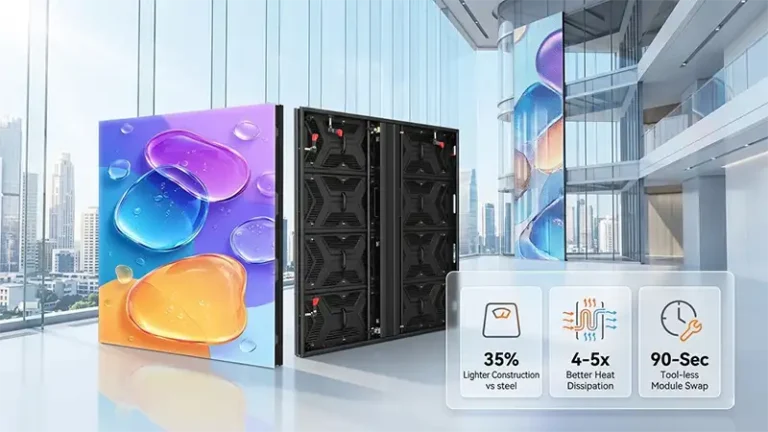
- Durability. IP65 front and rear sealing, a -20°C to +65°C operating range, and front-and-rear hot-swappable service — a module swap takes about 90 seconds without shutting down the screen.
Which LED Cabinet Type Fits Your Building: L-Shaped, Curved, or Flat?
The L-shaped right-angle cabinet delivers the strongest 3D effect and is the standard for corner buildings; curved cabinets suit cylindrical facades with a softer, wraparound illusion; flat screens produce the weakest effect and only work with carefully angled content.
| Cabinet Type | 3D Effect Strength | Structural Cost | Best Fit |
| L-shaped (90° corner) | Strongest — true corner depth, viral-grade illusion | Moderate — asymmetric wind loads need an engineered steel frame | Corner buildings, boulevard facades, landmark billboards |
| Curved / flexible | Moderate — continuous wraparound depth, no hard edge | Higher — custom bending, flexible modules, complex splicing | Cylindrical towers, atrium columns, rounded retail facades |
| Flat | Weakest — depth relies entirely on content perspective | Lowest — standard billboard structure | Walls without corners, ceiling-hung indoor screens, tight budgets |
Three practical notes:
- Corner quality decides the L-shape’s success. Adhaiwell engineers its cabinets for precise 90° splicing so pixel pitch stays consistent through the corner — any gap or misalignment shows up as a visual “seam” exactly where the depth is supposed to happen.
- Curved installations trade impact for architecture. The radius must be fixed at design stage, because anamorphic content calibrated for one radius will distort on another.
- Flat is a budget choice, not a 3D choice. If the building has no usable corner, the honest options are a projected-corner structure or a flatter “2.5D” effect from perspective content.
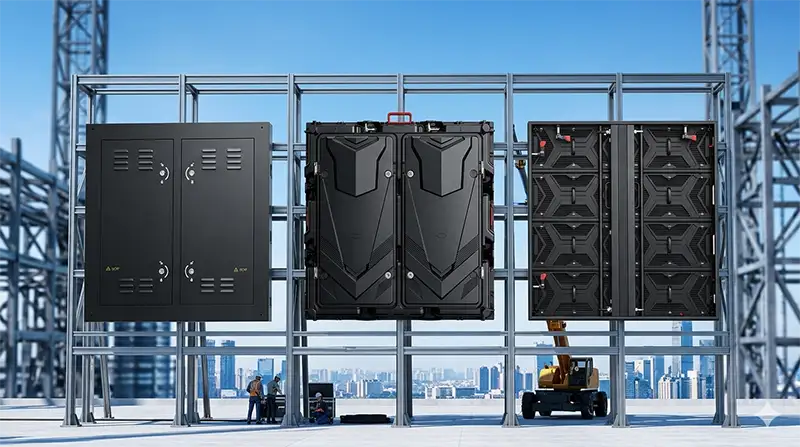
For a deeper walkthrough of cabinet materials and structures, see Adhaiwell’s guide on how to choose an outdoor LED display cabinet, which covers steel versus aluminum trade-offs in detail.
How Is the 3D Video Content Produced?
3D video content is produced through a five-step pipeline — site survey, 3D modeling, perspective calibration, rendering, and playback testing — and every step is anchored to your screen’s exact geometry, which is why generic footage underperforms and custom content is what makes the effect work.
The pipeline in practice:
- Step 1 — Site survey. The team records the building’s corner dimensions, viewing angles, and main pedestrian sightlines. A smartphone video plus approximate viewing distance is enough to start.
- Step 2 — 3D modeling. Artists build a digital twin of your exact screen — every meter of face, the corner angle, the pixel grid — inside a 3D environment (typically Cinema 4D).
- Step 3 — Perspective calibration. The virtual camera is locked to the real-world viewing position, so converging lines in the render match what a person on the sidewalk actually sees.
- Step 4 — Rendering. Scenes are rendered at the screen’s native resolution and frame rate; a 30-second anamorphic loop for a large landmark can take days of render time per revision.
- Step 5 — Playback testing. The finished file is played on the configured screen or a factory test rig to verify corner alignment, brightness behavior, and camera-friendliness before the content ships.
Adhaiwell’s team documented this workflow in its guide on how to make 3D LED videos, and its in-house C4D team delivered end-to-end content — scripting, modeling, and final render — for an IDB trade-and-development project in Port of Spain, Trinidad and Tobago (operator-reported case). The content team calibrated perspective angles against the real building geometry through remote video collaboration with local installers.
One warning for buyers: if a supplier quotes you a screen and then says “just download some 3D videos,” the effect will disappoint. Content production runs in parallel with screen manufacturing — start both at order time, not after the containers arrive.
Where Does It Make Business Sense: Outdoor Landmarks, Malls, Airports, or Retail?
It makes business sense wherever foot traffic, dwell time, and social sharing overlap: outdoor landmark billboards drive premium media rates, indoor mall and airport installations sell high-resolution brand storytelling, and retail showcase units bring the same illusion to product level.
- Outdoor landmarks (IP65, large format). The flagship use case — 70.2% of the market by type, per PW Consulting’s 2025 estimate. Owners monetize through premium advertising slots, because brands pay for the shareable moment an anamorphic campaign creates.
- Shopping malls and airports (P1.5–P3 fine pitch indoors). Indoors you control the light, so the pitch gets finer and the content more detailed. Airports reward the format: long dwell times, a captive audience, and a predictable viewing zone make perspective calibration easy.
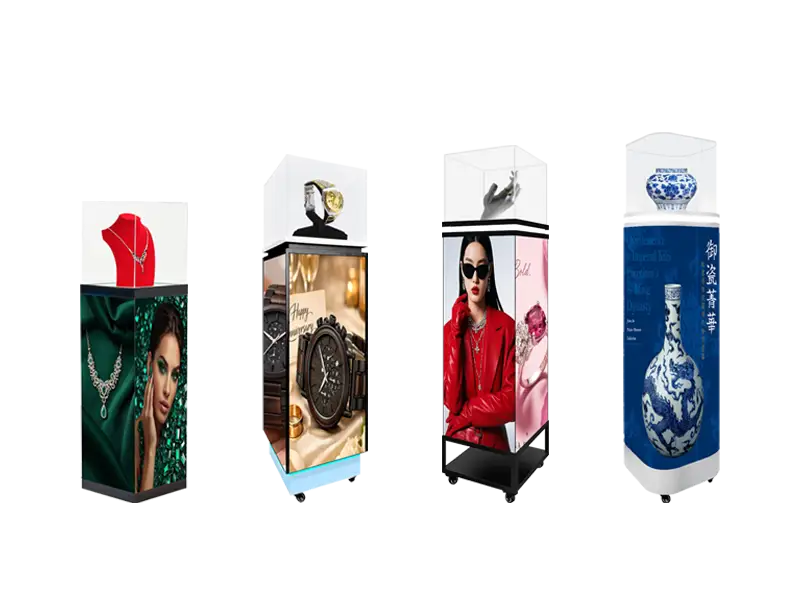
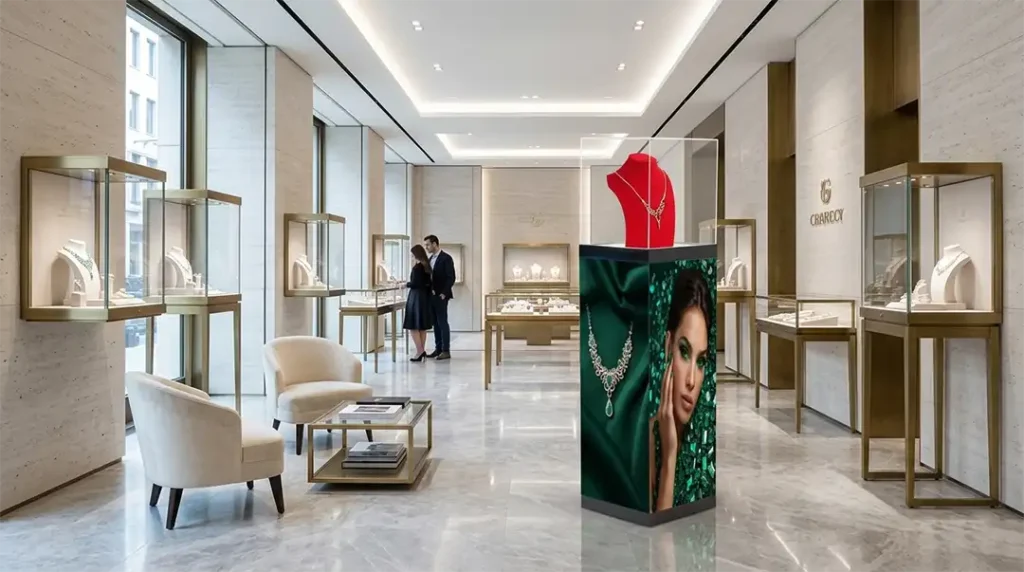
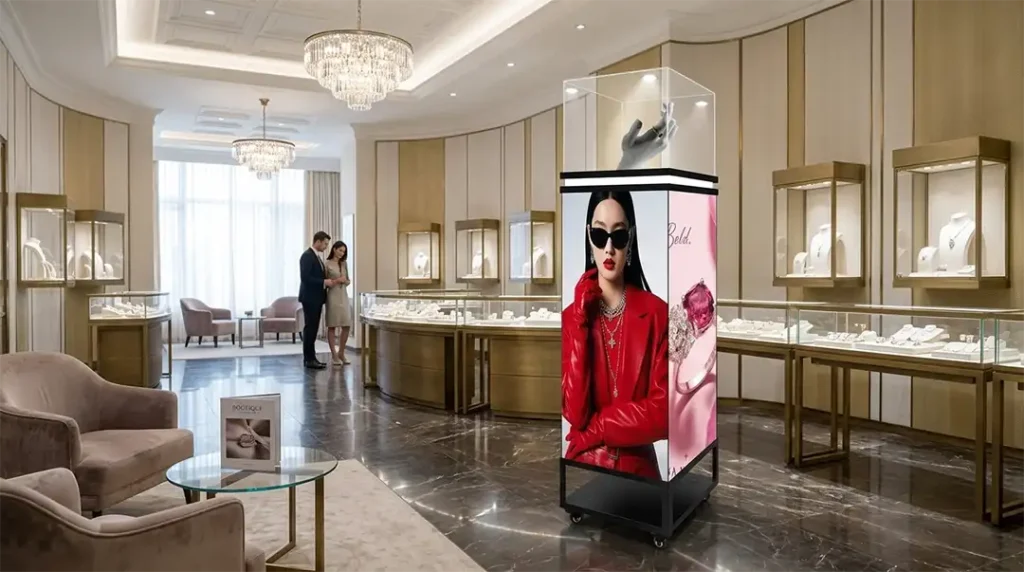
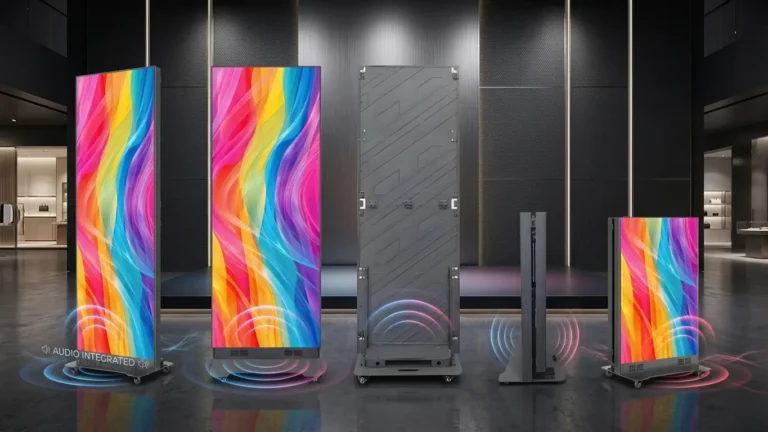
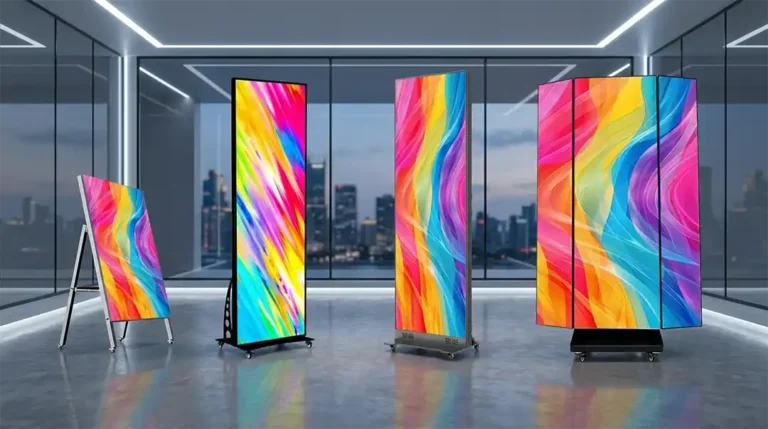
- Retail showcase level (CrystalView class). At product level, the same physics shrinks into a display case. Adhaiwell’s CrystalView 3D LED pedestal display case uses four seamless P1.86 GOB panels at 650 nits with a 3840Hz refresh rate, topped by an illuminated acrylic case for watches and jewelry — the 3D illusion sells the product sitting inside the case above it.
- A note on expectations. A 3D screen does not automatically generate revenue. The business case rests on location quality, viewing distance, and a content refresh plan — your payback depends on your site’s traffic, not on the category’s growth rate.
What Does Installation Involve: Steel Structure, Permits, and Timeline?
Installation involves an engineered steel structure designed for asymmetric loads, local permits and certifications for customs clearance, and a realistic timeline of 25–35 working days for production plus 15–35 days of ocean freight.
What to plan for:
- Steel structure engineering. An L-shaped screen places uneven wind and gravity loads on its support frame — a standard billboard structure is not automatically safe for it. Adhaiwell provides free custom steel-structure CAD drawings, load calculations, and material lists based on your site photos and video; most clients fabricate the frame locally to save shipping cost.
- Permits and compliance. Outdoor large-format screens face municipal review in most cities — structural approval, light pollution rules, and sometimes driver-distraction limits. These are local processes; a responsible supplier provides the structural drawings and electrical documentation for the application but cannot file the permit for you.
- Certifications for customs. Adhaiwell screens carry CE and EMC certification — the documents customs officers in the EU, UK, US, Canada, Australia, and the Middle East will ask for at import.
- Timeline. Production runs 25–35 working days (including a 72-hour burn-in test before shipment), followed by 15–35 days of ocean freight. 3D video production runs in parallel, and air freight is available for urgent launches. Adhaiwell’s recent P4.81 aluminum-profile installation for a 6m × 3m facade in Bulgaria (operator-reported case) followed this sequence with weekly photo and video production updates.
FAQ: 5 Questions Buyers Ask Before Ordering a 3D LED Screen
These answers come from Adhaiwell’s engineering and export team — a Shenzhen factory with 16+ years of LED display manufacturing and projects delivered to buyers in 60+ countries. The same questions come up in nearly every first inquiry, so they are answered here in plain terms.
1. What is the minimum screen size for a convincing 3D effect? About 4m × 3m per face, which gives an L-shape of roughly 8m total width. Below that, forced perspective has too little canvas to work with. For landmark-grade impact, plan on 10m × 10m or larger.
2. Which pixel pitch should I choose? Match pitch to viewing distance: P3.91 works for 10–15m, P4.81 for 15–25m, P6.25 for 25–40m, and P8–P10 beyond 40m. A factory that knows your site’s nearest viewing point should make the final call — ordering too fine a pitch wastes budget with no visible gain.
3. How long do manufacturing and delivery take? Production takes 25–35 working days, plus 15–35 days of ocean freight. 3D video production runs in parallel during manufacturing, and air freight is available when a launch date is fixed.
4. What warranty and after-sales support should I expect? Adhaiwell ships with a 2-year hardware warranty, remote diagnostics, spare-part modules shipped within 5 working days, and 24/7 WhatsApp technical support. Front-and-rear hot-swap cabinets let local technicians replace a module in about 90 seconds.
5. What information do I need to provide for a quotation? Send site photos and a short video, your approximate screen size (or ask for a recommendation), the nearest viewer distance, your target installation date, and your city and country — the location data is needed for wind-load and shipping calculations. Quotations typically come back within 24–48 hours.
About Adhaiwell: One Factory, One Contact, One Complete Solution
Adhaiwell (HAIWELL (GZ) ADVERTISING INDUSTRIAL CO., LIMITED) is a Shenzhen-based manufacturer of indoor and outdoor advertising LED display systems with 16+ years of manufacturing history and projects delivered across 60+ countries, including documented installations in Mozambique, Trinidad and Tobago, and Bulgaria (operator-reported cases).
What the company does differently is consolidation. Most Shenzhen factories sell you cabinets and stop there — you then hire a local fabricator who has never mounted an L-shaped LED frame and a video studio that has never seen your site. Adhaiwell supplies all three pieces in-house: industrial-grade LED hardware (Nationstar LEDs, NovaStar control, 3840Hz refresh, IP65 sealing), free custom steel-structure CAD engineering based on your site video, and an in-house anamorphic 3D content team working in Cinema 4D. OEM and ODM support is available for integrators reselling under their own brand.
When you evaluate any supplier for a 3D LED project — Adhaiwell or anyone else — ask three questions before comparing prices: Can you show steel-structure drawings from a past corner installation? Can your own team produce the anamorphic content calibrated to my screen? And what is your spare-parts and remote-support commitment after the container lands? A factory that answers all three with evidence is the one that delivers a working 3D landmark instead of a very expensive flat screen.
Ready to launch your next high-impact visual advertising project? Contact Adhaiwell Display today to discuss your 3D LED screen requirements, request a custom project proposal, or get direct factory pricing and technical engineering support from our experienced team.