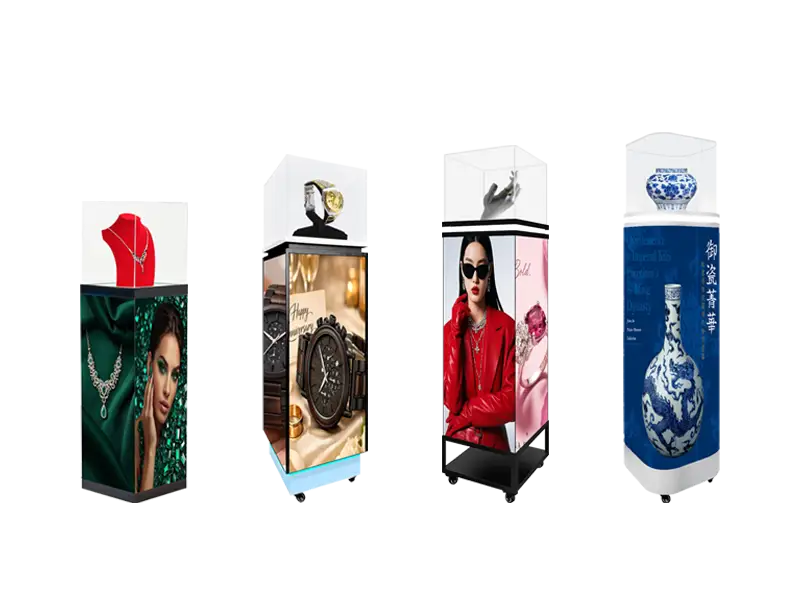
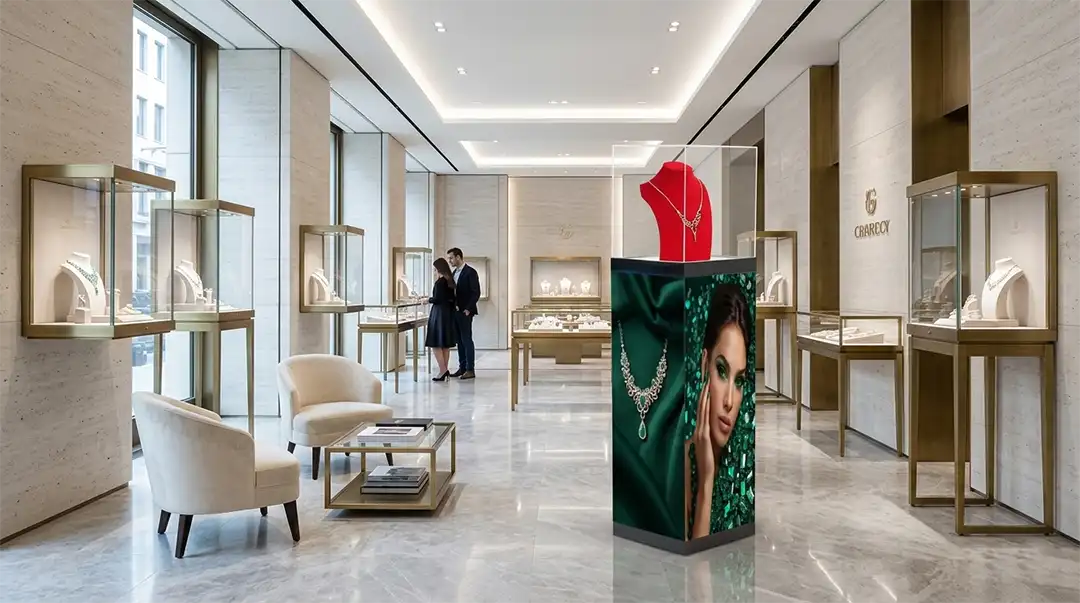
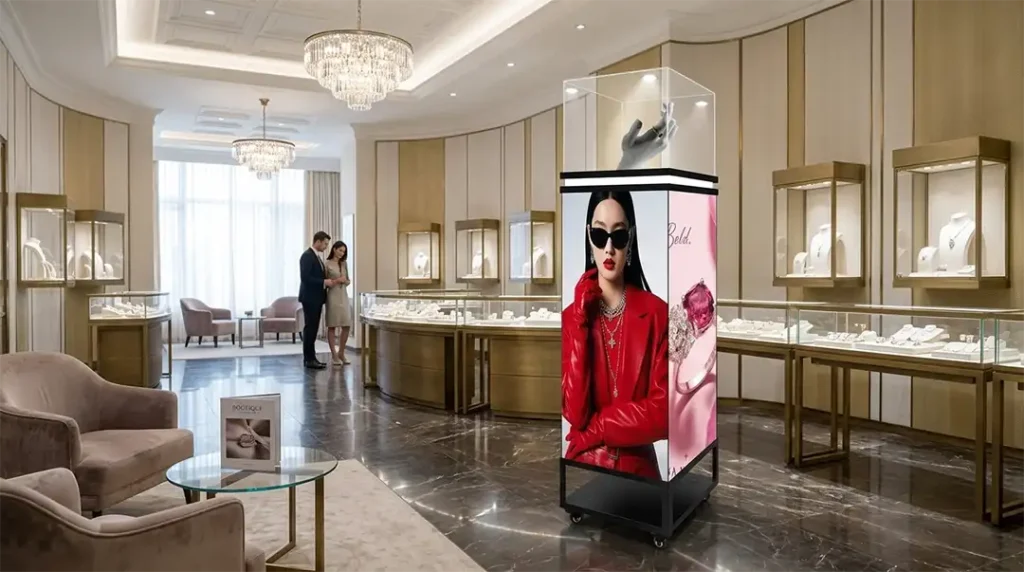
If you run a high-end watch boutique, a jewelry showroom, or a museum gift shop, you already know that customers don’t just “look” at luxury products—they expect an experience. A velvet cushion under a spotlight simply doesn’t cut it anymore. That’s where the 3D LED Pedestal Display Case comes in: a four-sided LED screen cube topped with a clear acrylic showcase that plays 360° 3D videos while presenting your physical product right on top.
Think of it as a digital storyteller and a physical display case rolled into one.This is why the market is rapidly shifting toward intelligent, interactive commercial visual solutions. But if you are a digital signage integrator or a luxury brand procurement manager, how do you sort through the hardware specs to choose a display that actually protects your merchandise and drives sales? Let’s break it down in plain English.
Key Takeaways
- A 3D LED pedestal display case uses four-sided LED screens to create naked-eye 3D illusions without requiring special glasses, making it ideal for high-end retail and museum exhibits.
- For close-up viewing in luxury stores, P1.86 pixel pitch delivers sharper detail than P2.5, as smaller pitch means higher pixel density and smoother image rendering.
- GOB (Glue on Board) encapsulation offers superior impact resistance, dustproofing, and moisture protection—critical for high-traffic retail environments.
- An illuminated acrylic top allows physical product display alongside 360° digital content, creating a dual-function merchandising tool that tells a complete brand story.
- Customizing with a Shenzhen-based LED manufacturer gives you direct control over size, frame branding, and controller configuration while significantly reducing per-unit costs compared to Western suppliers
What Is a 3D LED Pedestal Display Case?
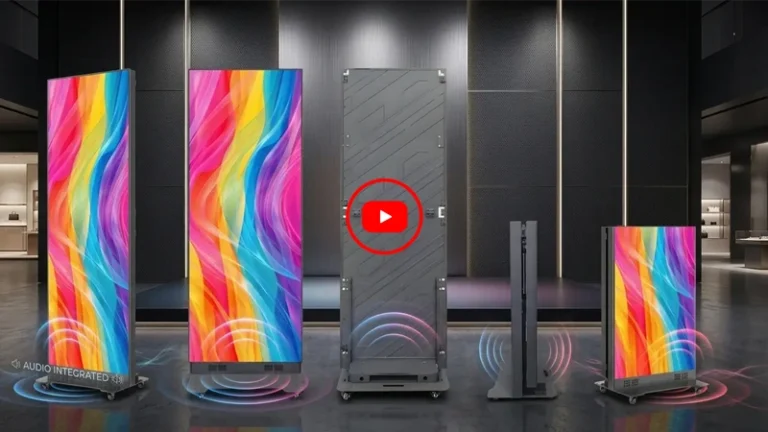
At its core, this is a pedestal-shaped unit with LED screens on all four sides. Each side measures roughly 320mm wide by 800mm tall, and together they form a continuous 1280mm-wide LED cube that wraps around 360°. The real magic is “naked-eye 3D”: when you load specially produced 3D content, customers walking around the pedestal see depth and motion without wearing any glasses. It’s hologram-like, but it’s real.
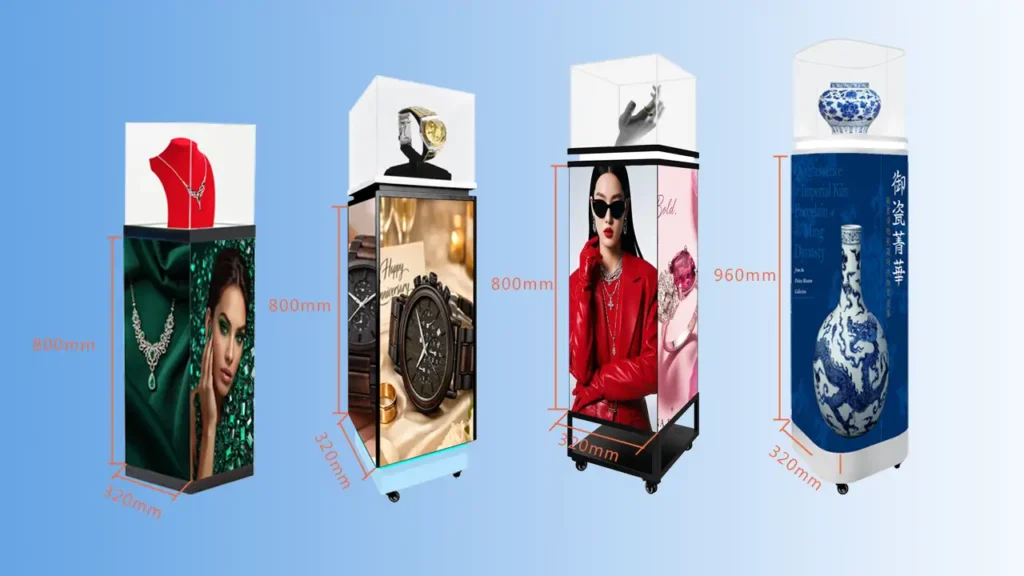
On top sits a crystal-clear acrylic cover with built-in illumination from below. That top area is where you physically place your product—a $10,000 watch, a diamond necklace, a limited-edition perfume bottle, or a museum artifact. So you get digital animation swirling around the base while the real product sits center stage under flattering white light. That’s a one-two punch most traditional displays can’t touch.
Why Luxury Retail Needs a 360° LED Showcase
Here’s the thing about luxury buyers: they want to feel like they’ve discovered something special. A static display says “this item is for sale.” A dynamic 360° LED pedestal says “this item is an event.” The moving visuals draw people in from across the store floor. Once they approach, the illuminated acrylic top does the rest, showing off craftsmanship details that flat glass cases bury under glare.
This format works exceptionally well for:
- Jewelry – Ring settings, diamond facets, and chain textures can be emphasized with moving light patterns.
- Watches – Animated movements around the pedestal can mirror the internal mechanics of a tourbillon.
- Cosmetics and fragrances – The “holographic effect” makes luxury bottles appear to float or radiate.
- Collectibles and artifacts – Museums and galleries can tell the story of an object through looping visuals without touching the artifact itself.
Key Specs to Look At – And How to Decode Them
You don’t need to be an engineer, but understanding a few technical parameters will save you from buying the wrong product. Let’s go through them one by one.
Pixel pitch: P1.86 vs P2.5
Pixel pitch is the distance in millimeters between the centers of two adjacent LED pixels. The smaller the number, the higher the resolution. For an indoor display where customers will stand within 1.5 to 2 meters of the pedestal, you want P1.86. Why? Because at close range, a wider pixel pitch like P2.5 starts to show visible pixelation—you’ll literally see little dots instead of a smooth image. P1.86 delivers crisp details at these short distances, which is non-negotiable when you’re displaying high-res product animations.
Most premium projects in luxury retail now spec P1.86 as the baseline. The price difference is worth it because your display will look sharper and more premium.
GOB encapsulation: why it matters for retail
Most LED panels use SMD (Surface Mounted Device) technology, where individual LED lamps sit exposed on the board. GOB, which stands for Glue on Board, adds a transparent epoxy resin layer over the entire module. This does three things: it protects the LEDs from accidental bumps (think shopping carts, elbows, cleaning staff), makes the screen dustproof and moisture-resistant, and reduces glare so the image looks smoother from wide angles.
Retail environments are high-traffic and less controlled than a broadcast studio. GOB gives you peace of mind that a stray knock won’t kill a cluster of pixels. The extra 15–20% upfront cost is generally offset by lower maintenance and longer lifespan.
Brightness (nits): indoor is different from outdoor
Don’t chase outdoor numbers. Many outdoor billboards boast 5000+ nits because they compete with direct sunlight. For indoor luxury retail, 650–800 nits is actually the sweet spot. Too bright and the LEDs will overpower the subtle lighting of your store interior; too dim and the visuals will look washed out under spotlights. The P1.86 GOB panels in this series run at approximately 650 nits, which is calibrated for showroom and exhibition hall lighting conditions.
Control system: make sure it’s plug-and-play
You don’t want to wire a computer to your pedestal every morning. Look for an integrated media player built into the base. Novastar controllers are the industry standard here—they support USB, HDMI, and SD card inputs so you can load content from a thumb drive and let the unit run standalone. You’ll also want to check refresh rate (3840Hz is solid) and gray scale (14–16 bits), which determine how smooth motion looks and how many shades of color the screen can show. These numbers should be in the product spec sheet; if they’re missing, ask for them.
The illuminated acrylic top: more than just a lid
Don’t overlook the top component. Some cheaper pedestals use standard glass or omit the light source entirely. An illuminated acrylic top with built-in LED lighting underneath makes the physical product “pop” by eliminating shadows and creating a gallery-like presentation. If you’re displaying jewelry with small diamonds or intricate engravings, this diffused white light is vastly superior to harsh overhead spots that create hot spots and reflections. Some configurations also offer a dual-zone illuminated base that adds a glowing effect from the bottom, creating a layered lighting experience.
Which Industries Get the Most Out of These?
Three sectors consistently see strong ROI from 3D LED pedestal cases:
- Luxury watch retailers – The combination of 3D animations showing movement and mechanics plus the physical watch on the acrylic top creates a “living brochure” effect. Customers linger longer and ask more questions.
- Fine jewelry boutiques – Diamond and gemstone displays can be accompanied by particle-effect animations that visually “zoom in” on cut and clarity details. The 360° screen ensures every angle of the pedestal delivers a selling message.
- Museums and cultural institutions – Heritage artifacts, antiques, and porcelain pieces can be contextualized with looping historical footage or interactive 3D reconstructions while the original object remains protected under acrylic.
- High-end cosmetics pop-ups – Fragrance launches and limited-edition makeup collections benefit from the “wow factor” that pulls passersby into a temporary retail activation.
Why Customizing with a Chinese Manufacturer Makes Sense for Projects
If you’re an integrator, procurement specialist, or retail design firm handling multiple projects, you’ve probably noticed that off-the-shelf LED pedestals never quite fit the spec. Maybe the height is wrong, or the cabinet color doesn’t match the brand identity, or you need a specific input configuration.
This is where custom manufacturing from Shenzhen—China’s LED production hub—becomes a strategic advantage. Chinese manufacturers produce over 80% of the world’s LED displays, and the supply chain density in places like Shenzhen means you can get fully customized dimensions, branded chassis finishes, and even integrated media suites without paying boutique Western prices.
A direct factory partner like Adhaiwell (based in Shenzhen’s Baoan District) can handle:
- Custom height and width adjustments (the standard pedestal is 800–960mm tall, but taller or shorter dimensions can be engineered)
- Branded cabinet colors and finishes (black, white, metallic, or custom RAL codes)
- NovaStar controller variants depending on your content delivery preference
- Rigorous burn-in testing—72 hours continuous run before shipping—which most resellers skip
Lead times for custom configurations typically run 25–35 days after deposit, plus shipping via sea or air freight. For large-scale retail rollouts or museum installations, the cost savings and flexibility of direct factory sourcing are substantial.
What You Should Ask Any Supplier Before Buying
Whether you’re buying one unit for a flagship store or twenty for an international rollout, ask these five questions:
- What’s the actual pixel pitch and module size? If they say “high resolution” without giving you a number, walk away.
- Is the LED encapsulation GOB or standard SMD? For retail, you want GOB.
- What controller is built in, and does it accept USB/HDMI/SD? If they don’t specify a brand (like NovaStar), ask for documentation.
- Can I see the unit running custom 3D content in a real room? A demo video under perfect studio lighting doesn’t reflect showroom conditions.
- What’s the burn-in and quality control process? A reliable factory runs at least 48–72 hours of continuous testing before packing.
Bringing It All Together
Choosing a 3D LED pedestal display case doesn’t have to be complicated. Start with the environment: indoor luxury retail demands P1.86 pixel pitch for close-up clarity. Prioritize GOB encapsulation for durability in high-traffic spaces. Make sure the acrylic top is illuminated—that’s where the physical product lives, and lighting matters more than you think. And if you’re sourcing for a larger project, going directly to a Shenzhen-based custom manufacturer will give you more control over specs and better pricing than buying through intermediaries.
The right pedestal does more than just display a product. It tells a story, keeps customers engaged for an extra 30 seconds, and gives them a reason to pull out their phone and share what they’re seeing. That’s not just a display case. That’s a marketing asset.