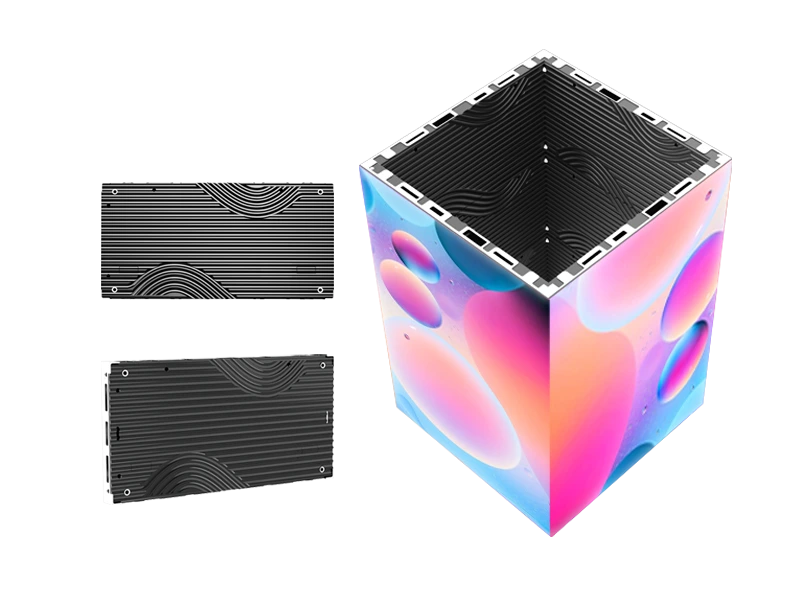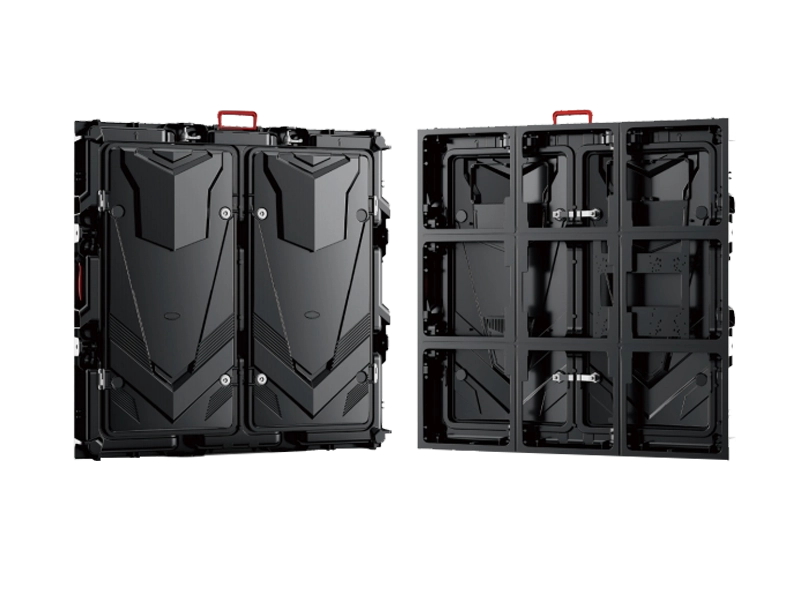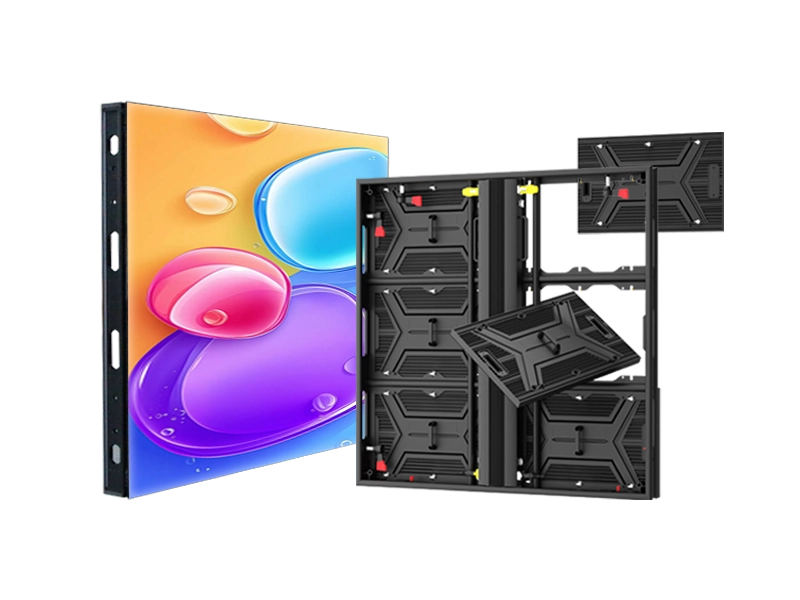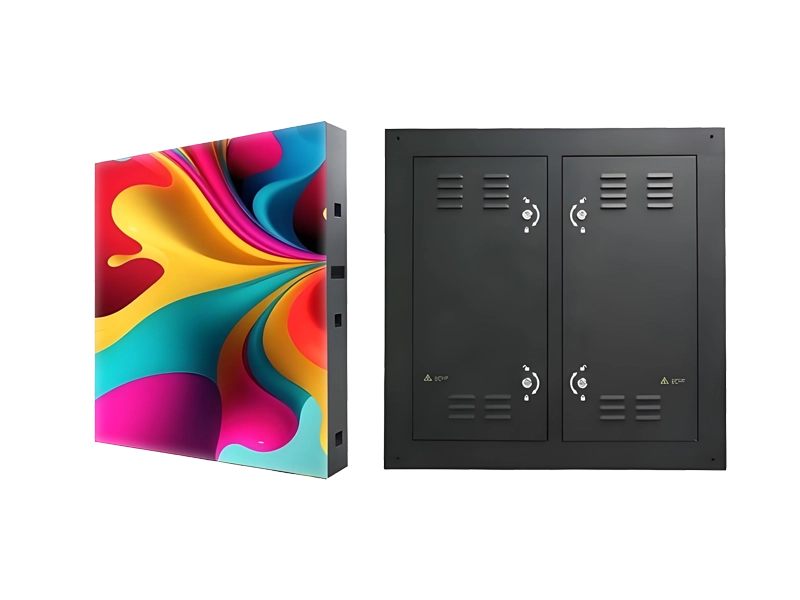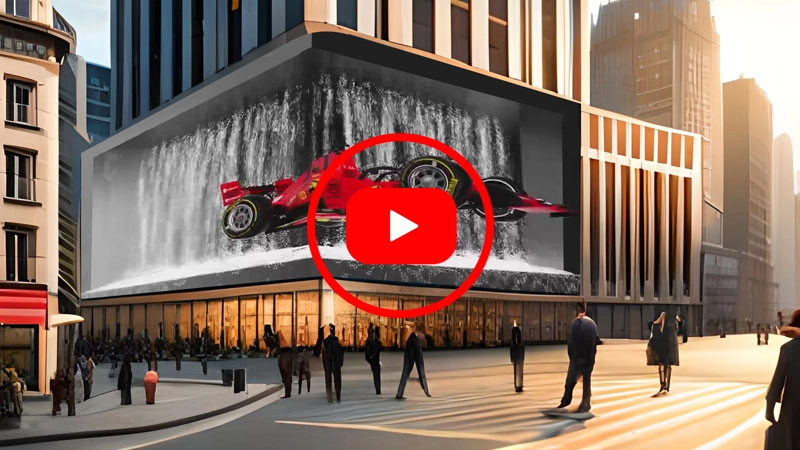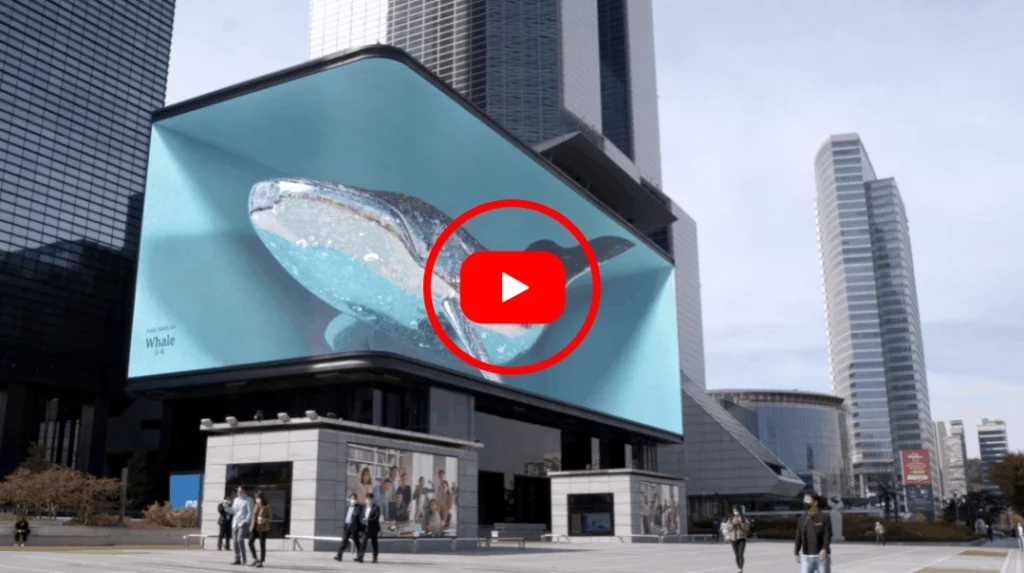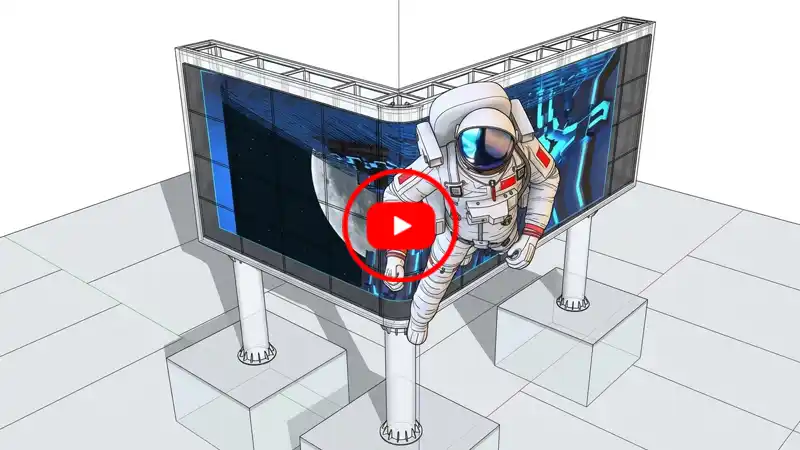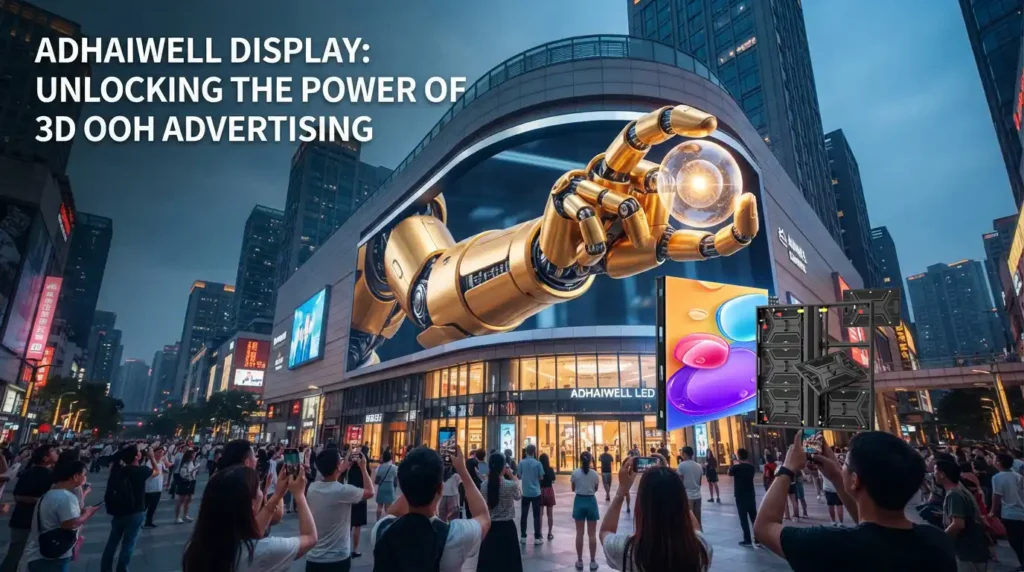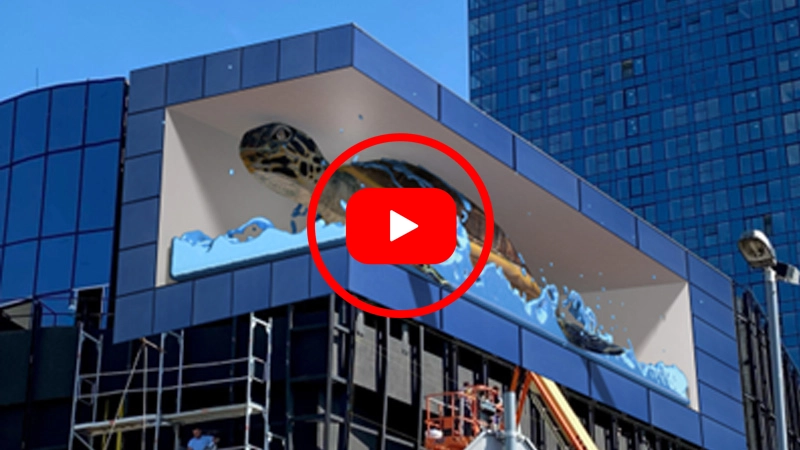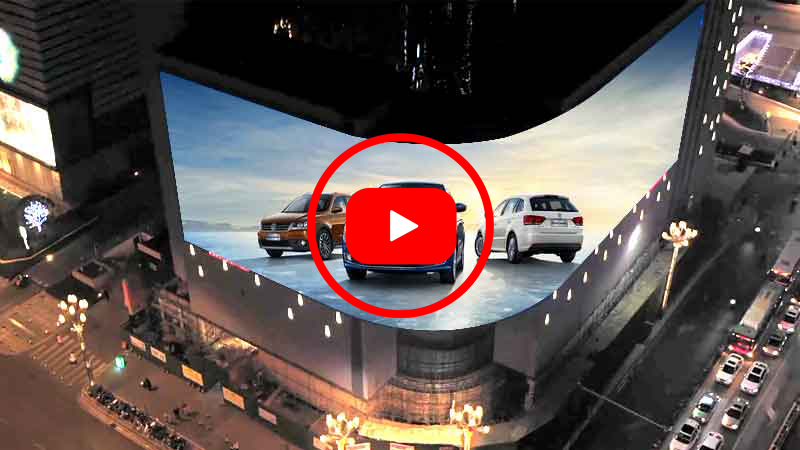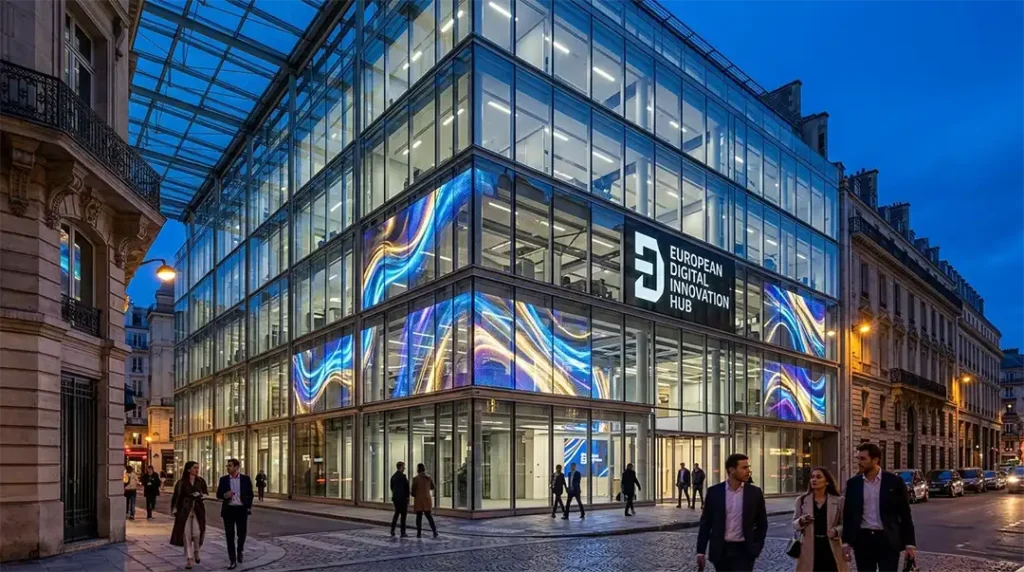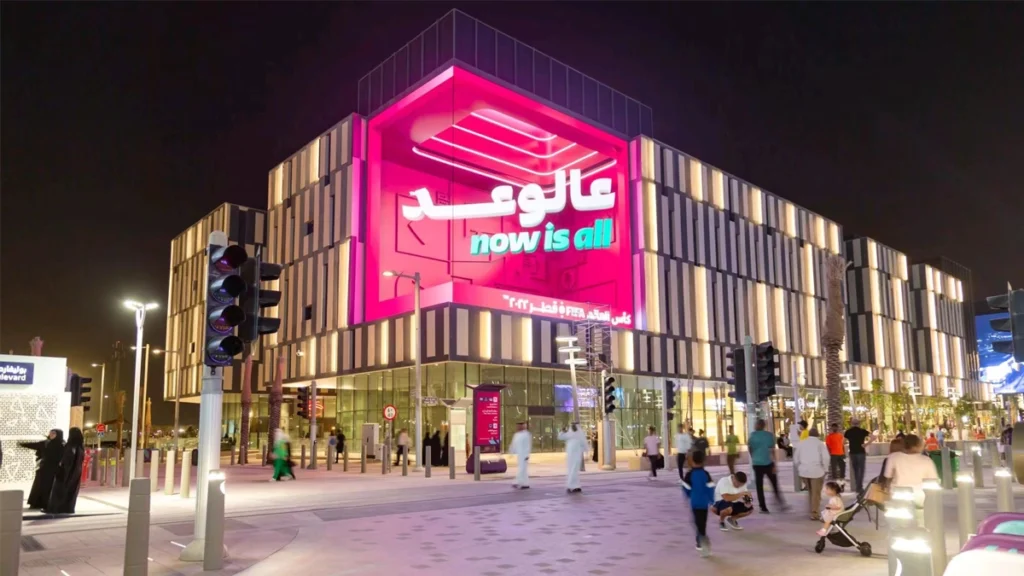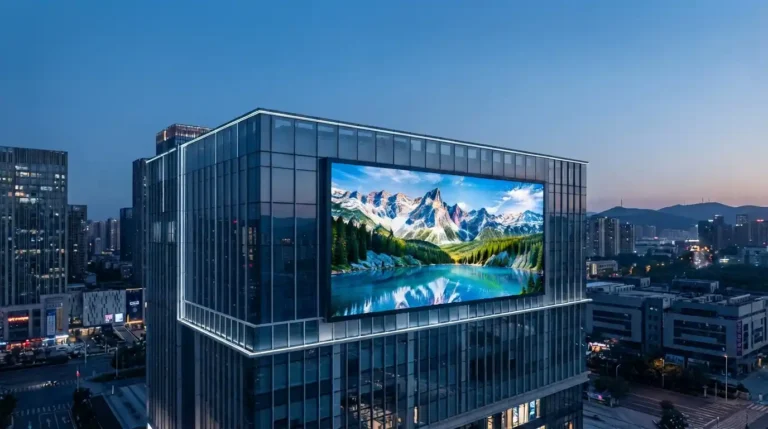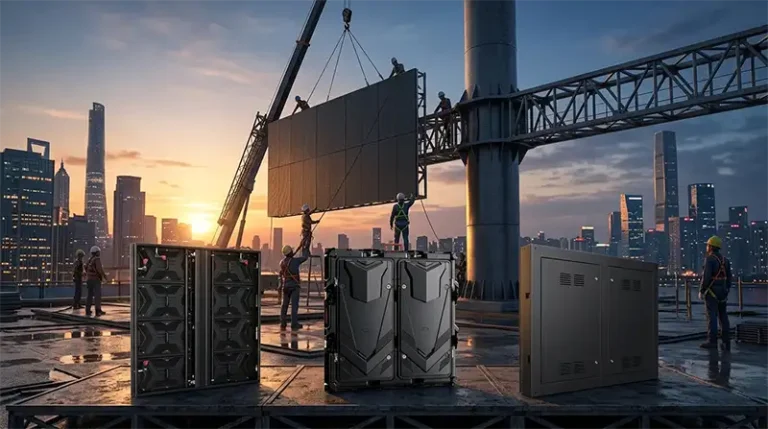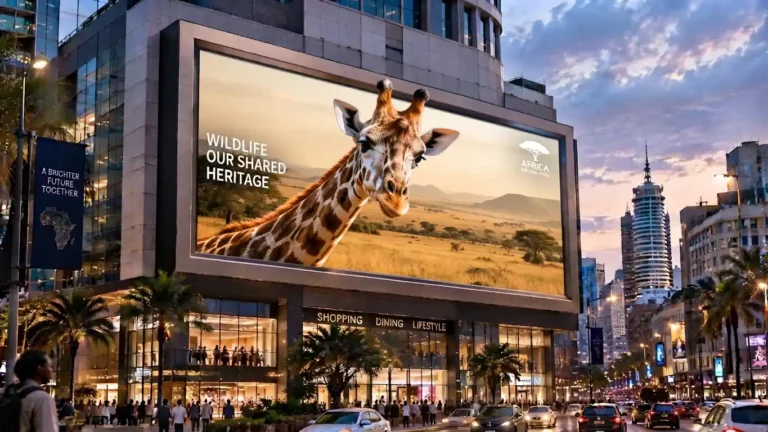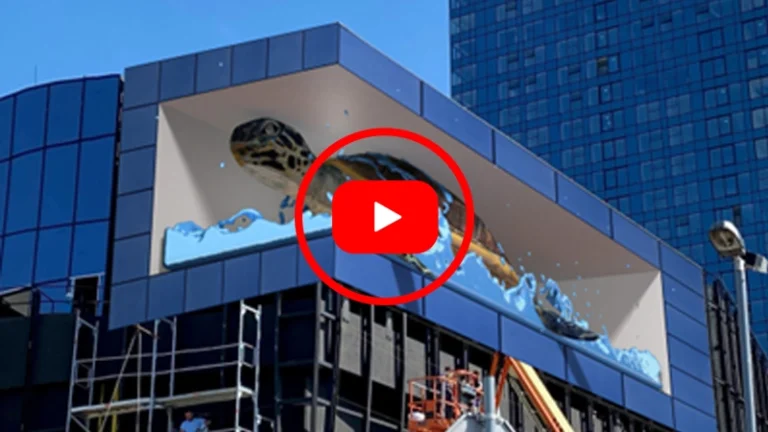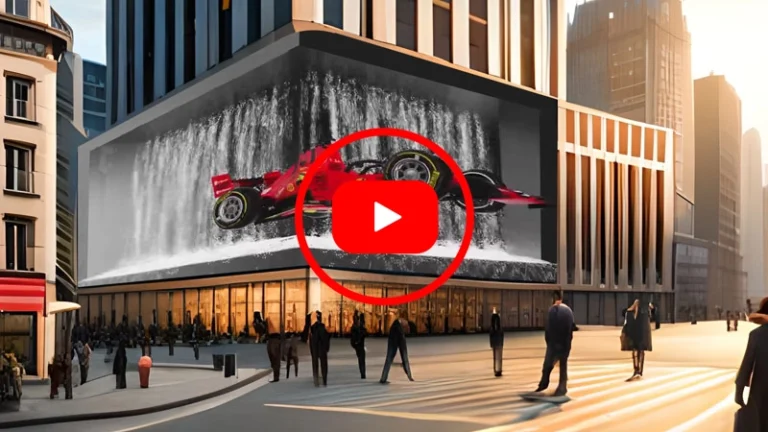
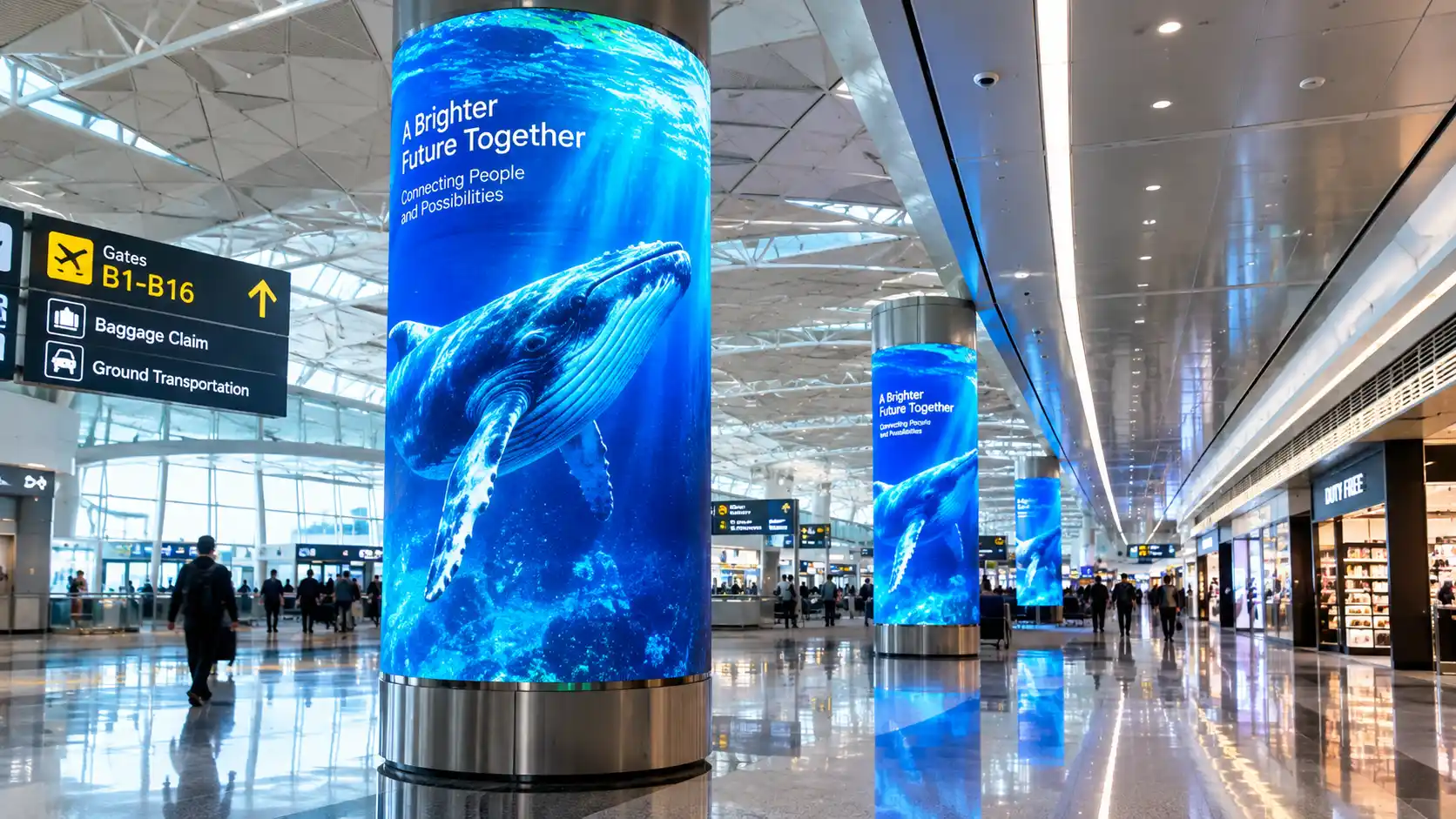
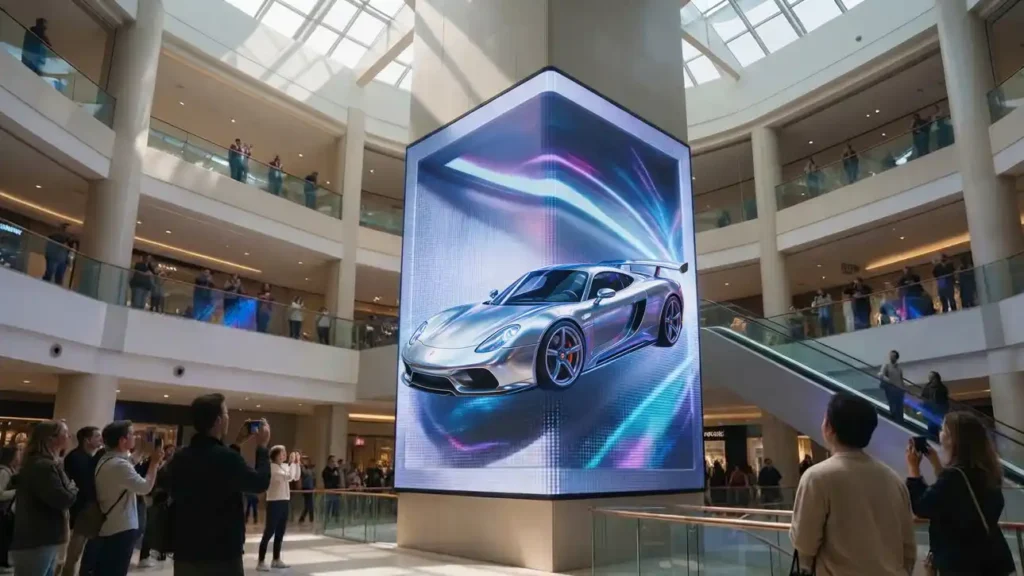
A Cylindrical Naked-eye 3D LED Screen is a wrap-around LED display built onto a pillar, column, or custom cylinder structure that plays 3D content engineered for its curved geometry, so viewers see a glasses-free 3D effect from any direction they approach. Once found mostly as flat or L-shaped facade billboards, the 3D format is now moving onto one of the most underused surfaces in commercial architecture: the structural column. Shopping malls, exhibition halls, airports, and street-side developments are wrapping their pillars in flexible LED modules, and the result is a display category with different physics, different content rules, and different buying risks than the corner billboards that made the format famous.
Key Takeaways
- Naked-eye 3D is expanding beyond 90° corner facades onto cylindrical and pillar structures — the newest growth pocket in a market PW Consulting sizes at US
4.45 billion (2025) heading to US11.14 billion by 2032. - A cylinder has no fixed viewing corner, so the 3D illusion depends on 360° content rendered to the column’s exact diameter, height, and viewing distance.
- Hardware decisions that matter most on pillars: flexible curved modules, front maintenance, pixel pitch matched to close-range viewing, and structural load review of the existing column.
- A September 2026 installation at a Chinese department store (operator-reported) shows the pattern: a static poster-wrapped pillar converted into a P2, 3,840 Hz 360° screen serving roughly 8,000 visitors a day.
- Buyers should shortlist suppliers who can do structure, content, and LED hardware under one technical owner — not three separate vendors.
1. Why Are Shopping Malls Wrapping Their Pillars in LED Screens?
Because pillars occupy the most valuable sightline positions in a mall — atrium centers, corridor junctions, entrance plazas — and until recently those surfaces could only carry static posters that nobody photographed.
- Dead structure becomes media. A load-bearing column cannot be removed, but its surface can carry a full-height 360 degree LED display instead of a printed banner. The real estate already exists; only the surface technology changes.
- 360° coverage multiplies impressions. A flat screen faces one direction. A cylindrical screen faces every direction, which matters in atriums where shoppers circulate on multiple floors and approach from several angles.
- The 3D format now carries proven market weight. PW Consulting estimates the global naked-eye 3D LED display screen market at US$4.45 billion in 2025, projected to reach US$11.14 billion by 2032 — a 14.0% CAGR, with outdoor installations at 70.2% of the market and commercial advertising taking a 55.3% application share (third-party estimate; commercial research reports use differing methodologies, so treat these figures as directional context, not a forecast for any single project).
- DOOH budgets keep shifting to digital. The World Out of Home Organization estimates global digital out-of-home revenue at US$25.5 billion in 2025, rising to about US$28 billion in 2026 (WOO, 2025–2026) — the spend pool that ultimately funds screens like these.
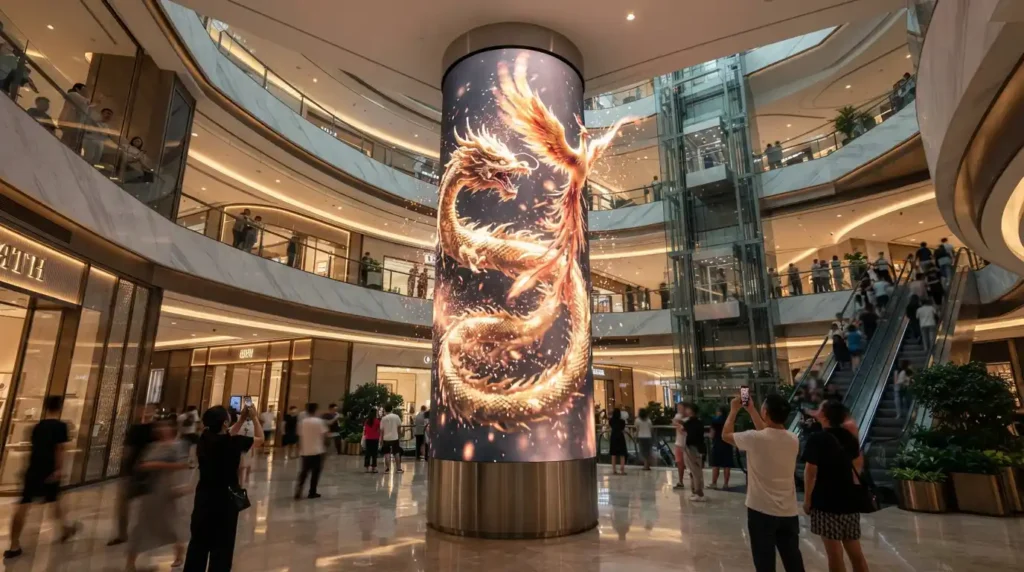
A recent Chinese installation shows the pattern in practice. In September 2026, an integrator completed a P2.5 cylindrical LED screen wrapped around an atrium pillar at the Department Store, replacing static posters that had been reprinted monthly (operator-reported). The column previously passed roughly 8,000 visitors a day; the new screen runs at a 3,840 Hz refresh rate so smartphone recordings stay free of scan lines, uses front-maintenance flexible modules so servicing never blocks walkways, and updates content remotely. The mall reports shoppers now film and share the pillar voluntarily — the social-distribution effect that made corner billboards famous, relocated to a column.
2. How Does Naked-Eye 3D Work on a Cylinder When There Is No 90° Corner?
It works through curved-surface perspective instead of corner perspective: the content is rendered so the cylinder’s curve itself supplies the depth cues, with objects appearing to rotate out of the surface or extend beyond its silhouette.
- The corner rule does not transfer. The classic anamorphic billboard relies on a 90° corner — one face shows the “front” of an object, the other the “side,” and the brain fuses them into a volume. A cylinder has no such edge, so the illusion comes from the continuous wrap: a car can appear to drive around the column, a product can rotate into view, an animal can seem to lean past the surface edge.
- Content and geometry must match 1:1 — in two dimensions of curvature. The render must map onto the column’s exact diameter, height, and pixel grid. A file authored for a flat or corner screen will visibly distort when wrapped, exactly as generic footage fails on a corner build. The underlying principle is the same one that governs how a naked-eye 3D LED screen works on any geometry: the content pipeline starts from the physical screen, never from a stock clip.
- Curved cabinets behave differently from flat ones. Flexible soft modules bend to the column radius, while rigid curved cabinets hold a fixed arc. Which one fits depends on diameter, viewing distance, and whether the column is truly cylindrical or polygonal — a decision Adhaiwell breaks down in its comparison of L-shaped, curved, and flat LED cabinets for 3D effect.
- The viewing zone is wider but shallower. A corner billboard concentrates its effect in one frontal zone across the street. A cylinder works at close range from all sides, which trades maximum depth for total angular coverage — usually the right trade indoors, and a design decision to make consciously outdoors.
3. What Hardware Does a Cylindrical 3D LED Pillar Actually Need?
It needs flexible or curved modules matched to the column radius, a pixel pitch chosen for close-range viewing, front maintenance for public-space access, and a structural review of the host column before a single module is ordered.
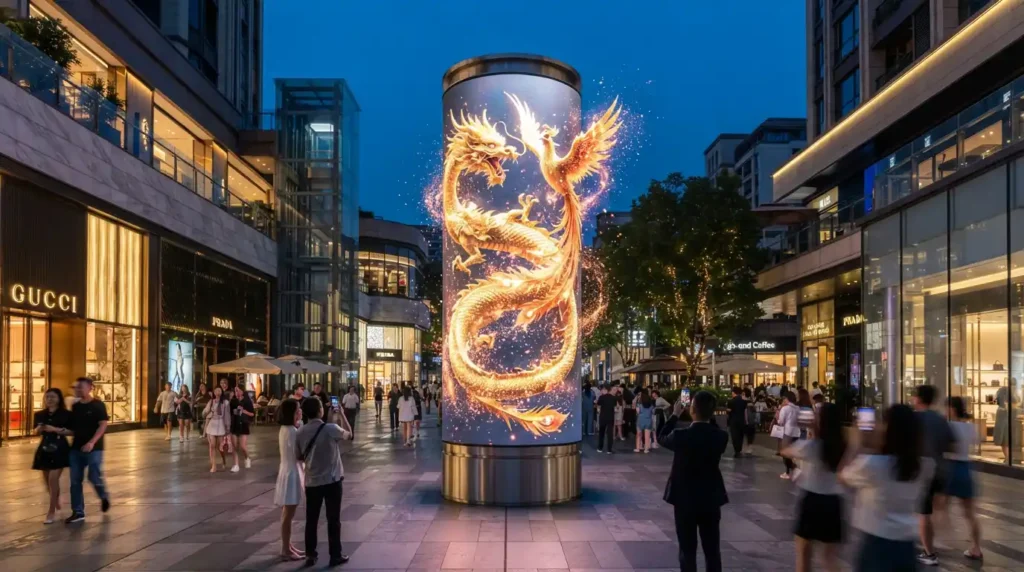
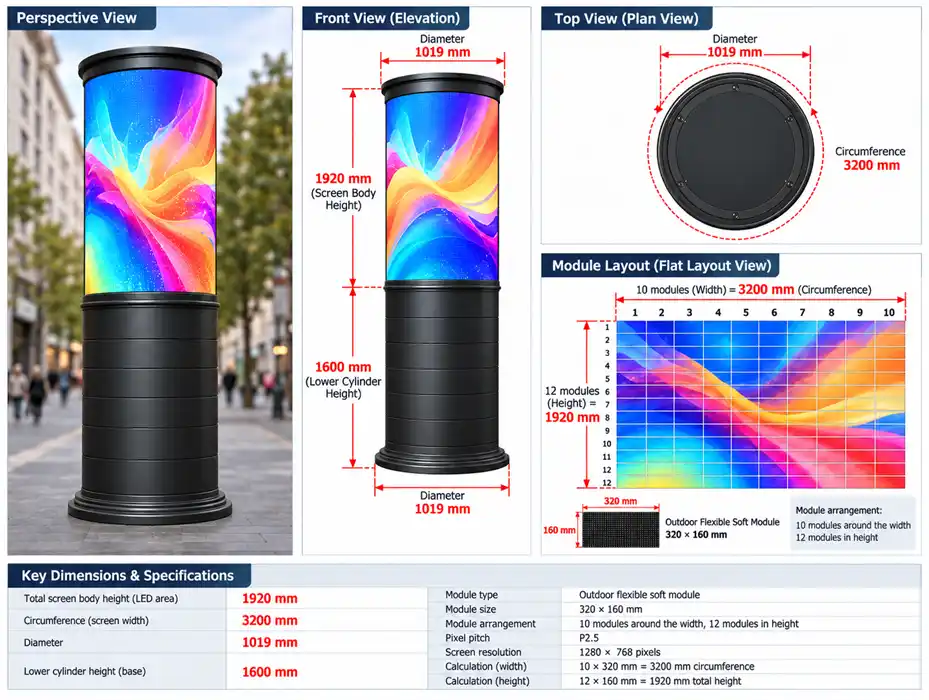
- Pixel pitch for proximity. Mall visitors stand 2–5 meters from an atrium pillar, not 40 meters away as with building‑facade displays. Indoor pillar screens typically run P1.5–P2.5, specifications well‑matched by fine‑pitch indoor LED screens; outdoor street columns usually land P4–P6.25. Specifying facade‑grade pixel pitch for close‑range pillar installations will result in visible pixelation when viewed at arm’s length.
- Brightness matched to environment, not maximized. Indoor atriums mix daylight and artificial light; adaptive brightness in the 400–800 nit range handles that swing. Outdoor columns need full-sunlight ratings — Adhaiwell’s aluminium profile indoor LED displays, for example, are rated 5,500–8,000 nits with IP65 front-and-rear sealing for exactly this kind of street-side duty.
- 3,840 Hz refresh as the social baseline. The category lives or dies on user-generated video. Below 3,840 Hz, smartphone cameras record scan-line banding; at or above it, the screen films clean.
- Front maintenance as a hard requirement. Pillars sit against walls, above walkways, or inside atriums with no rear access. Magnetic front-service flexible modules let a technician swap a unit in minutes without scaffolding or closing the corridor.
- Structure before surface. The host column must carry the screen’s added weight and wind load (outdoor) without modification to its load-bearing function. Reputable suppliers deliver CAD drawings and load calculations as part of the quotation, not after the deposit.
- Weight and thermal design. Flexible modules with low-profile aluminum construction keep added load down; fanless passive cooling keeps noise out of retail and exhibition environments.
4. Which Locations Get the Most Value from Cylindrical 3D Screens?
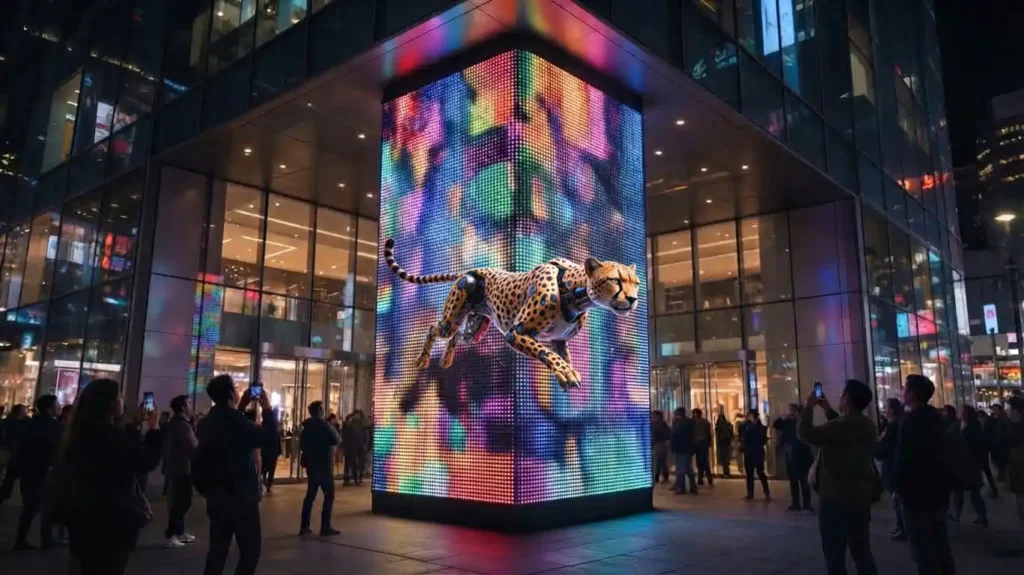
Locations with circulating — not just passing — audiences get the most value: shopping-mall atriums, exhibition and brand-showroom halls, transportation hubs, and street-side commercial developments where pedestrians orbit the structure rather than walk past it.
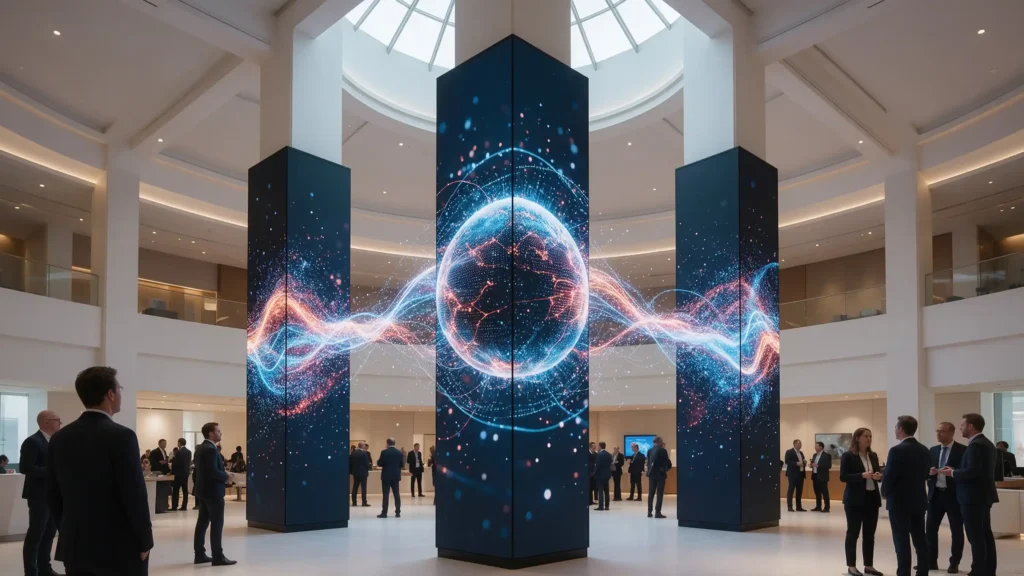
- Shopping-mall atriums. Multi-floor circulation means every escalator landing has a sightline to the central column. Atrium pillars double as event backdrops for product launches, holiday campaigns, and IP activations — a rotating cast of uses that amortizes the hardware across many campaigns.
- Exhibition halls and corporate showrooms. Columns become standalone exhibits: a cylindrical screen can present a product from all sides in a single rotating loop, turning structural clutter into a designed focal point.
- Commercial streets and tourism districts. Outdoor columns at intersections and pedestrian zones become night-economy landmarks. The site-selection logic mirrors what already governs where naked-eye 3D LED displays are deployed globally — footfall, open sightlines, and dwell time matter more than raw screen size.
- What separates success from expensive furniture. The screen does not generate value by existing. Sites with proven dwell time, content refreshed on a campaign calendar, and a management team that treats the pillar as a media asset — not a decoration — are the ones that recover the investment.
5. How Is 3D Content Produced for a 360° Curved Surface?
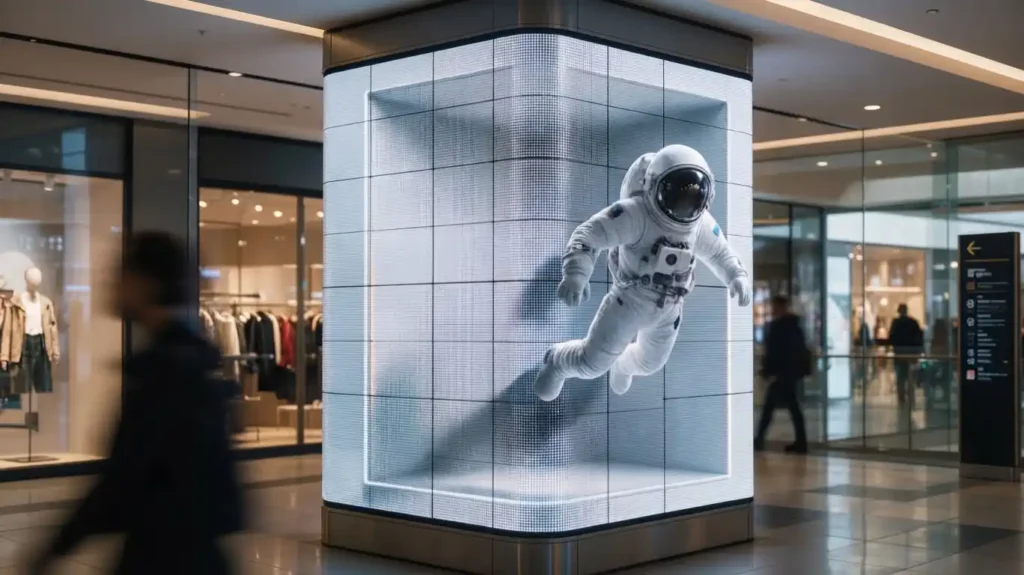
Through the same five-stage pipeline used for corner billboards — site survey, 3D modeling, perspective calibration, rendering, playback testing — but with the virtual camera and the digital twin rebuilt around the cylinder’s radius and its multiple viewing positions.
- The digital twin is the cylinder, not a flat plane. Every module seam, curvature degree, and pixel row is modeled so rendered perspective lines stay correct from any approach angle — not just one calibrated viewpoint.
- Seamless looping matters more. A 360° screen has no frame, so the loop must resolve cleanly at every rotational position. Content is typically designed so the hero action (the “breakout” moment) cycles around the column, giving each side of the structure its share of the effect.
- Multi-angle testing replaces single-vantage testing. Corner billboards are validated from the main sidewalk; cylindrical content is validated from four or more positions at the real viewing distances recorded during the site survey.
- Production starts at order time, not at delivery. A 30-second calibrated loop can take days of render time per revision, so the content schedule must run parallel to screen manufacturing — starting it after the containers arrive is the most common self-inflicted delay in 3D projects of any geometry.
6. What Should Buyers Verify Before Ordering a Cylindrical 3D LED Screen?
Verify four things that generic screen quotations tend to skip: the supplier’s experience with curved-geometry 3D content, structural engineering for your specific column, front-maintenance design for your installation position, and after-sales response terms in writing.
- Ask for curved-geometry evidence. Request footage of past cylindrical or curved 3D installations and the content files’ calibration method. A supplier whose 3D portfolio is entirely flat or corner builds will be learning on your budget.
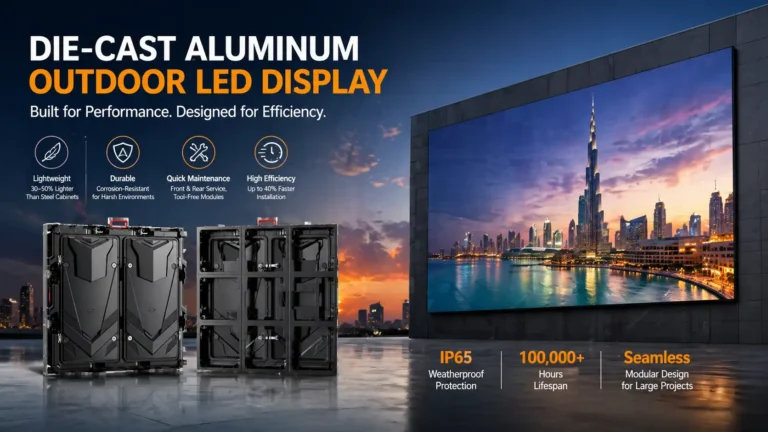
- Demand site-specific structural drawings. Column diameter, height, cladding, and (outdoor) local wind-load data should feed CAD drawings and load calculations included in the quotation. For pole- and column-mounted outdoor positions, hardware designed for that duty — such as Adhaiwell’s die-cast aluminium outdoor LED displays, which support pole and column mounting — is a better starting point than adapted facade cabinets.
- Check the maintenance path physically. Ask how a single module is replaced at your pillar’s exact height and position. If the answer involves closing the atrium or renting a lift, the design is wrong for the location.
- Confirm content ownership and update terms. Who owns the calibrated content files? What does a new campaign loop cost? Can your team upload seasonal content remotely, or does every change route through the supplier?
- Compare suppliers on integration, not cabinet price. The cheapest per-square-meter quote from a vendor that handles only hardware usually costs more once a separate fabricator and a separate content studio enter the project. When evaluating any cylindrical LED screen manufacturer in China or elsewhere, the decisive question is whether structure, content, and LED hardware sit under one technical owner — the same integration test that separates working 3D landmarks from very expensive flat screens.
FAQ: Cylindrical Naked-Eye 3D LED Screens
These answers come from Adhaiwell’s engineering and export team — a Shenzhen LED display manufacturer with more than 15 years of production experience and 3D LED projects delivered across Africa, the Caribbean, and Asia (operator-reported). They are the questions buyers ask most often when a project moves from flat facade to cylindrical geometry.
1. Does a cylindrical screen need a corner to produce a 3D effect?
No. The cylinder itself supplies depth cues through its curved surface, with content rendered to wrap the geometry. The effect differs from corner billboards — wider angular coverage, shallower maximum depth — but it is genuine glasses-free 3D when content and structure match.
2. What pixel pitch suits a shopping-mall pillar?
P1.5–P2.5 for indoor atriums viewed at 2–5 meters; P4–P6.25 for outdoor street columns viewed farther back. Match pitch to the nearest realistic viewing distance, not to a spec-sheet maximum.
3. Can existing posters or 2D videos play on a cylindrical 3D LED screen?
Yes — the LED screen plays any standard content for everyday schedules. But the 3D effect only appears with content rendered to the column’s exact diameter and height, so the 3D loop is a separate production item, not a download.
4. How long does a cylindrical 3D project take?
Screen manufacturing typically runs 25–35 working days plus freight, with 3D content produced in parallel. Complex custom diameters or outdoor structural work add engineering time at the front end, so start with the site survey, not with cabinet selection.
5. What information should I send for a quotation?
Column dimensions (diameter, height) with photos and a short video, the nearest and most common viewing distances, indoor or outdoor location with city and country, and your target launch date. The location data drives brightness, wind-load, and shipping calculations; quotations typically return within 24–48 hours.
About Adhaiwell
As a leading China-based LED display manufacturer and specialist in custom curved geometry solutions, Adhaiwell helps shopping malls, commercial operators, and integrators bring ambitious 3D digital landmarks to life. From flexible LED modules and structural column engineering to turnkey display hardware, we deliver reliable solutions tailored to your exact architectural dimensions. Ready to turn your building’s pillars into high-impact media assets? Contact Adhaiwell today for a professional quotation and structural consultation within 24–48 hours.