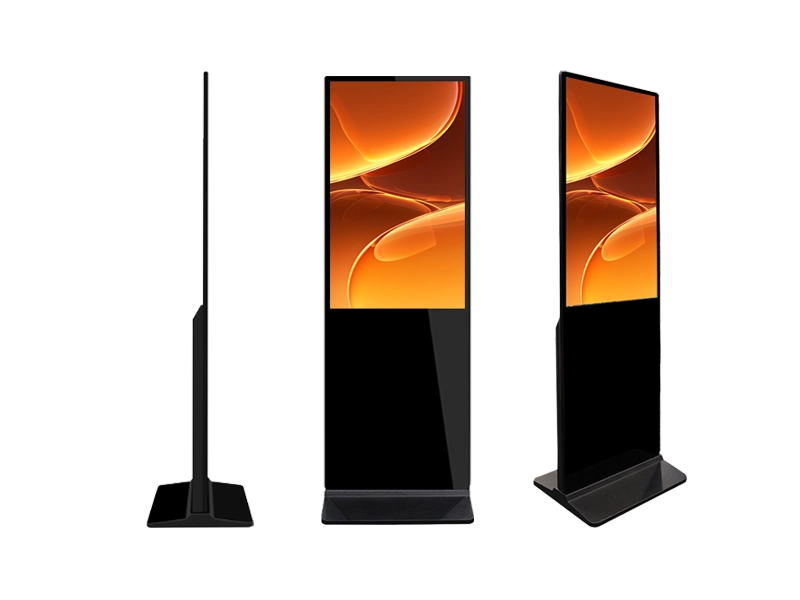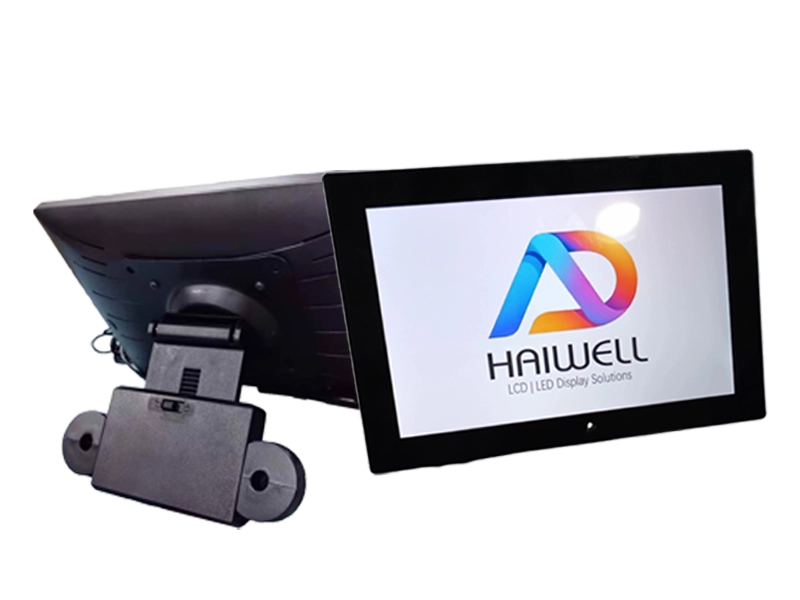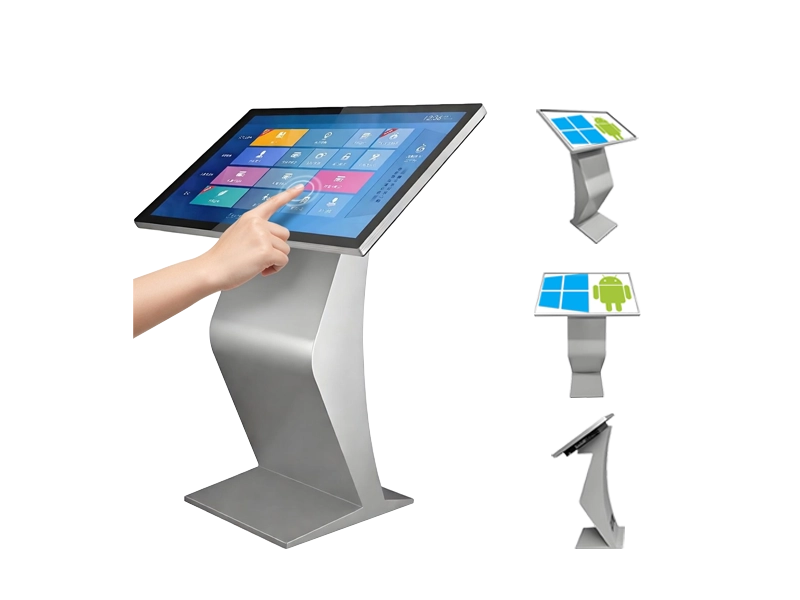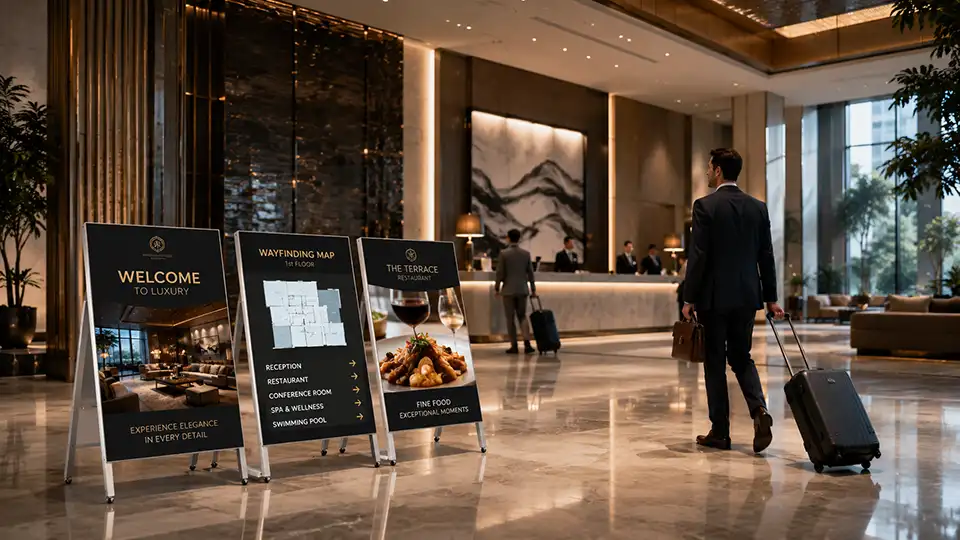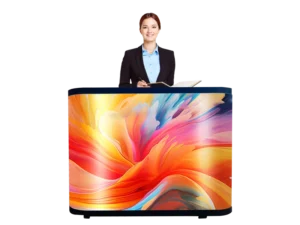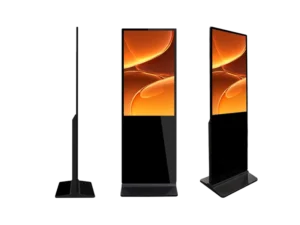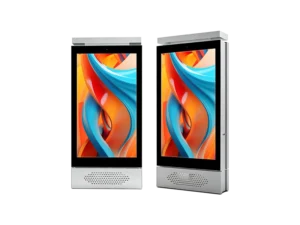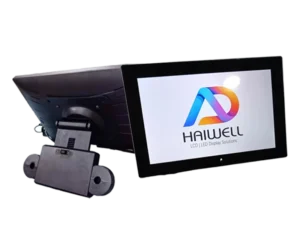
Elevator LCD Digital Signage transforms passive waiting times into highly profitable, engaging visual touchpoints across premium commercial properties. Modern commercial property management demands more than just static notice boards; it requires dynamic, real-time communication tools that drive revenue and improve the occupant experience. For international system integrators, property developers, and indoor advertising operators, sourcing premium commercial building advertising displays from China represents the most cost-effective path to scaling a high-performance media network.
Why Elevator LCD Digital Signage Is Reshaping Indoor Advertising in 2026
Here is the fact: the elevator cabin is one of the last truly captive advertising environments. A closed space, zero signal, nowhere to look — just a screen and a viewer trapped for 30 to 60 seconds.
The global elevator advertising machine market was valued at USD 246.98 million in 2025 and is projected to grow at an 8.59% CAGR to reach USD 439.76 million by 2032. Within outdoor video media, elevator LCD screens grew 32% year-over-year in early 2026, leading all categories.
This growth is happening because digital elevator screens deliver something static posters never could: accountability. A major Qtenboard study covering Southeast Asia and the Middle East found that 68% of commercial properties and office buildings have already replaced traditional posters with digital elevator display screens.
Property owners making the switch aren’t just modernizing. They are unlocking new revenue streams, capturing hard data on viewer engagement, and turning a mandatory daily wait into a monetizable media asset.
What is Elevator LCD Digital Signage?
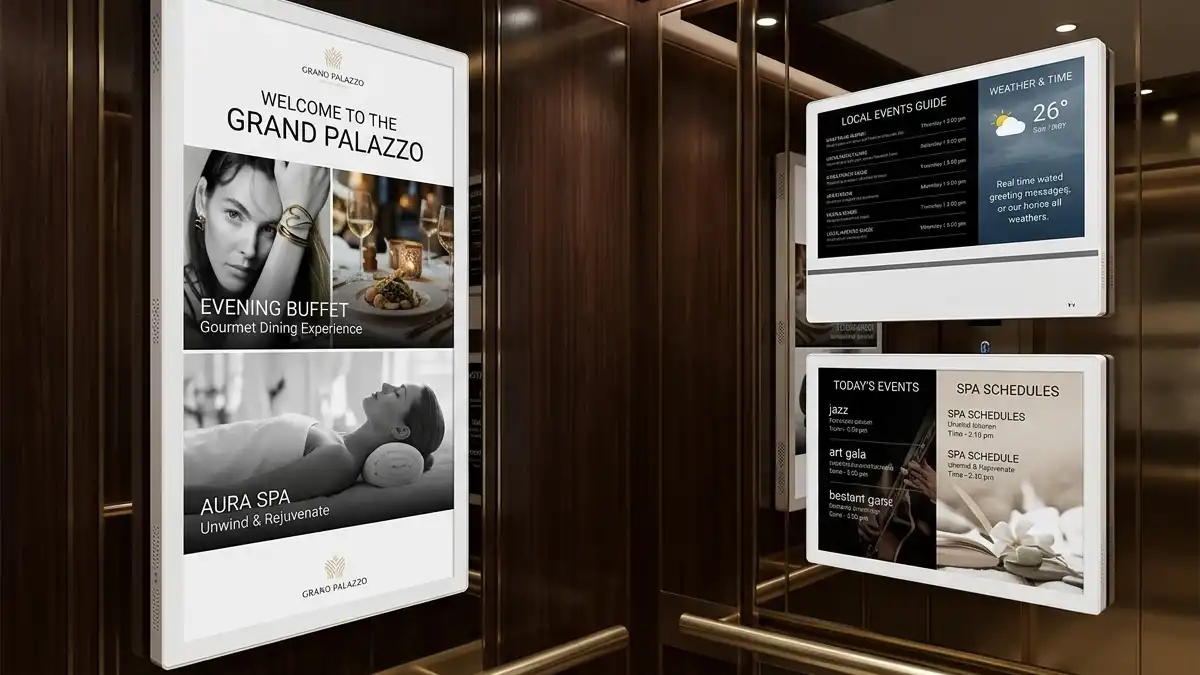
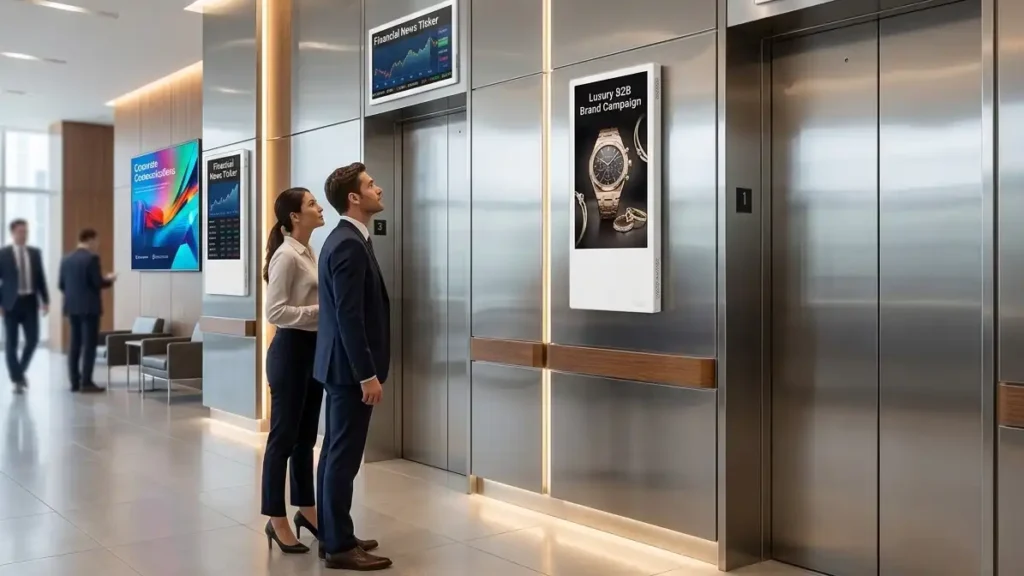
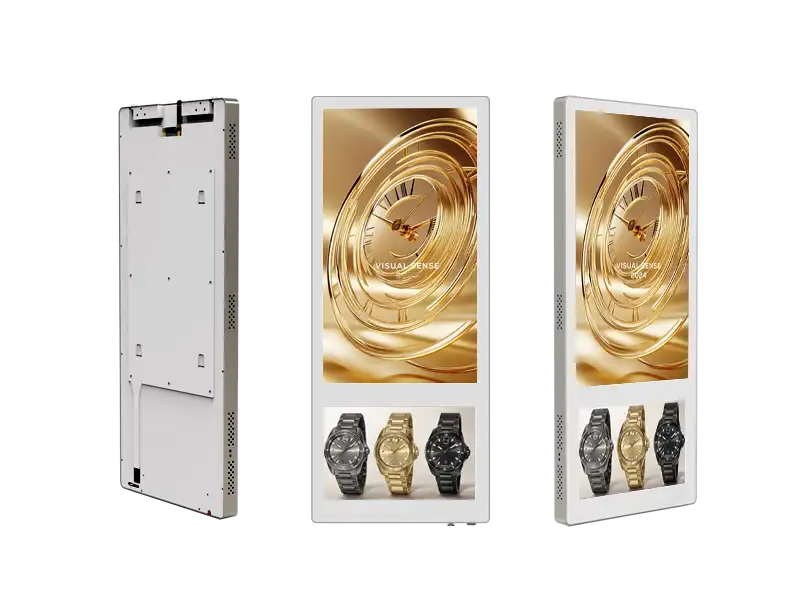
Elevator LCD Digital Signage is a digital screen installed inside an elevator cabin or in the elevator lobby to show advertisements, announcements, news, wayfinding, or brand content. It is widely used in commercial buildings, hotels, offices, apartments, and malls because it delivers messages in a high-attention, captive viewing space.
Case Study 1: Commercial Building — From Tenant Notices to Network Monetization
The challenge. SpaceAdd, a South Korean spatial media platform, saw what most property managers ignored. High-end office towers in Seoul had lobbies full of professionals waiting for elevators — 172 seconds per trip, 4.4 times per day. That idle time was pure dead space. Paper posters sat ignored, and tenants received no real-time building information.
The solution. SpaceAdd began installing digital displays in lobbies and elevator areas across 600 prime office buildings, reaching approximately 2 million workers and visitors. The screens run silent (zero audio fatigue), delivering 15- to 30-second ad segments tailored to each building’s tenant demographic, plus real-time building announcements. Contracts stay active — renewal rates are nearly perfect.
The result. Since turning profitable in 2022, SpaceAdd has posted annual growth of roughly 50%, with plans to double its footprint to 1,200 buildings by 2028. Major advertisers across automotive, finance, film, and beauty run on the network through agencies like Cheil Worldwide and Innocean.
For B2B buyers. The SpaceAdd model proves that elevator signage can scale from single-building tenant communication into a citywide advertising network. The hardware is the same. The economics change completely once you control distribution.
Case Study 2: Hotel Hospitality — Elevating Guest Experience and Brand Revenue
The challenge. High-end hotels face a unique problem: guests expect seamless, premium experiences everywhere — including the elevator. Outdated static signage feels cheap. Relying on printed notices for events, dining specials, or local recommendations means missed revenue opportunities.
The solution. The Turing Building (Lendlease) in East London demonstrates how premium properties approach digital communication. ECN deployed a comprehensive system including a 75-inch lift lobby screen installed with precise recessed mounting into a custom feature wall — seamless architectural integration. The system delivers real-time tenant engagement, wayfinding, and building communications from a centralized platform.
The result. Despite joining late in construction, ECN completed installation on time for Lendlease’s launch event. The screen blends perfectly with high-end design standards while giving property managers instant control over messaging.
For hotel buyers. Hotels adopting elevator LCD signage run two content streams: third-party ads (revenue) and property-generated content (guest experience). One does not cannibalize the other. Cloud CMS allows scheduling — happy hour specials run at 5:00 PM; spa promotions run in the morning; building announcements override both when needed.
Case Study 3: Shopping Mall — Driving Foot Traffic from the Ride Up
The challenge. Shopping malls fight for every foot of in-store traffic. Static elevator posters can’t adapt to daily promotions, flash sales, or weather-driven offers. By the time a new poster gets printed and installed, the promotion has already expired.
The solution. Qtenboard’s deployment data shows that malls using elevator display screens with 178° wide-viewing-angle panels and dynamic video content achieve measurable lifts in retail traffic. The screens support multi-network connectivity (Wi-Fi, LAN, 4G) and cloud-based remote content management — no on-site updates needed.
The result. The same study covering multiple mall deployments found that switching from static posters to elevator digital signage increases audience engagement by 75% and directly drives a 32% lift in in-store foot traffic. In a Singapore office building case within the same study, 60% of viewers engaged with brand content for more than 10 seconds — data that static posters could never provide.
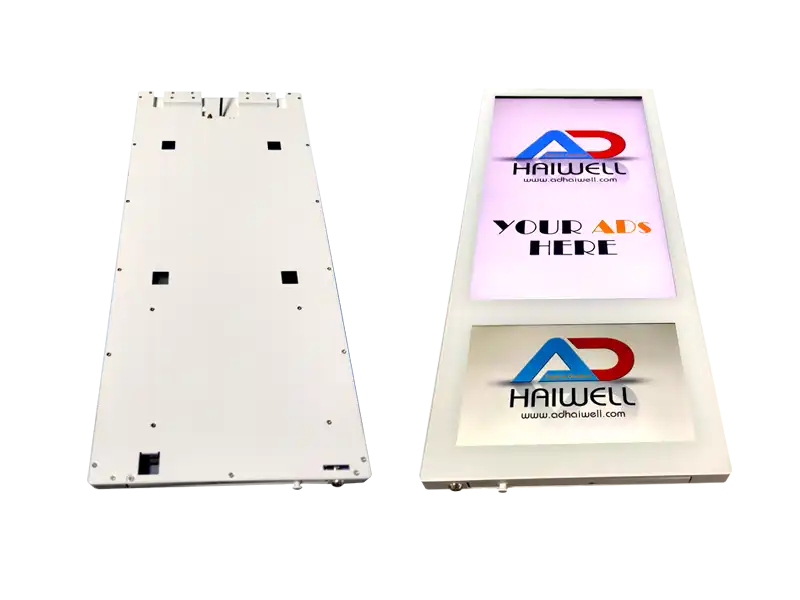
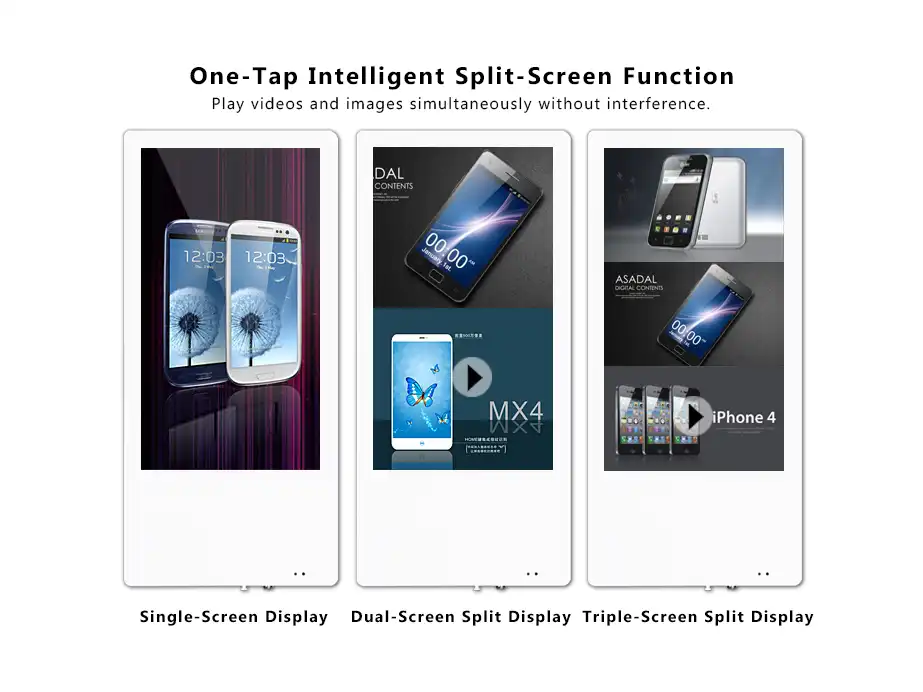
For mall operators. The split-screen function (standard on Adhaiwell’s cloud CMS) lets malls run rotating third-party ads on one panel while pushing property announcements or wayfinding on another — all from the same screen, all updated remotely.
What Cloud CMS Does — And Why It Changes Everything for Multi-Site Deployments
Cloud-based content management is not a nice-to-have on elevator LCD signage. It is the entire business model.
Adhaiwell’s elevator LCD digital signage runs on Android 11.0 with free cloud CMS, supporting Wi-Fi, LAN, and 4G connectivity. No software subscriptions. No per-screen licensing fees. From a single dashboard, operators can:
- Push content to hundreds of screens across different buildings in different cities
- Schedule playlists by time of day, day of week, or specific dates (happy hour at 5:00 PM, breakfast specials at 8:00 AM)
- Run split-screen layouts combining third-party ads, building info, and community notices
- Update emergency alerts or building closures instantly — no truck rolls, no printed replacements
- Set automatic on/off timers per screen based on building operating hours
For advertisers, this means the ability to run programmatic or direct campaigns across a distributed network with real-time reporting. For property owners, it means zero operational overhead after installation.
Real-world reference point. Elevision, which operates over 1,700 elevator screens reaching nearly half a million viewers daily in Dubai, uses a wireless system ensuring constant connectivity without touching the building’s data network. Each campaign delivers 1.5 exposures per day per unique viewer based on a 4-minute loop, generating approximately 750,000 impressions daily across the full network.
That math works for any portfolio — 50 screens or 5,000.
The Numbers That Matter: Engagement, ROI, and Cost Comparison
Let’s stop talking about “digital transformation” and talk about money.
| Metric | Traditional Posters | Elevator LCD Digital Signage |
|---|---|---|
| Average attention rate | ~12% | 75% higher engagement |
| Update cycle | 1–2 weeks manual replacement | Real-time, cloud-based |
| Annual cost (100 elevators) | $20,000+ | One-time hardware + low power |
| In-store traffic lift | Baseline | +32% |
| ROI measurement | None (blind investment) | Full data tracking |
Data sources: Qtenboard case studies, 2025–2026 deployment data
Cost breakdown. A mid-sized office building with 100 elevators spends over $20,000 annually on printed posters — design, printing, and installation labor. Over three years, that is $60,000+ with nothing to show but waste. An elevator LCD digital signage deployment requires a one-time hardware investment, low-power operation (standby ≤1W, rated ≤85W), and reduces 3-year costs by 50–60% while eliminating paper waste entirely.
For advertising network operators, each screen in a high-traffic commercial location can generate $30–$40 per month in programmatic ad revenue, with premium locations earning several hundred dollars monthly. Across a 500-screen network, that is $15,000–$20,000+ per month in recurring revenue after hardware is deployed.
Why These Case Studies Replicate Across Other Buildings and Markets
These deployments succeeded for the same three reasons. If you are evaluating elevator LCD digital signage for your own projects — whether as an installer, building owner, or advertising operator — these criteria determine your outcome.
One: captive audience + forced dwell time. Elevators are not lobbies. People cannot walk past a screen or look at their phones (no signal). The confined environment and short but consistent ride time create guaranteed exposure. Every deployment that works starts here.
Two: cloud CMS removes operational friction. Property managers will not accept systems that require on-site USB updates or technical staff. Free cloud CMS with remote scheduling and split-screen capability makes elevator signage a “set it and forget it” asset, not an operational headache.
Three: dual-purpose content drives adoption. The screens that stick around are the ones that deliver value to building owners (tenant communication, emergency alerts, wayfinding) and advertisers (measurable campaigns, demographic targeting). Elevision’s model — giving building owners free access to screens for their own announcements — is the template.
If your elevator signage project checks all three boxes, it works in office towers in Seoul, hotels in London, and malls in Singapore. There is nothing location-specific about the logic.
Deployment Roadmap for Integrators, Installers, and Advertising Operators
If you are sourcing elevator LCD digital signage from China — whether as a system integrator, a property technology provider, or an advertising network operator — here is how successful B2B buyers structure their deployments.
Step 1: Match screen specifications to the installation environment. Adhaiwell supplies elevator LCD digital signage in 15.6‑inch, 18.5‑inch, 21.5‑inch, and 27‑inch sizes, with both portrait and landscape orientations. The hardware uses industrial-grade LCD panels (LG/BOE) with 1080P Full HD resolution, 350 nits brightness, and built-in speakers. For high-rise luxury buildings with extended ride times, larger screens with higher brightness are the correct choice. For standard office elevators, 18.5‑inch portrait screens deliver optimal cost-to-impact.
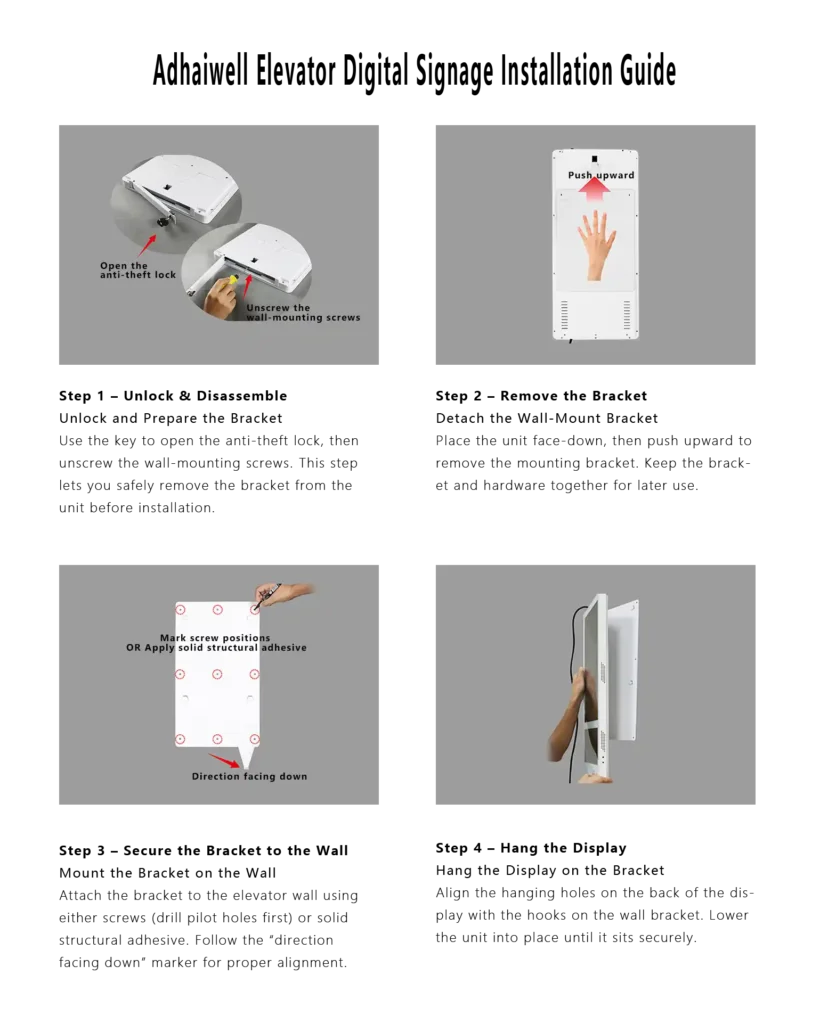
Step 2: Choose your mounting approach before ordering. Wall mount works for most cabins. Recessed installation (as used in the Turing Building) requires custom integration but yields a seamless architectural finish. Adhaiwell supports both options through OEM/ODM customization.
Step 3: Plan your connectivity strategy. Wi-Fi works in most modern buildings. For older properties or multi-site deployments where network access is inconsistent, 4G connectivity ensures every screen stays online independently.
Step 4: Structure your content economics before deployment starts. The most profitable operators run hybrid models: property owners get free access for internal communications; third-party advertisers pay for dedicated time slots; programmatic networks fill remaining inventory. Without this framework in place, screens become cost centers rather than revenue assets.
Step 5: Source directly from a China manufacturer with global delivery. Adhaiwell operates factory-direct from Shenzhen with 24‑hour response times, 72‑hour burn‑in testing on every unit, and OEM/ODM customization for international project requirements.
Buyer’s Guide: Smart Deployment Steps for System Integrators
When sourcing elevator LCD digital signage directly from leading industrial manufacturing hubs, following a structured deployment strategy prevents common project delays.
- Evaluate Power and Weight Constraints: Ensure the elevator car canopy can support the display’s weight (look for ultra-slim designs under 10kg) and verify that the power supply safely handles standard AC 100-240V inputs.
- Select the Right Connectivity: If a building has thick concrete elevator shafts that block Wi-Fi signals, opt for hardware configurations that support 4G LTE SIM cards or pre-install network traveling cables inside the lift bundle.
- Prioritize Security Features: Elevator screens are accessible to the public. Always specify hardware equipped with locking mechanisms for the SD card/USB ports and a tempered glass front panel (at least 7H hardness) to protect against accidental impact or intentional vandalism.
- Partner for Volume Sourcing: Work closely with an established manufacturer capable of offering tailored customization, such as custom brand logo printing, specific frame color matching, and optimized international packaging to keep bulk shipping rates low.
Elevator LCD digital signage is no longer an experimental channel. The 2026 market data is clear: 8.59% CAGR, 32% year‑over‑year growth in video category, and 68% of commercial properties in key regions have already made the switch. The case studies from Seoul, Dubai, London, and Singapore all tell the same story: captive audience, cloud CMS, dual-purpose content, and measurable revenue.
For B2B buyers sourcing from China — whether you are equipping your first building or scaling a 1,000‑screen network — the winning formula is straightforward. Deploy industrial-grade hardware with free cloud CMS. Match screen sizes to your elevator environment. Structure content to serve both building owners and advertisers. And capture the data that static posters could never provide.
The question is not whether elevator advertising works. The question is how quickly you deploy.
Disclaimer: All case study data and market statistics cited are from publicly available industry reports and third‑party studies as referenced. For specific deployment metrics and pricing, contact Adhaiwell directly for project‑specific quotations.