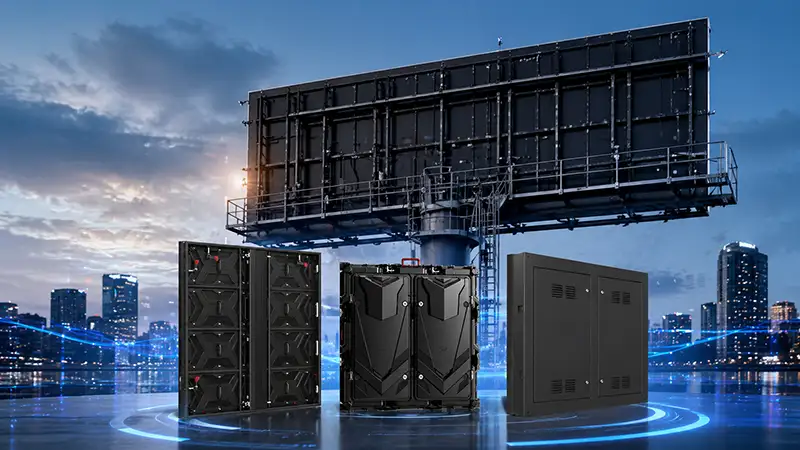
When you specify an outdoor LED display for a highway gantry, a coastal billboard, or a stadium perimeter, the cabinet material is not a cosmetic choice – it’s a structural and financial decision that will affect installation cost, maintenance frequency, and service life for the next 8–10 years.
I’ve reviewed dozens of LED display procurement packages where the cabinet material was an afterthought. Two years later, the same buyers are dealing with corroded bolt holes, sagging modules, and water ingress that kills driver ICs. This guide cuts through marketing claims. You’ll get a side-by-side engineering comparison, a decision matrix for real-world conditions, and a procurement checklist you can hand to any supplier.
Why Cabinet Material Determines Long-Term Performance More Than Pixel Pitch
The hidden role of rigidity in maintaining IP ratings
- An outdoor LED display is not a static sign – it vibrates from wind, passing trucks, and thermal expansion. With a flexible cabinet, the gap between modules can widen by 1–2 mm, turning an IP65 enclosure into an IP54 dust collector.
- Steel cabinets (minimum 1.5mm cold-rolled steel) maintain flatness under dynamic loads. Aluminum cabinets under 1.8mm thickness show measurable deflection at wind speeds above 40 m/s.
- Real-world data: In a 24-month highway installation, steel cabinets required zero module re-alignment; aluminum cabinets from the same project (same supplier) needed adjustment twice.
Thermal management – the material property everyone misunderstands
- Aluminum has higher thermal conductivity (≈237 W/(m·K)) than steel (≈50 W/(m·K)). That sounds better for cooling LED drivers – but it also means the cabinet heats and cools faster, causing gasket fatigue.
- Steel’s lower conductivity creates a more stable thermal environment for internal electronics, especially in desert climates where surface temperatures swing 40°C in a single day.
- The real thermal failure mode is not the cabinet material – it’s poor ventilation design. But a thin aluminum cabinet combined with inadequate airflow is a faster death sentence than steel.
Corrosion – where coatings matter more than base metal
- Bare aluminum forms a passive oxide layer that protects against general atmospheric corrosion. Steel without coating rusts visibly within months.
- However, the moment you drill a hole, cut an edge, or scratch the surface, aluminum becomes vulnerable to pitting corrosion – especially in coastal or industrial environments.
- A properly coated steel cabinet (hot-dip galvanized ≥80µm + polyester powder coat ≥60µm) outperforms anodized aluminum in salt spray tests beyond 500 hours.
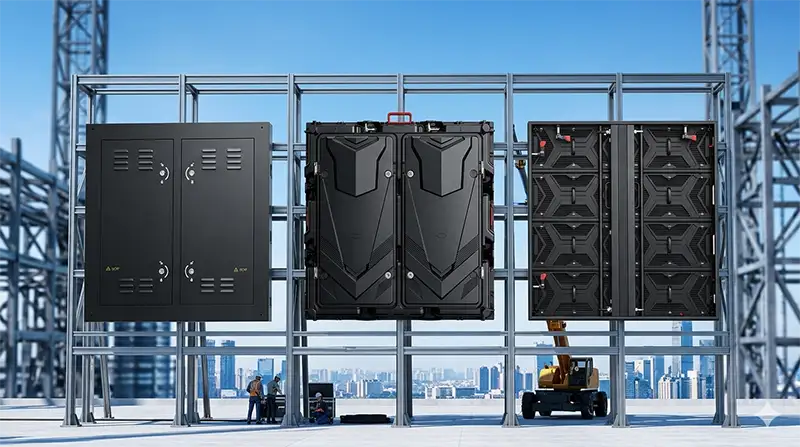
Steel Cabinet Outdoor LED Display – Engineering Deep Dive
Material specifications you must demand
- Steel grade: Q235B (equivalent to ASTM A36) minimum. Do not accept “mild steel” without a mill certificate.
- Thickness: 1.5mm – 2.0mm for standard modules. Below 1.2mm, the cabinet will resonate and fatigue at weld points.
- Coating system: Two-layer protection. Zinc primer (hot-dip or electro-galvanized) + polyester powder coat. Total dry film thickness ≥140µm.
- Salt spray test: Request ASTM B117 report with samples that include welded corners and drilled holes – not just flat panels.
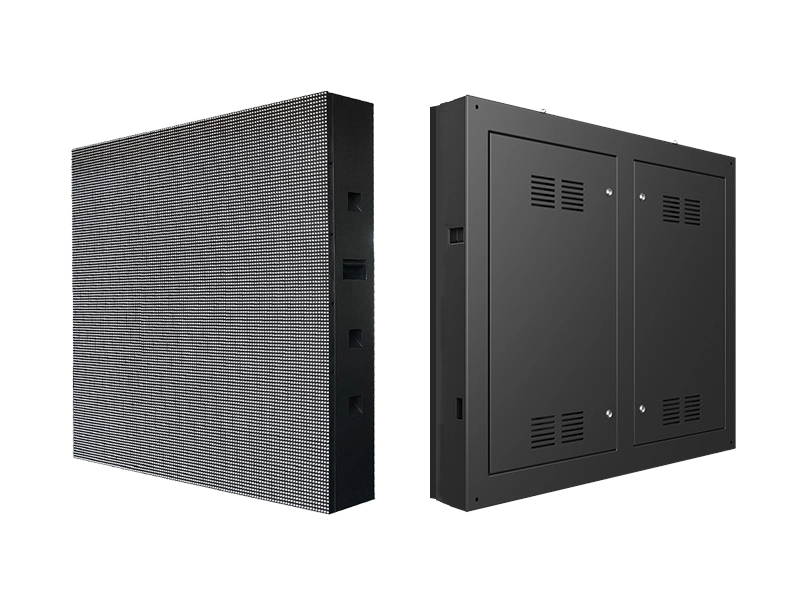
Weight and structural implications
- Steel cabinets weigh 35–50 kg per square meter. For a 20 m² screen, that’s 700–1000 kg of cabinet alone.
- This requires stronger support steelwork (add 15–20% to structural budget) and heavier lifting equipment during installation.
- Trade-off: The added mass reduces vibration transmission. On highway gantries, steel screens produce less image jitter at the same wind speed.
When steel is the wrong choice (yes, sometimes)
- Indoor-outdoor transitional screens under 6 m² mounted on a building facade with limited structural capacity.
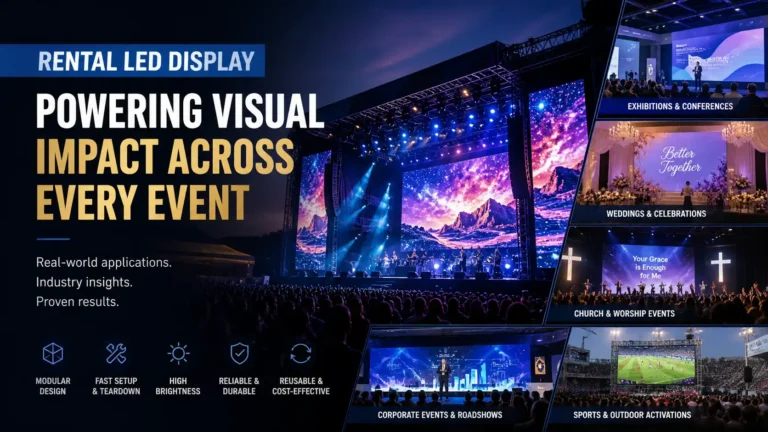
- Rental and staging applications where frequent assembly/disassembly is required – the weight penalty becomes a labor cost problem.
- Pole-mounted displays in low-wind inland areas where a lighter aluminum cabinet with an anti-theft design is sufficient.
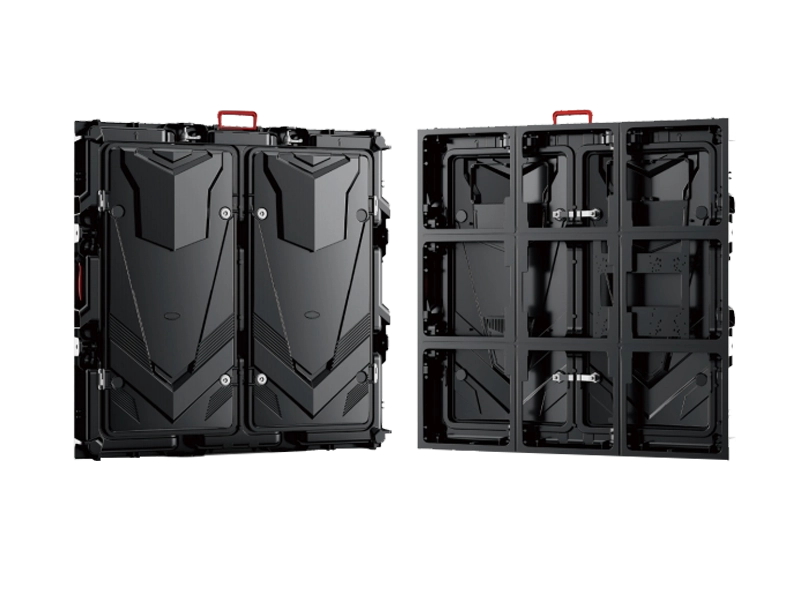
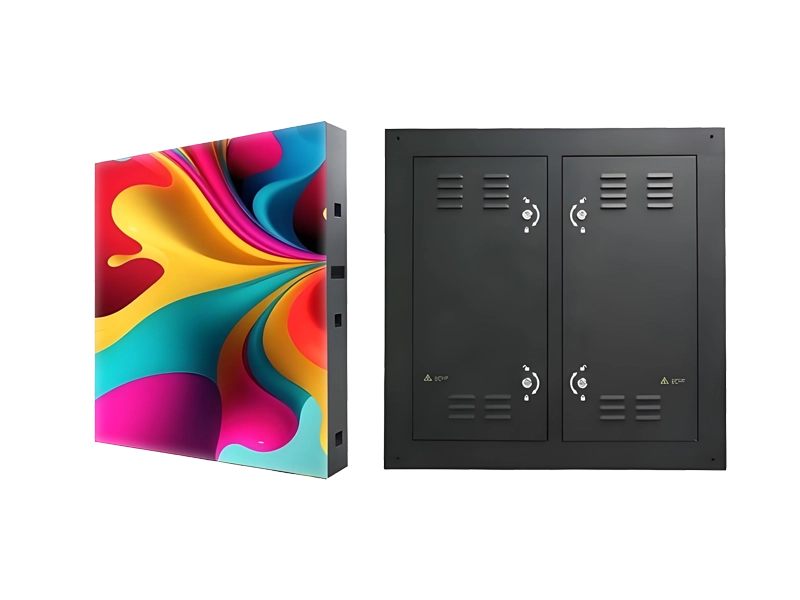
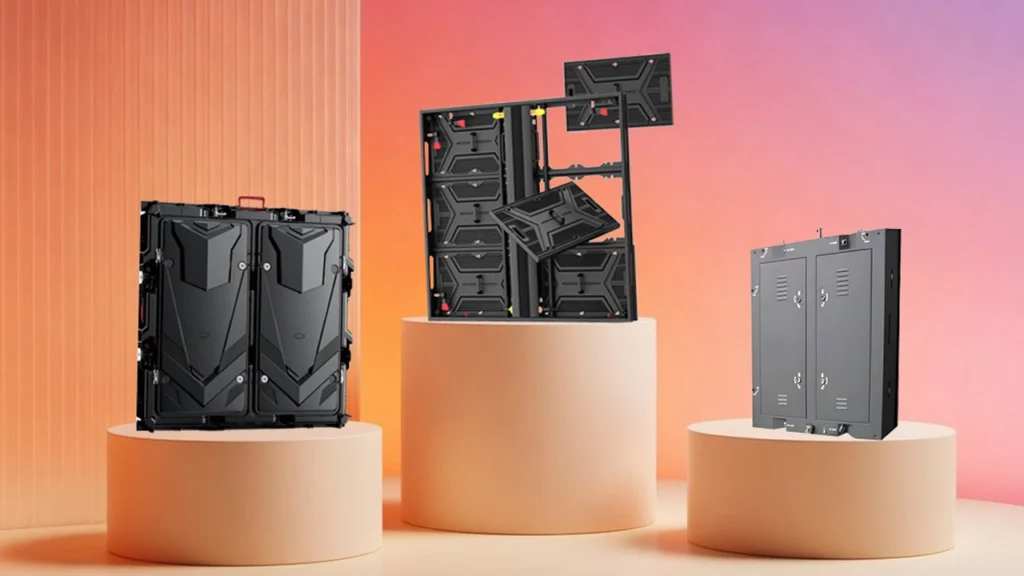
For large-scale fixed billboards where structural integrity and budget-efficiency are paramount, heavy-duty steel cabinet outdoor LED displays remain the industry standard due to their high impact resistance and customization flexibility.
Aluminum LED Display Cabinet – Strengths and Engineering Limits
Where aluminum genuinely outperforms steel
- Weight: 18–28 kg per m². A 30 m² screen saves 500–700 kg of total cabinet weight, reducing crane time and structural steel costs.
- Thermal conductivity: Excellent for high-density (P2.5–P4) displays where driver ICs need direct heat path to the cabinet back.
- Naturally corrosion-resistant in non-aggressive environments (rain, UV, moderate pollution). No coating required for basic indoor-outdoor use.
The three failure scenarios we see in the field
- Wind-induced flex: Large aluminum cabinets (width >2m) without internal bracing flex in gusts. The result: module gaps open, water enters, and connectors corrode.
- Galvanic corrosion: When aluminum cabinets are mounted on galvanized steel support structures without insulating washers, electrolysis destroys the aluminum within 18–24 months.
- Thread stripping: Aluminum tapped holes for module mounting strip after 3–4 service cycles. Steel threaded inserts are the solution, but few budget suppliers include them.
Acceptable aluminum specifications for harsh environments
- Alloy: 5052 or 6061 (marine grade). Avoid 6063 for permanent outdoor use – it has lower strength and poorer corrosion resistance.
- Surface finish: Anodizing (≥15µm) + sealing, or fluorocarbon coating. Bare or clear-anodized only is inadequate for coastal areas.
- Minimum thickness: 1.5mm for main frame, 2.0mm for corner brackets. Do not accept 1.2mm extrusions for any screen larger than 8 m².
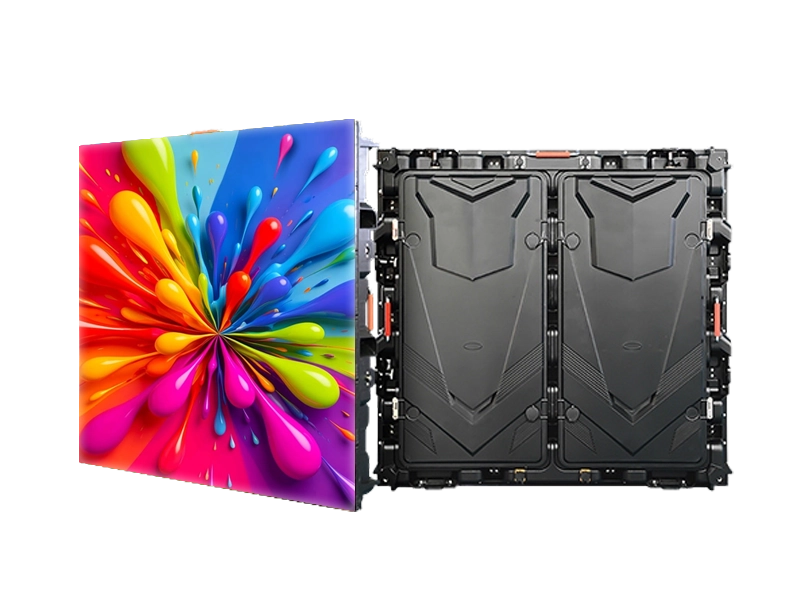
In coastal environments where salt-spray corrosion is a constant threat, utilizing aluminum profile alloy outdoor LED displays provides a superior strength-to-weight ratio and enhanced natural resistance to oxidation.
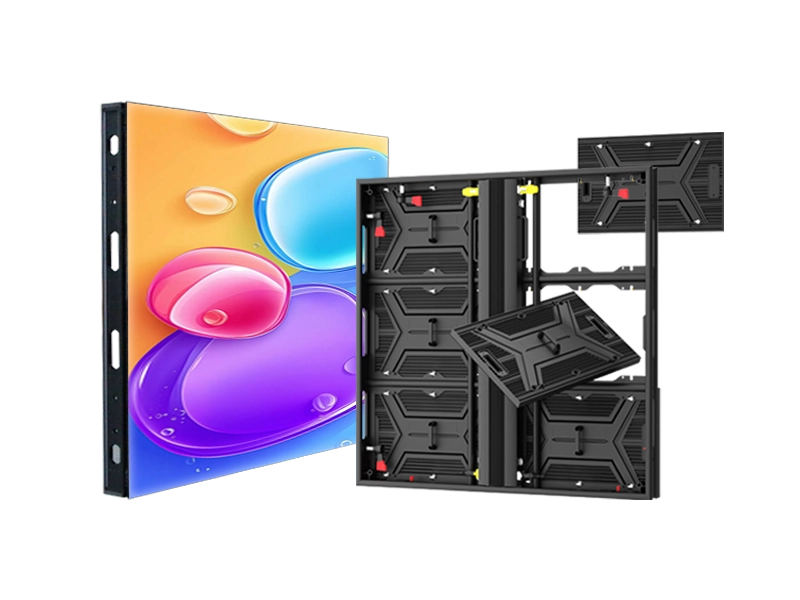
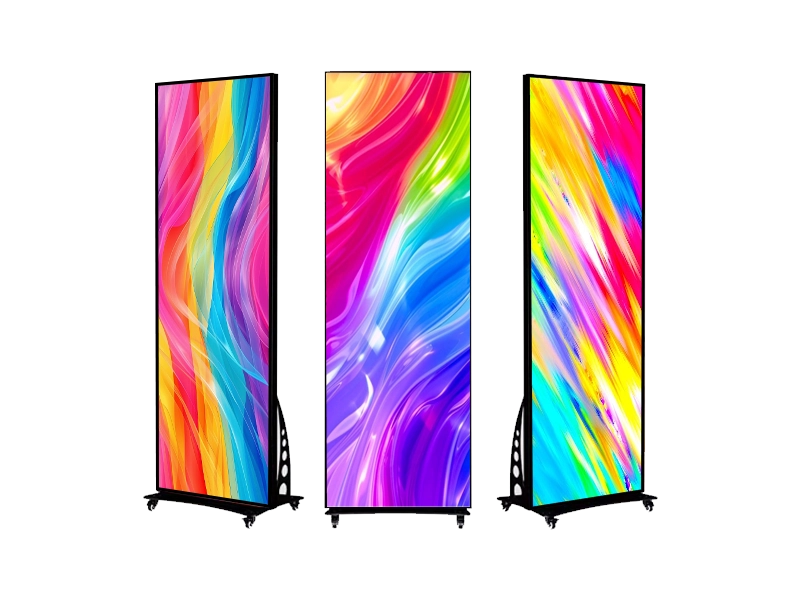
When project requirements prioritize rapid installation and frequent maintenance access, precision die-cast aluminum outdoor LED displays offer the lightweight benefits and heat dissipation performance needed for high-density screen configurations.
Side-by-Side Comparison: Steel vs Aluminum LED Display Cabinets
| Parameter | Steel Cabinet | Aluminum Cabinet |
|---|---|---|
| Typical thickness | 1.5 – 2.5 mm | 1.2 – 1.8 mm |
| Weight per m² | 35 – 50 kg | 18 – 28 kg |
| Max wind load resistance | Up to 60 m/s (with bracing) | Up to 45 m/s |
| Salt spray test hours (coated) | ≥720h | ≥300h (anodized) / 500h (fluorocarbon) |
| Rigidity (deflection under 1kN/m load) | <0.5 mm | 1.2 – 2.0 mm |
| Thermal conductivity | ~50 W/(m·K) | ~237 W/(m·K) |
| Thermal expansion coefficient | ~12 µm/(m·K) | ~23 µm/(m·K) |
| Repair method for localized damage | Spot sand + repaint | Full panel replacement |
| Base cabinet cost per m² (10m² order) | $$ | $$$ (for same rigidity) |
| Typical service life – mild climate | 10+ years | 8–10 years |
| Typical service life – coastal / desert | 8–10 years | 4–6 years |
Total Cost of Ownership (TCO) – Real Numbers for a 20 m² Permanent Outdoor Display
Cost components often ignored in the initial quote
- Structural steelwork: Steel cabinets require 15–20% stronger support frame. On a 20 m² display, this adds 1,200–1,800.
- Installation labor: Steel cabinets need more workers or a crane. Add one extra day of rigging (800–1,500).
- Maintenance access: Steel cabinets allow technicians to walk on top (with temporary planks). Aluminum requires lighter platforms – but more frequent module reseating.
8-year TCO comparison (inland, moderate climate)
- Steel cabinet: Initial 24,000+structural1,500 + maintenance 2,800=28,300
- Aluminum cabinet: Initial 28,000+structural800 + maintenance 4,200(moreresealing)=33,000
- Steel is 14% cheaper over 8 years even before resale value.
8-year TCO comparison (coastal, 500m from sea)
- Steel cabinet (proper coating): Initial 26,000+structural1,500 + maintenance 3,500(repaintingonce)=31,000
- Aluminum cabinet (marine grade + anodizing): Initial 32,000+structural800 + maintenance9000(panelreplacementatyear5) =41,800
- Steel saves 26% – and avoids a mid-life screen replacement.
Decision Matrix – Which Cabinet Material for Your Specific Installation?
| Installation Environment | Recommended Cabinet | Key Justification |
|---|---|---|
| Highway gantry (road salt, vibration) | Steel – heavy coating | Vibration resistance and repairability |
| Stadium perimeter (crowd impact, snow load) | Steel – with seamless corners | Impact strength |
| Coastal billboard (<1km from sea) | Steel – hot-dip galvanized + powder coat | Salt spray life >8 years |
| Desert solar-powered (UV, heat, sand) | Aluminum – with UV-stable coating | Weight saving reduces pole cost |
| Ferry terminal (salt + public vandalism) | Steel – stainless steel screws | Impact + corrosion resistance |
| Shopping mall facade (mild climate, front access) | Aluminum – 6061 with anodizing | Good balance, easier install |
| Indoor/outdoor transition (covered but exposed to rain) | Either – focus on IP rating and gasket type | Material less critical in low wind |
| High-frequency rental (assembled/disassembled monthly) | Aluminum – with steel threaded inserts | Weight and handling speed |
Visual recommendation for this section: Insert a photo or CAD drawing showing a steel cabinet cross-section (left) and aluminum cabinet (right). Call out the thickness difference, weld detail, and gasket groove depth. Caption: *“Figure 1: Cross-section comparison – steel cabinet (1.8mm powder-coated, full weld) vs aluminum cabinet (1.5mm anodized, riveted corner). Steel’s deeper gasket groove maintains IP65 after thermal cycling.”*
Frequently Asked Questions (FAQ)
Q1: Is a steel cabinet outdoor LED display always heavier than aluminum?
A: Yes, by about 40–60% per square meter. But for fixed installations over 15 m², the total project cost difference is often less than 8% because weight is not the only shipping factor – volume and crating dominate freight cost.
Q2: Can I use an aluminum cabinet for a coastal outdoor LED display?
A: Yes, but with strict specifications: marine-grade 5052 or 6061, anodizing ≥15µm plus sealing, and you must accept a shorter lifespan (5–6 years vs 9–10 years for coated steel). Most professional integrators still specify steel for permanent coastal installations.
Q3: How do I verify a supplier’s salt spray test report?
A: Look for ASTM B117 or ISO 9227. The report must show sample preparation (cut edges, drilled holes) and test duration. If the report only shows polished flat panels, reject it. Also request photos of the samples after testing – red rust on steel or pitting on aluminum is a failure.
Q4: Does a steel cabinet block wireless control signals more than aluminum?
A: No meaningful difference. Both are conductive enclosures that attenuate RF signals. Use external antennas or wired control – any competent integrator already does this.
Q5: What is the realistic payback period for choosing steel over aluminum in harsh weather?
A: Typically 2–3 years. When you account for reduced module replacement, less re-sealing, and no mid-life panel exchange, steel becomes the lower-cost option from year four onward.
Q6: Can I mix steel and aluminum cabinets in one large display?
A: Only with careful design. Dissimilar metals in contact cause galvanic corrosion unless isolated with nylon washers or rubber gaskets. For a single contiguous screen, stick to one material.